

Google has long been a go-to in the treatment industry for inquiries, and for good reason. High intent key terms like “drug rehab” on Page 1 in organic search, or at the top of the page as an ad, can connect a serious number of patients looking for help to providers by getting them in front of those looking to get into treatment right now.
Yet, at the same time, providers that relied too heavily on Google have gone bankrupt. Just take a look at many of the largest providers in the country a few years ago. They all had huge networks of websites the majority of them still went bankrupt. Both were known for a large number of web properties. All these businesses failed miserably in spite of dominating the SERPs (Marketing lingo for: Search Engine Results Pages) as well as Google Ads.

So what gives? Why is there this strong desire for overreliance on Google if those who relied on it heavily have not done well?
Google dominates in marketing for a couple reasons:
1st Reason
Google owns search attention. Why? Because they have the best product. All highly successful businesses are predicated upon a differentiated product or service that is better than the competition. Do you ever see Google advertise their search engine? Me neither, yet 91.98%+ of search is performed on Google every day worldwide.
2nd Reason
Google has got an advertising product that does more than simply aggregate attention and eyeballs, they’ve done something most companies only dreamed about. They found a way to aggregate attention for very specific things at the moment of decision-making.
Additionally, they finally gave both marketers and companies another dreamed of feature, data-driven insights into campaign effectiveness. Ever try to figure out how many people saw your TV ad and then took action? Good luck.
But, with digital campaigns, not only can you assess how many people viewed your ad, you can assess how many actually clicked on it and then, in turn, what percent of those people inquired or became a customer/admission.
Before we get to 3, let’s go a little deeper here. Because aggregating final decision-making stage attention is only highly valuable in an undifferentiated market space.
Let’s say you want to get your oil changed. A lot of people don’t have a preference here. They’ll simply Google “oil change near me” and go to the closest one. So SEO and Google Ads are incredibly important in the quick oil change industry. Housing contractors – electricians, plumbers, roofers, etc. – are often quite similar. You either ask friends and family, or you Google them, that’s about it. But take a bigger decision, like buying a car. A good percentage of people won’t simply search, “car dealership near me,” they’ll search “Ford dealership near me” or “Mercedes dealership near me.” Most people have already decided on the brand of car they’re interested in before searching for a dealership. In a differentiated market, especially around high-cost items, marketing prior to search is incredibly important, because these expensive purchase decisions take more than just an ad at the point of final decision.
As I often like to point out, say someone searches for “best new car 2020” and there is an ad at the top of the results that says, “Saico Talon, best car to buy this year.” You’ve never heard of Saico cars before. While there’s a small chance you’ll click the ad out of curiosity, no matter how good that landing page is, you’re not going to decide to drop $30,000 on a car from a brand you’ve never heard of.
High-cost items require extensive trust-building, and, in the days of high deductibles of $2,000 or more, healthcare is a high-cost item.
3rd Reason
Most importantly, Google plays into the naiveté of many business owners. A surprising number of business owners, even today, still have a “build it and they will come mentality”. Basically, the thinking goes, “I have a service people need, like addiction treatment, so all I have to do is simply let people know I’m here and they’ll come running.”
Of course, business never works this way unless you are the sole option in the area, which, let’s be frank, is exactly the business model the majority of behavioral health providers have operated on for decades. What happened when there weren’t enough people searching for treatment in Florida? Well, let’s expand marketing into the Northeast where there weren’t many worthwhile treatment programs. The Northeast is crowded now, let’s go to the Midwest. The Midwest is crowded, rates are terrible in the Deep South, but let’s go anyway. Nobody was building a quality business, they were basically in a rat race to jump into untapped markets, until those markets were tapped out in the standard maturation of an industry. While this does work for a time, it’s not a sustainable strategy.
People do not buy products or services simply because they fill a need. If that were the case, anyone could start a new soap or coffee company tomorrow and grow it exponentially in no time. Products and services like soap or coffee are called commodities for a reason. One of the only ways to win in the commodity game is to have the leanest, most efficient business model, allowing you to compete on price.
It’s a race to the bottom, which is a tough business model to succeed with. The average consumer (not the under 5% of America that is willing to pay 5 times extra for the slightly larger legroom on a plane ticket), will simply buy what’s cheapest. Occasionally, we get a Starbucks that differentiates themselves both through quality or product and quality of service, but definitely not easy to do in the commodity space.
Google plays into this whole naiveté. They say to business owners, “Look, just buy our ads and we’ll put you in front of the people that are going to buy, buy, buy! The only thing you need to do is simply have better ads than the other guy.”
What they don’t tell you is that less than 5% of all searchers click on ads for behavioral health. Most people inherently distrust ads, so skip over them without even thinking about it.
And, of course, there is a cap on such search volume. Nationwide, for the term “drug rehab” there are roughly 289,000 searches a month. But if you comb through, many are state or city-specific, looking for free rehab, etc. When you filter through to generic searches, you end up with about 80,000 searches a month for drug rehab-related terms.
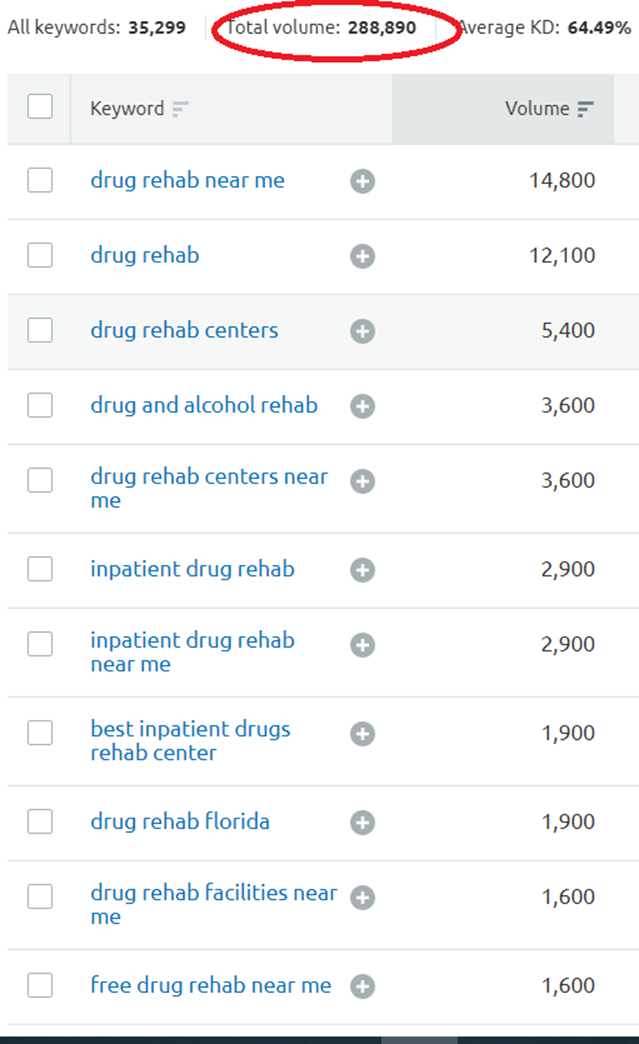
Now let’s cut that in half, because we can safely assume half of those searches are just doing some research, maybe for a college paper or out of curiosity, or it’s the same person performing multiple searches. That leaves us with 40,000 searches a month. Now, only 5% of people click on ads in total, not on your ad. Remember, Google shows at least 3 ads at the top of any search. So maybe your ad gets 2% of the click volume. We’re down to 1,600 clicks.
Of those clicks, how many people actually bother to pick up the phone and call? 10% would be really good. So now we’re at 160. Now how about insurance? What percent have private insurance vs Medicaid? Google Ads tends to be Medicaid heavy for reasons I won’t get into here, but we’ll be generous and say 30%. So now we’re at 48 viable calls. Finally, how good is your call team? How well do calls turn into admissions? A really good team might convert at 10%, so we get 4.8 admissions!
Of course, business owners love this because the math and tracking is so simple. I can see the ad, see the click, see the call, and see the admission. But that doesn’t matter much if you’re a 50-bed facility and all you can get is 4-5 admissions a month from “drug rehab” ads.
Volume is the key here. If you’re a small 6-bed treatment center in or near a big city, the search volume on Google Ads will be enough for you. But if you’re looking at filling 30 beds or more, there simply isn’t enough volume to fill a program at those conversion rates (and the ones listed above were generous. Most programs have terrible optimizations in their campaigns, less than stellar landing pages, and inadequately trained call teams, so conversion rates at each point of that marketing funnel are usually lower).
A more sophisticated business owner will ask, “Well, if Google Ads click volume is so low, but I know that organic search volume is high, then let’s focus on SEO. That way we can compete for the other 95% of the click volume.”
Now that’s some pretty smart thinking. However, SEO for drug rehabs is really tough. It’s a long game that takes a lot of time and money. Even once you get to position 2 or 3 (you usually can’t get to 1 because Google has pinned the SAMHSA website to that position for addiction treatment at least), you’ll get between 30 and 60% of the click volume.
That math is a hell of a lot better, but, if we run the 60% of clicks through the same formula above, we get 144 admissions. That’s pretty good. Of course, this entire model is run off of national search volume data. That search volume is actually spread across the entire US, and most people don’t want to fly for treatment these days, on top of the fact that pushing out a marketing budget to the entire US on a single search term would cost you $7,000 a month with just a 2% click rate on total volume. $7,000 for a single search term when a good campaign has a minimum of 60 terms. $7,000 X 60 is $420,000 a month. Not the best use of a marketing budget.
In reality, most people don’t seek treatment outside of a 150-mile radius of where they live these days, so you actually have to cut that search volume up by state, which ends up leaving us with only a handful of admissions per state out of that total volume.
The secret here is to expand into as many high-intent search terms as possible to capture maximum search volume. But this strategy still runs into volume limits eventually.
Let’s also remember that, according to the National Institute on Alcohol Abuse and Alcoholism, over 23 million Americans struggle with addiction every year. Yet, when we combine all the high intent search terms on addiction, we only get about 500,000 searches a month or 6 million a year. Where are the other 17 million+ people? The answer is, not searching on Google.
 That’s the real key. Each marketing channel, each geography, has a cap, just like an industry has a market cap. Google has 6 million searches a year, but a lot of those are from the same people, include people researching but not actually looking for treatment, and are predominantly Medicaid. Let’s be generous and say that 3 million of those searches are legitimate people seeking or who will be seeking treatment that have private insurance to pay for traditional rehab. 3 million is still only 13% of the total 23 million people who need treatment.
Google knows all of this. They have a product to sell like everyone else. Like any good marketing, they do more than sell the product, they sell the solution. Businesses want sales and Google tells you that if you just advertise enough on their platform, you can grow your business to any size you want.
 But it’s not true because most people that end up in treatment are not searching for it on Google. Most people find treatment from a wide variety of other channels.
The business strategy to leave you with is that successful business growth requires volume. Each marketing channel only has limited volume, which is why multiple marketing channels are required for large-scale growth over time, not to mention that combining marketing channels is synergistic and drives additional growth when they mutually support each other.
 It’s not that Google doesn’t work, it is an absolutely fabulous marketing channel for behavioral health providers, but it has limits and is only one among many.
Need help driving a diversified, multi-channel strategy to enable growth? Get in touch.