

Have you ever done a Google search for a topic and all the articles on the entire first page of Google say the same thing, just in a different way? As you click page after page, looking for better answers or more specific information on a particular question you have, you grow increasingly frustrated as you find the same information only reworded on every site. This is derivative content.
Derivative content is a huge problem in the world of marketing. Google is constantly working to solve this problem, so it kills your SEO. People hate it because it’s uninformative or misleading. And the worst of it spreads misinformation; rather than helping people, it sends them on a wild goose chase.
How does this happen?
Because the way that most content is created is lazy. The research and writing process is the equivalent of a college student rushing to write a 5-page essay the night before it’s due. They google the topic, read the first couple articles, then write their essay combining information from all three articles in their own words. If they’ve got some extra time, they might go to page 2 or 3, find some titles of articles that seem in line with their essay, and then add them as references at the bottom of theirs. Done!
And the reality is that most people writing the content have the level of knowledge of a college student on the subject. These are paid writers, not experts in the field because most businesses aren’t willing to pay for experts, they want or can only afford the college writer. (Though, as we’ll see, even academic researchers often don’t fare much better.)
On Google, this happens through cycle after cycle of content writer. Not only is page 1 content the easiest to find, but, apparently Google likes it. “Let’s use what Google likes in the hopes that they’ll rank us as well”, is the very valid and understandable logic.
Eventually, what ends up at the top of Google are rewrites of rewrites of rewrites as dozens of writers optimizing for SEO follow the same process. This, then, creates our trash pile of derivative content.
The Cost of Derivative Misinformation - An In-depth Review of Internet Rankings for the Deleterious Effects of Mouth Breathing
Today we’re going to look at a perhaps surprising topic for our example - mouth breathing. Why mouth breathing you ask? Because it came up in a random conversation with my daughter after dinner. She had heard that mouth breathing was bad. I told her I’d recalled hearing the same, but didn’t know anything about. As I often do in these situations, I said, “Let’s look it up.” The first 5 results are, in order, Cleveland Clinic, Healthline, Wikipedia, Mayo Clinic, and WebMD
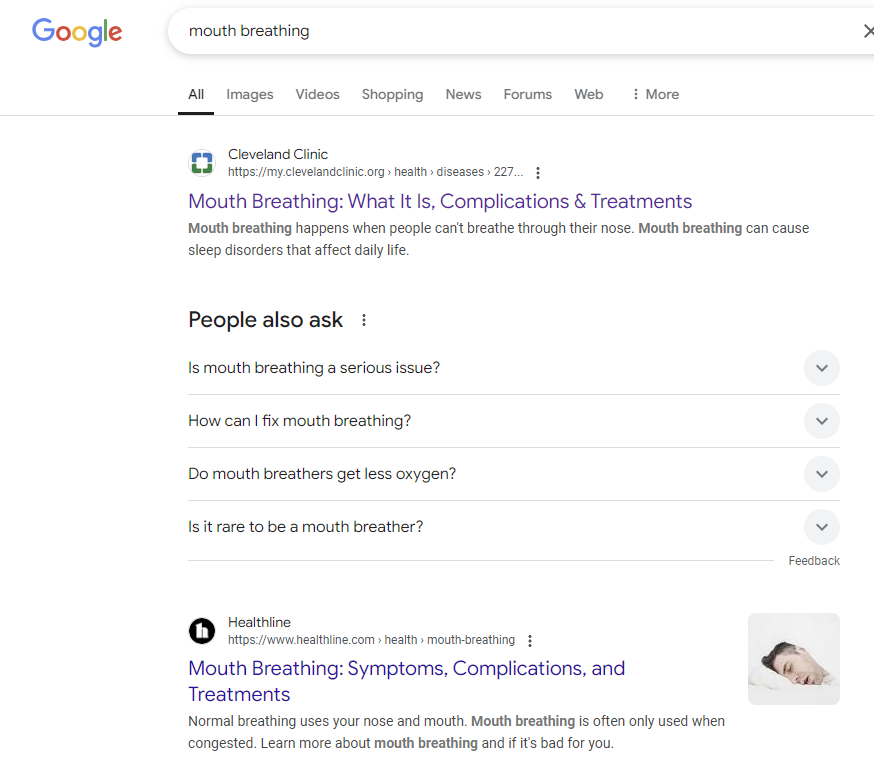
Every single one of the articles expounds upon how terrible mouth breathing is compared to nasal breathing. Apparently, it causes everything from dry mouth to facial misalignment to even ADHD!
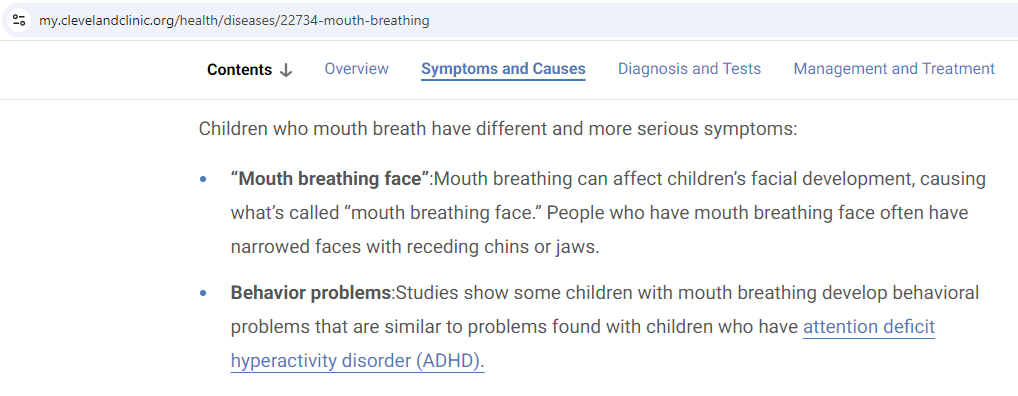
Now, this all sounded a bit farfetched. First off, I personally have a deviated septum, so breathe through my mouth more often than my nose since breathing through my nose is much harder. This was red flag number 1.
Red flag number 2. According to this article in Nature, up to 40% of 12-year-olds are mouth breathers and as the Mayo Clinic’s page states, “consistent or chronic mouth breathing, especially in children, is linked to slower growth, behavioral issues, dental and facial abnormalities.” I don’t know about you, but I have not noticed 40% of 12-year-olds with facial abnormalities.
Clearly, we needed to go beyond a page 1 Google search since all we were getting was derivative, poorly researched content. First, we looked for sources in the articles themselves. The Cleveland Clinic, Mayo Clinic, and WebMD didn’t provide a single source or citation! There was no way to evaluate the validity of their claims.
Healthline, thankfully, did and they claim to have “strict sourcing guidelines.”
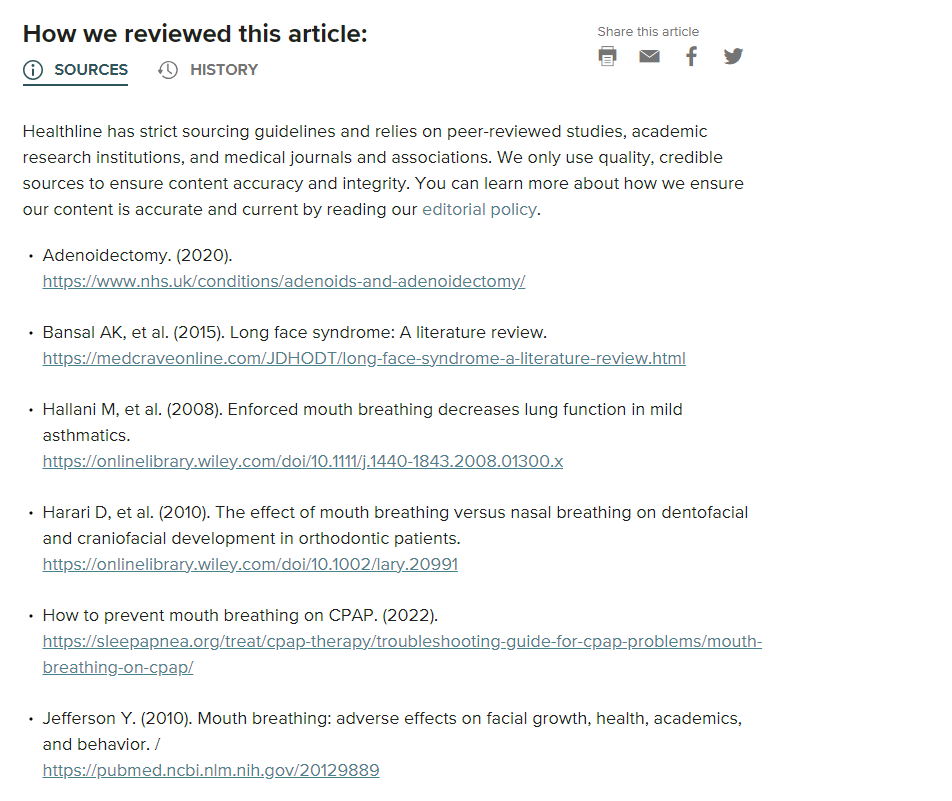
Only one of the citations mentioned “facial abnormalities”. Clicking on “long face syndrome”, we find this:
“Long face morphology is a relatively common presentation among orthodontic patients.” and “Both genetic and environmental factors have been associated with the etiology of excessive vertical facial development, although it is likely that more than one subtype of the phenotype exists. Etiological factors such as enlarged adenoids, nasal allergies, weak masticatory muscles, oral habits, and genetic factors have all been implicated in the development of the long face morphology… Despite being described extensively in the orthodontic literature the long face morphology still remains unclear. “
That certainly doesn’t have much to say about mouth breathing. Further on, the paper mentions that mouth breathing could “theoretically” contribute to the issue.
Then we have the behavioral claim. Reading Jefferson’s article abstract, we find that “These children do not sleep well at night due to obstructed airways; this lack of sleep can adversely effect their growth and academic performance. Many of these children are misdiagnosed with attention deficit disorder (ADD) and hyperactivity.”
So mouth breathing is not causing ADHD. Instead, disruption in sleep patterns and poor sleep may be causing inattention issues, which would make actual sense.
Clearly, the articles we’ve found so far aren’t overly reliable, so we decided to see if we could find some more reliable research. A quick Google scholar search turned up the article “The impact of mouth breathing on dentofacial development: A concise review” published in the journal Frontiers in Public Health.
Almost the entire 12-page research paper discusses the detrimental effects of mouth breathing, stating at the outset that, “Mouth breathing is one of the most common deleterious oral habits in children.”
However, finally getting to page 11, we get these comments thrown in at the end:
“A systematic review concluded that a significant correlation between children with OSA and maxillofacial abnormalities could not be established (55). According to the conclusion of another systematic review, it could not be identified yet that there was an association between mouth breathing and craniofacial and occlusal development (56). The current studies suffer from several methodological problems, such as the limits of sample size, geography, and ethnic selection, which may be the reason that no consensus can be reached temporarily. Future studies could consider mouth breathing as a single influential factor and make research protocols more rigorous to explore the relationship between breathing patterns and maxillofacial development. Also, there is an unequivocal necessity for evidence-based approaches.”
And
“Actually, for more than 100 years since mouth breathing was proposed, its influence on the malocclusion and morphological and functional development of the maxillofacial region has been controversial. What remains unknown is the precise contribution of genetic and environmental factors. In recent years, new relevant studies elaborate their findings and offer different opinions. What counts is that there is no high-quality evidence elucidating the effects of mouth breathing on dentofacial development and health, which is also due to the lack of well-designed clinical studies. The mechanism of mouth-breathing impact on the development of the dental and craniofacial region is still unclear.
Many studies have relied on questionnaires, inspection, simple screening tests (such as water holding test and mirror test), and the diagnosis of nasal endoscopy used by otolaryngologists to identify mouth-breathing patients. To our knowledge, there are no strict criteria for the diagnosis of mouth breathing, and the subjective assessment of mouth breathing may be one of the reasons why the findings are difficult to achieve agreement. The lack of diagnostic criteria makes the research on the association between mouth breathing and dentofacial development limited as well. In the future, more comprehensive studies should also be devoted to the establishment of a unified guideline of mouth breathing diagnostic criteria, as well as improvement of research methods, and further exploration of the effects and mechanisms of mouth breathing.”
Unfortunately, none of this is surprising. Anyone familiar with academic research knows that most of it is junk, published because researchers have to publish X amount of papers to either keep their university positions or obtain some kind of funding. Small samples sizes, biased analysis, misinterpreted data, intentionally misreported data, the list goes on and on. Often, the best way to go is a quality meta-analysis.
Performing another Google Scholar search, there aren’t many. Finding one, it reveals that, of the 2,510 studies that were discovered on the topic, the researchers were only able to include 19. Less than 1% were considered eligible due to quality issues! And of those 19 they deemed worthy of inclusion, the authors report that:
“Certain limitations of the present study require to be elaborated on and considered while interpreting the results. Firstly, the strength of evidence of any review and meta-analysis is measured by the quality of the included studies. Based on the present assessment, the quality of the included studies was not high.” (emphasis added)
We were able to find one meta-analysis on learning problems associated with mouth breathing from a Brazilian Journal. In the abstract, it concludes:”This systematic review has shown that mouth breathers are more likely to have learning difficulties than nasal breathers.”
However, upon going to the full text link, we gain a much clearer understanding. Of the 347 articles they first looked at only 10 of “moderate methodological strength” ended up being included in the review.
The authors reach the following conclusions:
“This respiratory pattern is considered a pathological adaptation6, which can affect the quality of sleep, mood, behavior, and school performance7; however, there are few studies that show such interrelation. Moreover, the prevalence of mouth breathing is considered high in childhood8 and, thus, the present systematic review was carried out.
As shown by the sample composition, little has been investigated on the subject (2.8% of 357 studies), demonstrating the need for further studies in this area…it is ideal when such studies show high evidence strength, which are usually controlled and randomized studies; such randomized controlled studies were not identified in our sample.”
And
“Thus, it is possible to conclude that the understanding of the determinants of learning and its failure are multifactorial and complex; moreover, there are few validated tools to investigate learning disorders, and that creates difficulty when comparing the procedures.”
The authors discuss the effects of gender, learning environment, socio-economic background, and even urban environments with heavy pollution that increased hospitalizations resulting in more time away from school all as confounding factors in the research. In short, the ability and even likelihood of ever being able to single out a factor such as mouth breathing having a linear effect on learning ability is well nigh impossible.
Quality Content Takes Time and Effort
As we can see from our rather long diversion into the rankings and research on mouth breathing, this kind of work takes time and effort. Research needs to be conducted, information carefully evaluated, cross comparisons made, and conclusions drawn.
Then, after all that, we still have to write the damn thing!
But the bottom line is that it’s useful! None of the top 10 ranking pages on Google gave us the information we needed. All of it was regurgitated junk compiled from low quality sources or cursory analyses. Problematically, for a healthcare provider, they are regurgitating inaccurate and even potentially harmful information. How many parents come across those articles and decide that their child’s inattention and hyperactivity problems are a result of mouth breathing rather than seeking therapy or making other changes? Now, rather than focusing on an effective solution, they’re spending time and money on some wild goose chase.
A Quick Note on AI
As you can probably guess, AI does not perform the above analysis. AI acts like our lazy or time-strapped content writers. It scans a bunch of content, then rewrites it according to the parameters you input into the command.
That’s it, that’s all there is to AI as it relates to content writing. All it’s been able to do is accelerate the trash piling of derivative content on Google because it can produce it 10 times faster than a human.
AI has some great use cases for improving work flows and speeding up repetitive tasks, but there is nothing else to say related to the production of original content or quality research analysis.
Following the Crowd Produces the Same Results as Everyone Else
If you want to separate your organization from the pack, you need to write something that’s better than what’s already out there. Copying what already exists isn’t going to impress Google or human visitors.
Here’s an article we did for an MAT provider in Appalachia.



These are articles with value. They tell readers something they didn’t know or compile useful information together in one place for convenient consumption. These are the kinds of articles that help you stand out as a provider and get noticed.
SEO Is Only 1 Channel: Investing in the Distribution of Quality Content
An important point is that SEO should not always be the primary consideration in creating great content. How many people are searching for barriers to opioid treatment among the working class of Appalachia or self-medicating hospitality workers? These topics are definitely searched, but not to the degree that someone might search “counseling services” or “dentist” near me.
Those articles rank nationally on Page 1 for related search terms because no other provider has quality content like them, but that volume is still small. We need to get the content in front of more people, which is where paid media campaigns come in.
It would be foolish of us to invest so much time in such high quality content to only have it seen by a small volume of searchers, so we develop email campaigns and allocate paid media spends to boost distribution.
Stand Out from the Pack, Create Content that Matters
Instead of creating one more piece of derivative content that only adds to the Google trash pile, spend the time to write something that matters. What’s missing from existing articles? What would you like to know that they don’t discuss? Is the information on page 1 even accurate?
Need some help with that? Get in touch. 800-396-9927 or engage@27aa2dbd3f.nxcli.io.