
Branding is an annoyingly vague and fluffy term. Marketers tell you that you need to “build your brand” and “tell your story.” They say things like “content is king” or “use aspirational messaging.”
A lot of time gets spent on fonts, colors, clever plays on words in campaigns, and visual appeal.
But how does any of this lead to ROI?
Brand building can absolutely lead to ROI, but, the fact of the matter is that the way “brand building” is conducted at many organizations is simply fluff. It sounds nice, looks pretty, seems to have an element of common sense that makes it believable, but doesn’t end up driving any bottom-line impact.
In this article, we’ll break down real brand building that works for healthcare organizations (or any organization).
First off, what is “brand”? It seems to be this all-encompassing term that has many meanings but little in the way of clarity. In reality, when you wipe away all the superficial fluff, brand is simply your reputation – what are you known for?
And herein lies the first secret of brand building. Marketing campaign messaging is NOT the core component of brand building. Just like with an individual, your reputation is not built by what you say; it’s built by what you do.
If your friend tells you you can count on them any time, but then, whenever you reach out, they seem to disappear, you label them as unreliable despite their protestations to the contrary.
The brand/reputation for a healthcare provider works exactly the same. Saying you “put patients first” when your systems and processes are actually designed to simplify internal workflows that make life better for you, but are more frustrating for patients, means you build a reputation for poor patient experience. Saying you provide “individualized treatment” when everyone ends up getting the same exact program means you develop a reputation as a generic, run-of-the-mill provider. This bears repeating. It’s not what you say, it’s what you do that matters.
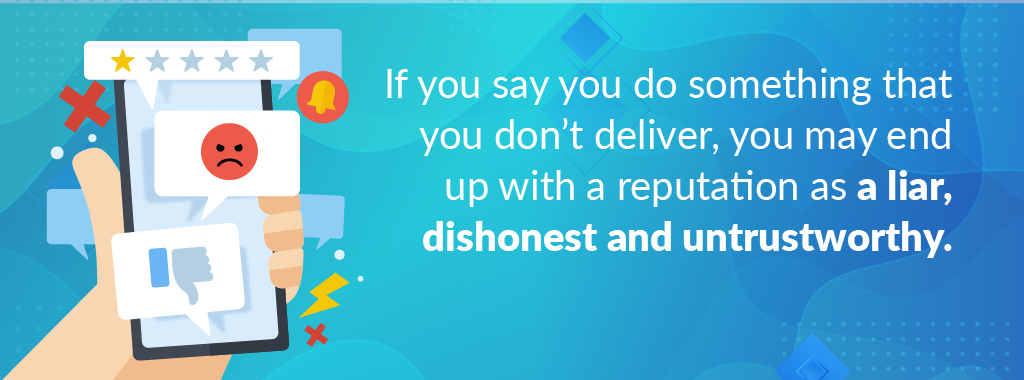
Going further, if you say you do something that you don’t deliver, you may end up with a reputation as a liar, dishonest and untrustworthy. Imagine a new steak restaurant in town that invested in a large marketing campaign for “the best steaks in town,” but, when you go, they’re hard and rubbery. The bad reviews will pile up online and negative word-of-mouth will spread like wildfire. Because there was a mismatch between marketing messaging and what the restaurant delivered, marketing ends up driving a wildfire of negativity, leading to the business failing. This process happens in the same way for healthcare providers, or any business.
The starting point for all ROI as it relates to brand building is matching your actual strengths and differentiators with accurate messaging that’s being delivered.
Now, this is hard work. The reality is that many healthcare organizations don’t have much in the way of differentiators. They do the same thing the provider across the street does. This is what we refer to as “vanilla care.”
This means that many providers aren’t able to identify differentiators. Instead, they need to actually create them. Here at Circle Social, we often spend a lot of time upfront with providers to help them get clarity on how to position themselves, then work to consistently deliver. Brand building is a collaborative engagement between marketing and clinical. Marketing provides feedback on competition, patient needs and desires, and market opportunities. Clinical provides insight into current care delivery as well as what opportunities to build upon connected to nascent organizational strengths. Some simple questions here help to get started:
- Who do we serve? What needs and/or desires do our patients have that we are best suited to meet? Get very specific here. Yes, of course they need your services, but what specific elements? Are there dental patients looking for sedation dentistry, gentle dentists for children, or emergency fixes on a weekend? Are there addiction treatment patients looking for help with complex medical, LGBTQ-specific, or Christ-centered programming? Are orthopedic patients looking to get back into a sport quickly, manage chronic pain, or have better accessibility in communication between visits?
- What are our competitors in the market doing and can we do it better? If so, list out the exact systems, processes, talent, and deliverables needed to do that. It’s not enough to say you’ll do it better. You have to be able to identify how you’ll do it better. Reputations are built upon consistency. You need to deliver the differentiator most of the time (most, because nobody is perfect.)
- What are we already doing well or that’s different? Oftentimes, even if not fully fleshed out, we find that providers are doing something slightly different or better than competitors, but that this has to be more fully fleshed out. In many cases, it’s one location or a couple staff doing something that needs to be documented and systematized for organization-wide adoption.
- If we’re doing something well or different, can it be easily copied? The best differentiators are ones that are difficult to copy. It’s all in the execution. Take something like staffing. Many providers will say, “Our staff makes the difference. We have people that truly care.” That’s easy to say, but very hard to do, especially with the high turnover rates common in healthcare. So something that everyone says they’re doing can still be a real differentiator if you execute on it better. Starbucks doesn’t do anything any other coffee shop couldn’t do. But standardizing coffee quality and good service at scale is no easy feat, which is why your average corner coffee shop never grows beyond one location, but Starbucks grew to tens of thousands.
- What resources do we have at our disposal that are unique or that competitors may not have? Maybe your organization has political connections, relationships with unions, dedicated vehicles for transportation, or a Director of Training that other orgs don’t have. Examine these resources to determine how they could be leveraged to build out differentiators.
Identification is much easier. Our favorite example is Dominoes. Dominoes looked at its data and found that the overwhelming majority of its delivery trips were made in less than 30 minutes. They also knew that waiting too long for a delivery was a major source of customer frustration. Dominoes already had consistent execution, so now they turned it into a messaging strategy, promising “Your pizza delivered in 30 minutes or less. Or it’s free.”
Just like Dominoes did, once you’ve created and/or identified your differentiators, now it’s time to market them. Great or differentiated care doesn’t do much for you if nobody knows about it. After marketing has helped you identify and/or create your differentiators, then it’s time to build the most effective campaigns possible to reach your target audience and connect patients to care.
When we match marketing messaging to consistently delivered differentiators, that’s when brand building leads to ROI. Here’s what that looks like:
- In month 1, the provider spends a bunch on marketing and gets 10 patients to utilize their services.
- In month 2, the provider spends the same amount and gets another 10 patients. Plus, their last patients were so happy, half refer friends. Now we have 15.
- In month 3, we again get 10 from marketing and half of the past month’s patients refer 1 friend, so now we’ve got 17.
- In month 4, we get our 8 referrals from past patients, plus 2 come back, plus someone who’s been seeing ads but was on the fence for a long time comes in. And, of course, we get the usual 10 from marketing as well. So, in month 4, we have a total of 21.
The point is that marketing didn’t drive all those patients directly. Marketing was the catalyst that kicked off the process of cumulative growth. By delivering a good service, patients referred friends and came back again in addition to what marketing was doing. When marketing messaging and care delivered match, this builds trust with the community so that they’re more receptive to future marketing messages from your organization.
All large, successful businesses work off this process.
It’s not the direct Return on Advertising Spend that’s critical, but the combined factors of consistent marketing with cumulative word of mouth and repeat customers that create a snowball effect over time, leading to a strong and growing business. This only happens when the organization delivers on (or, better yet, exceeds) the promises it made in its marketing messaging.
Over time, this all creates community mindshare, which is incredibly valuable. Marketing costs money. The more people you have to reach and the more often you have to reach them, the more expensive it is.
As we’ve learned, people don’t take you at your (marketing) word. It’s about what you do. For a new or lesser-known organization, you have to spend more money to reach people at higher rates of frequency in order to get them to try you since the trust from an established reputation isn’t there yet.
But, once you get there, the ROI is huge. McDonald’s doesn’t need 3 billboards back to back stating they offer cheap, fast, traditional American foods. They can put up one billboard that only has an image of their logo, and immediately we know what’s available and what to expect versus our other options off the highway. Apple doesn’t need to buy 60-second TV commercials to explain that they provide high-quality, well-designed products that integrate seamlessly into their ecosystem. A 15-second ad with the Apple logo letting us know the next iPhone is coming out is enough. We already know all the rest.
That’s the value of brand building and community mindshare. We can spend less on marketing because we don’t need the longer ads and higher frequencies to educate our audiences on what sets us apart, they already know. Furthermore, we have positive word-of-mouth doing half of our advertising for us because we’ve built a reputation around our differentiators.
This doesn’t happen overnight though. It requires months and years of consistent execution on organizational differentiators with dedicated outbound marketing campaigns. Channels such as Google Ads and SEO contribute little to brand building and community mindshare. Instead, it’s Facebook, Twitter, LinkedIn, radio, TV, and billboards that are primary contributors for most healthcare organizations serving the commercially insured.
Questions on building brand and driving ROI? Contact us at engage@27aa2dbd3f.nxcli.io or 800-396-9927