
6-beds or other small addiction treatment and mental health programs, such as IOPs, are common starting points for those with limited capital, but interested in getting into the addiction or mental health treatment space. This article will provide extensive guidance on what’s needed to successfully attract and retain patients for small new programs at detox through IOP levels of care, adult or teen, SUD or mental health.
But first, before we get to that, we want to outline the reasons that you may want to change your mind. Despite what you may have heard or been told, opening a small treatment program is very, very difficult. The majority fail. We get contacted by 2-3 providers opening a 6-bed in California or a small new program every month. Most of them don’t survive the first year.
For those that do survive, they come to find that running such programs is a grind, often requiring 80-hour work weeks. Looking around, you’ll notice that the majority of larger providers in the country do not own small treatment programs. Instead, they have anywhere from 30-200 beds per location. This is because larger programs are much easier to make successful. We’ll discuss why that is later.
There are two providers that have evidenced some success off of a small facility model. These are Discovery Behavioral Health and Newport Academy. Discovery Behavioral is currently trying to divest all of its 6-bed and smaller locations because they have found it’s extremely difficult to run them profitably. Newport Academy is currently retaining this model, but, just like as happened with adult residential, that model will not be sustainable as reimbursements continue to come down and in-network providers become the norm.
6-beds and small treatment programs do not make much money. Detox and residential levels of care require a lot of cash to run each month in terms of real estate, staffing, and marketing costs. When people hear they can get reimbursed up to $75,000 a month per out-of-network patient, they assume that this is an easy business. All you need is 4 or 5 patients a month and you can do over $4 million a year in revenue.
The fact is that most six beds and smaller programs do $1.5 to $2 million a year or less in revenue. After accounting for real estate, staffing, and marketing costs, profits are maybe 10% in the first few years, if you make a profit at all. And, as an owner, you’ll be working up to 80 hours a week to make that 10%.
There are two primary reasons new providers fail:
- An inability to attract and retain patients
- An inability to get paid
Earlier, we mentioned that treatment to a residential out-of-network patient can, on paper, get reimbursed at up to $75,000. On very rare occasions, it’s even possible to get reimbursed up to twice that. However, the reality is that very few programs ever see that kind of reimbursement. In fact, looking over our $2 billion dollars of internal data on the industry across clients, we’ve found that out-of-network providers rarely make more money than in-network providers. As a new program, even if you plan to move in-network, you will have to start out-of-network. It takes at least 6 months for a program to become accredited and then obtaining in-network contracts after accreditation can take another 3 to 6 months.
With in-network reimbursement 50 to 75% less than out-of-network, how can it be the case that in-network providers make the same profit? There are many reasons:
- Just because a policy states a maximum allowable does not mean that you will receive that. In fact, most payers will end up reimbursing you for services at rates that aren’t that much higher than in-network
- The payers will fight and delay reimbursement for OON. So, while you may eventually collect higher payments, it will take you twice as long and you’ll spend twice as much in order to actually get paid. Most new providers are terrible at billing and many billing companies aren’t so great either. New providers often find they can’t collect at all. We’ve seen new providers unable to claim a single reimbursement their entire first 8 months in business because they didn’t know how to bill properly
- Patients don’t want to use OON benefits when there are plenty of in-network options available. 7 years ago, nobody accepted in-network insurance so patients were forced to choose OON providers. But, even then, their OON deductibles for residential treatment were less than $1,000. Today, patients have a plethora of choices and OON deductibles are as high as $10,000. Nowadays, most patients will choose an in-network program unless you can give them a really great reason not to, which is where marketing comes in.
With all of these challenges, the margin for error is small. This is why bigger programs have it easier. In a 6-bed, if two patients AMA (leave against medical advice), that can be the difference between a profitable month or a loss. For a provider with 30 beds or more, losing two patients is no treat, but it doesn’t have nearly the impact on overall revenue and margins.
Larger providers also have enough revenue to hire specialists in each role. Instead of one person doing business development and answering the phone, a common recipe for disaster we see with newer providers, a large program can easily hire a different person for each role. Larger programs also have enough revenue to diversify their marketing channels. If Google Ads underperforms one month, no problem, Facebook or any other channel can pick up the slack. For a small program with only 2-3 channels running, volatility is high as there isn’t volume coming from enough channels to cover gaps in any given month.
Marketing Is Either Expensive or Takes a Long Time
There are three primary channels to market a new, small program:
- Business Development (Community Outreach)
- SEO
- Google Ads
Given the smaller budget, those are the only 3 channels that a new provider should be focused on. Other channels can be added if the business grows to a larger size in the future.
BD and SEO take months to start driving inquiries and admissions. Google Ads is the only channel that does so starting within a couple days. This immediacy and ability to see fast results on Google Ads is why most small or new business owners focus on it obsessively, which is a mistake.
The problem? Google Ads is the single most expensive marketing channel by far. The average cost per call for an SUD or behavioral health inquiry at higher levels of care is $200. That’s for adults; for teen programs it’s $350.
19 out of 20 Google Ads are also Medicaid or no resources if you don’t know what you’re doing. If you’re very good at running Google Ads campaigns for behavioral health like we are, then that can be brought down to 9 out of 10. What this means is that you need to pay $2,000 in Google ads just to get a single call from someone with in-network insurance. Note that this doesn’t include those with OON benefits. For OON benefits, you’re talking 1 in 20 calls, so $4,000.
You’re not going to convert 100% of viable inquiries either. A good phone rep usually converts about 1 in 3. That’s a lot of money to connect a single patient into your care.
Due to the way Google Ads works, you need a minimum budget of $20,000 a month. This is simple math. First off, you have to push campaign data through 100s of keyword/ad text/landing page combinations. Each iteration needs a budget of at least $500 to test viability. With hundreds of combinations to test and minimum thresholds for statistically valid decision-making, the budget has to be big or campaigns will never optimize. The math is simpler on the admissions side. Let’s say your average cost per admission is $7,000 for OON. On a $15,000 budget, at best, that’s two admissions. But your call team will sometimes fumble one of those potential admissions. Now you have a cost per admission of $15,000. If you spend $20,000, now you could get potentially 3 admissions. Even if your call rep fumbles one call, that’s still two admissions for a cost per admission of $10,000. You can see how the math works strongly in your favor at higher budgets, giving your team and your cash flow more room for error.
Now, the nice thing versus other business models is that you can actually start serving patients right away through good marketing. Try opening a new e-commerce store, shoe store, hotel, cleaning company, or any other business. The likelihood of being able to attract customers in your first month of business is very very small.
In behavioral health, it is possible to attract patients right away with Google Ads, but you will pay through the nose for it. However, one advantage, like any business, is that behavioral health programs grow significantly through word of mouth and referrals over time. While paying $10,000 in Google Ads to attract a single patient is excessive, it does start to build your foundation for referrals that will become the lifeblood of your program down the line.
The other digital channel is SEO. Most new providers do not invest in SEO. This is a huge mistake. Google Ads are insanely expensive and highly volatile. While, generally, Google Ads will perform with decent consistency in any given quarter, there can be months with 0 admissions, then months with 4. Additionally, Google Ads work only as long as you’re paying for them.
SEO, on the other hand, is much much cheaper and drives long-term value for the organization through sticky rankings in Google search. The issue for new providers is that it takes at least a year for a brand new website to start ranking with good SEO. That means you’re investing marketing dollars for an entire year without seeing much of a return.
This is because SEO only drives inquiries once you’re on page one of Google. Do three months of SEO work and Google will actually start indexing numerous pages on your website. Another 3 months, and rankings for those pages might move to page 50. People don’t even go to page 2, much less page 50. Another 3 months, and now maybe you’re starting to get to page 5 or 6. Still, no one scrolls that far, so no calls. Finally, after a year, you’ll start ranking on page 1 and start to receive inquiries and admissions.
If it takes so long, then why would you want to invest in it? The answer is, because it will save your business. We can tell you for a fact that it is 100% unsustainable to rely on Google Ads for the majority of admissions long term. The business will fail. We’ve seen it time and again. However, $5,000 a month invested into SEO and, after enough work, you’re getting an admission a month for 1/3rd the cost that you’d pay on Google Ads. Keep the SEO work going and, soon enough, that’s 2-3 admissions a month at a cost per OON admission of under $2,000. In-network is less than $1,000. Now we have a financially stable business with a sticky marketing channel to boot.
That’s why every provider needs to invest in SEO. SEO needs to be built into the pro forma. We do not consider this optional if you want the business to survive long-term.
You Absolutely Need Business Development
We covered the two digital channels – SEO and Google Ads, but no new provider can survive without business development either. Business development is the act of doing outreach into the community in order to generate referrals from other community partners in touch with patients that need your services. These can be other healthcare providers, non profits, community groups, employers, schools, etc.
In an established provider, 70% of admissions come through community referrals when outreach has been done well. The cost to hire a single individual who can bring in 2-4 admissions a month is much, much cheaper than what can be achieved with Google Ads.
The problem here is that a good business development rep is incredibly difficult to find. Even good ones take months to start cultivating the relationships that drive community referrals.
Our very strong recommendation is that community outreach is handled by an owner of the program. The most successful small providers are those opened by individuals who already have a lot of connections in the community to attract referrals. Trust is everything when it comes to referrals and if a program owner is already trusted, getting referrals even in month 1 is much easier.
On the flip side, if you are opening a program but have no connections in the community related to behavioral health, we’d recommend thinking twice about opening a program. Either you yourself will have to figure out business development while wearing all the other hats that go with program ownership, or you’re going to have to try to hire someone for a role you don’t have expertise in. We have rarely seen new owners overcome that hurdle using either tactic. Sometimes, if the Clinical Director or Executive Director hired for the program has a very strong reputation among community referral partners, that can help drive some referrals early on, but those two roles will be busy working in the program, so their time available to do outreach is limited, especially once patients start entering the program. For this reason, they usually can’t be a reliable source of steady referrals.
The Person Answering Your Phone Will Make or Break You
You can have the best digital marketing and business development in the world, but none of that matters if the person answering the phone isn’t any good. This is a big issue we see with newer programs. They don’t have anyone with experience answering the phones and they lack the expertise to identify a good hire or train a mediocre one.
BD and personal referrals are easy to convert. The patient/family already has a certain level of trust in whoever is referring. This is why referrals generally convert at 50%. For Google Ads, there is no trust. The potential patient/family looked at your site for 30 seconds, maybe a minute at best. 33% of all Google Ads calls don’t even click to the site, they just call right off of the ad so they don’t even really know who they’re calling (which is one reason why Google Ads generates an annoyingly high rate of wrong number calls).
Not only do they know next to nothing about your facility when they call, but they’re calling 3-5 other places as well. Nobody just calls one facility. If one facility does a better job building rapport and differentiating their program, they’re going to get the patient.
And it’s 3 times as hard for OON. You must both convince patients and families that your program is the right fit and also convince them that dropping thousands of extra dollars on their OON deductible is worth it versus the other 3 places they called that are in-network. 7 years ago, everyone was OON, deductibles were under $1,000, beds were limited, and facilities paid for flights. It was super easy to convince desperate callers even if the call wasn’t handled the best.
Nowadays, you really really have to work the call to get the patient to choose you because they have so many options, most of which are cheaper. Also, the majority of callers (around 80% based on our data) are not in such crisis that they need to make a decision today. Most callers are shopping around, carefully evaluating providers. To tap into that majority of patient volume, you’ve got to be able to show them your facility is the best out of the 5 they called. Google Ads produces more crisis callers than other channels, but, as you expand your channel strategy, you’ll need to be able to convert the more discerning callers as well.
The Market Is Saturated. You Need to Stand Out
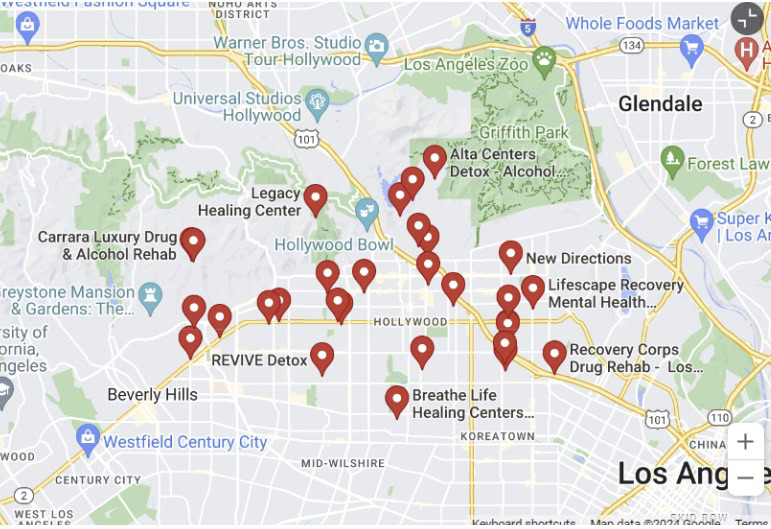
To that point, there are literally so many treatment providers in every area of Orange and Los Angeles Counties that Google won’t even display them all. It displays less than half of all providers in a 20-mile radius. There are often 2 treatment providers per square mile in many areas of Orange and Los Angeles Counties. Take a look at just what Google displays in the 20-mile radius screenshots below:
Hollywood
Huntington Beach
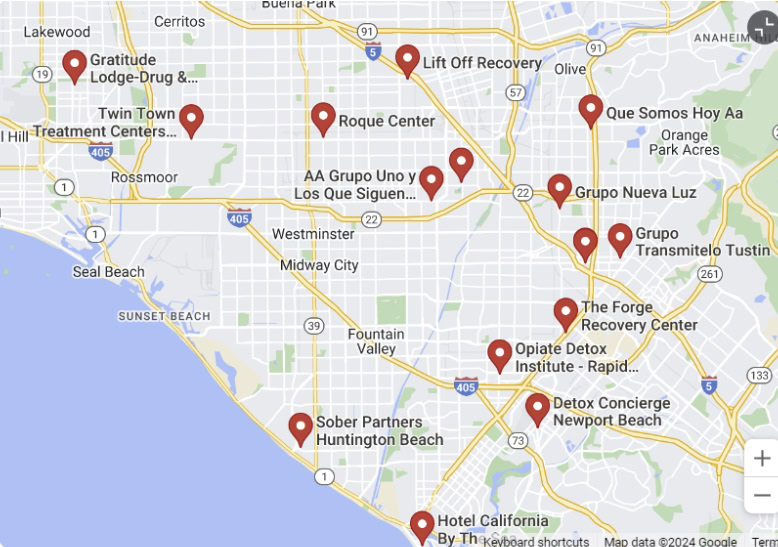
You can stand on most corners, throw a stone, and you’re likely to hit a treatment program.
That should make you stop and think. If a patient literally has 6 options within walking distance of their home, why should they choose you?
This is something else that most new providers miss. They’re opening the same program as everyone else. If you open two McDonald’s across the street from each other, what will happen? They’ll just cannibalize each other’s business.
Some programs mistakenly think that they’ll fly in patients from all over the country. That model hasn’t worked for going on 5 years now. The only reason it worked before was because deductibles were low, treatment programs paid for flights, and there were no providers closer to the patient’s home.
It’s the exact opposite today. Go anywhere in the country, and there are multiple treatment programs available nearby. We can tell you for a fact, again looking at $2 billion in data and over 500,000 admissions across our clients, that 95% of all admissions to residential programs come from less than 150 miles away. The majority come from less than 70 miles away. People do not want to fly across the country for treatment, especially if it means paying for their own travel and a high deductible.
You, your business development reps, your person answering the phone, and your marketing team all need to be able to answer the question, “What makes you different?” Why should they choose you rather than the other 4 programs they are absolutely talking to today as well? That’s the only way you’ll be able to get patients to choose you in a crowded market.
This needs to go beyond buzzwords like:
- Evidence-based care
- Holistic
- Caring team
- Dual diagnosis
- Individualized treatment
- Trauma-informed care
Every program lists those things, so they won’t set you apart.
One possible option is to take something everyone is using, such as “evidence-based care”, and highlight how you do it better. This approach can work, but we would maintain that having something truly unique is still the best route to success.
Creating the Foundation for Success
Hopefully, you have a better understanding of the challenges you’ll face opening a small program. If you get the foundation wrong, that’s a lot of time and money spent moving in the wrong direction, which is usually enough to ensure failure since small programs rarely have the capital to recover from mistarts.
Here’s a review of some of the key foundational items new programs must have in order to attract and retain new patients:
- A dedicated marketing budget built into the pro forma for SEO, business development, and possibly Google Ads
- SEO budget needs to be at least $5,000 a month. Anything less and you won’t be able to compete with other providers who’ve been investing in SEO for years ahead of you
- Business development budget can be absorbed under an owner’s salary with their job dedicated to outreach, or you can attempt to hire a decent rep at $6,500-$8,000 a month
- If you choose to utilize Google Ads for quick admissions rather than the slow build required of SEO and business development, then you need a minimum budget of $20,000 per month while not in-network. Less than that and you won’t have enough spend pushing through the campaigns to get reliable data back for optimization nor enough spend to minimize admissions volatility
- An excellent person to answer the phone and for whom answering the phone is their number one job. If 1 in 20 calls are a viable OON call, missing that one call can literally make or break census for the month. Every call must be answered
- Waterfall routing needs to be set up through the call system. It will inevitably be the case that some callers call at the same time. That call must be answered. If the main phone rep is busy, the call system needs to route them to the next designated person in the waterfall so no call goes unanswered
- Very clear understanding and implementation of what sets your program apart. Look at the websites of other programs in your area. Place mock calls into their facilities. Does your website or do your reps say the exact same things? Then you need to decide and build something different in order to make your program stand out.
Does that sound like a lot? That’s because it is. That’s not even getting into staffing, clinical delivery, technology setup, licensing, and accreditation. With a small program, there is very little room for error. You can try to go it alone, try to cut costs by hiring non-experts and pray for some luck, or give us a ring and we’ll ensure you’re doing everything right. At Circle Social, we don’t act as vendors, we openly and gladly share our extensive expertise surrounding all aspects of growing a successful behavioral health business. Get in touch at 800-396-9927 or engage@circlesocialinc.com.