
There’s a massive difference between marketing big and marketing small.
As an example, compare a private practice therapist to a group therapy practice with 10 therapists.
For the private practice therapist, they only need 20 patients to fill their schedule. Out of the hundreds to thousands of people looking for therapy in any decently-sized city, that’s quite easy.
But multiply that by 10, and now the group practice needs 200 patients. If there were only 300 patients in the area looking for treatment, the group practice would have to get in front of and convince 66% of them that they are the right place for the patient. Not nearly so easy.
The bigger you get, the harder it is to connect with the number of patients needed. This goes for dentists, surgeons, hospitals, clinics, therapy centers, treatment programs, or any kind of healthcare provider. For some of our clients, we need to connect over 20,000 patients a year into their facilities. That kind of volume can’t possibly come from just one or two channels. We have to have sophisticated multi-channel strategies to connect with patients where they are across platforms.
Competition is another important factor when it comes to scale and volume. If you need to see 200 patients a month and you have two competitors in the area that need the same, that’s 600 patients per month. And what if there are only 500 patients looking for treatment? Now everyone is competing for the same limited number of patients.
The small private practice still has it fairly easy. While they’ve got competitors in the area, just finding 20 patients is so much easier than finding 200.
The private practice therapist can market small. They can make some local connections, run a Google Ad or two, maybe send some emails, then rely on word-of-mouth referrals for most of their patients. When smaller programs try to expand, they are often stumped by how much more difficult it is to connect with patients because what worked in marketing when they were small is not what works as they get bigger.
The larger provider can’t market small. They need multiple channels.
Let’s take a look at some Google search data. For the Greater Indianapolis area, with over a million people, there are only an average of 50 searches a month for the term “therapy for depression.”
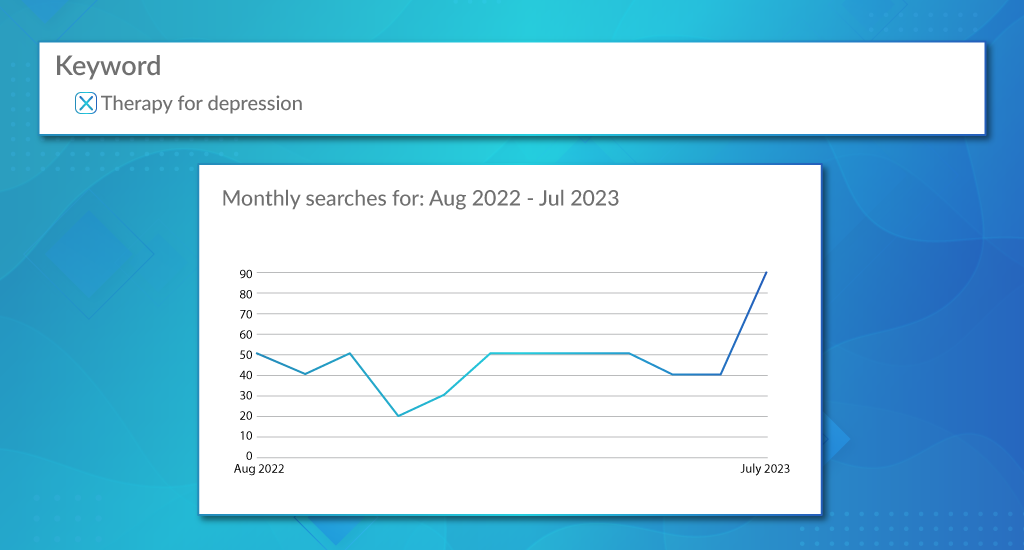
Of those 50 searches, we know that less than 50% will actually move forward with therapy anytime soon. That’s nowhere near enough to fill 200 open spots. The handful of patients you can connect with from Google will be enough for the private practitioner. For the group practice or large provider, it won’t even make a dent in their total patient count.
That means a larger or growing provider needs to market big. They have to be on multiple channels in order to get in front of all of the patients on the different channels (Google, Facebook, TV, TikTok, Email, LinkedIn, etc.). For our clients who need to connect with 100 or more patients a month per location, we need to be on no less than 5 separate channels. There is no other way to generate enough inquiries to fill a large need.
And let’s not forget, just like you, people don’t generally make healthcare decisions off of a single ad. The norm is for a patient or family to see ads 7-12 before they’ll seriously consider giving the provider a call.
Larger providers, or small providers trying to become a larger provider, need to think differently. Here are the most important questions a large or growing provider needs to ask:
- What channels are patients on?
- How many potential patients are on each channel?
- How much do the channels cost (CPMs and CPAs)?
- What part of the patient journey are they likely to be on on the different channels?
- How do we adapt messaging to fit the audience on each channel? How do we adapt messaging to match the section of the patient journey they’re on for each channel?
- What frequency of ads over what period of time is needed to drive decision-making behavior on each channel?
- How do we integrate campaigns across channels to ensure they’re supporting each other, not working in isolation?
- What are our KPIs per channel (new patients is the final KPI, but many channels don’t generate direct inquiries, so leading indicator KPIs are more important for any display channel)
By strategically evaluating the answers to the above questions, providers can make intelligent decisions about overall efforts and budgeting. Or, you could work with an agency like us that already knows the answers.