Can Drug Rehabs Benefit From Paid Advertising and How Does It Work?
Paid advertising is a broadly scoped term that encompasses any ad medium which you pay for. In addiction treatment and behavioral health marketing, there are "the big three": Google Ads, Microsoft Ads, and Facebook (Meta) Ads. These 3 platforms account for the majority of online traffic. In marketing, you need to advertise where your audience is, so these platforms are top considerations for any marketing strategy. In this article, we will be discussing digital pay per click (PPC) ads, which is Google Ads and, to a lesser extent, Microsoft Ads.
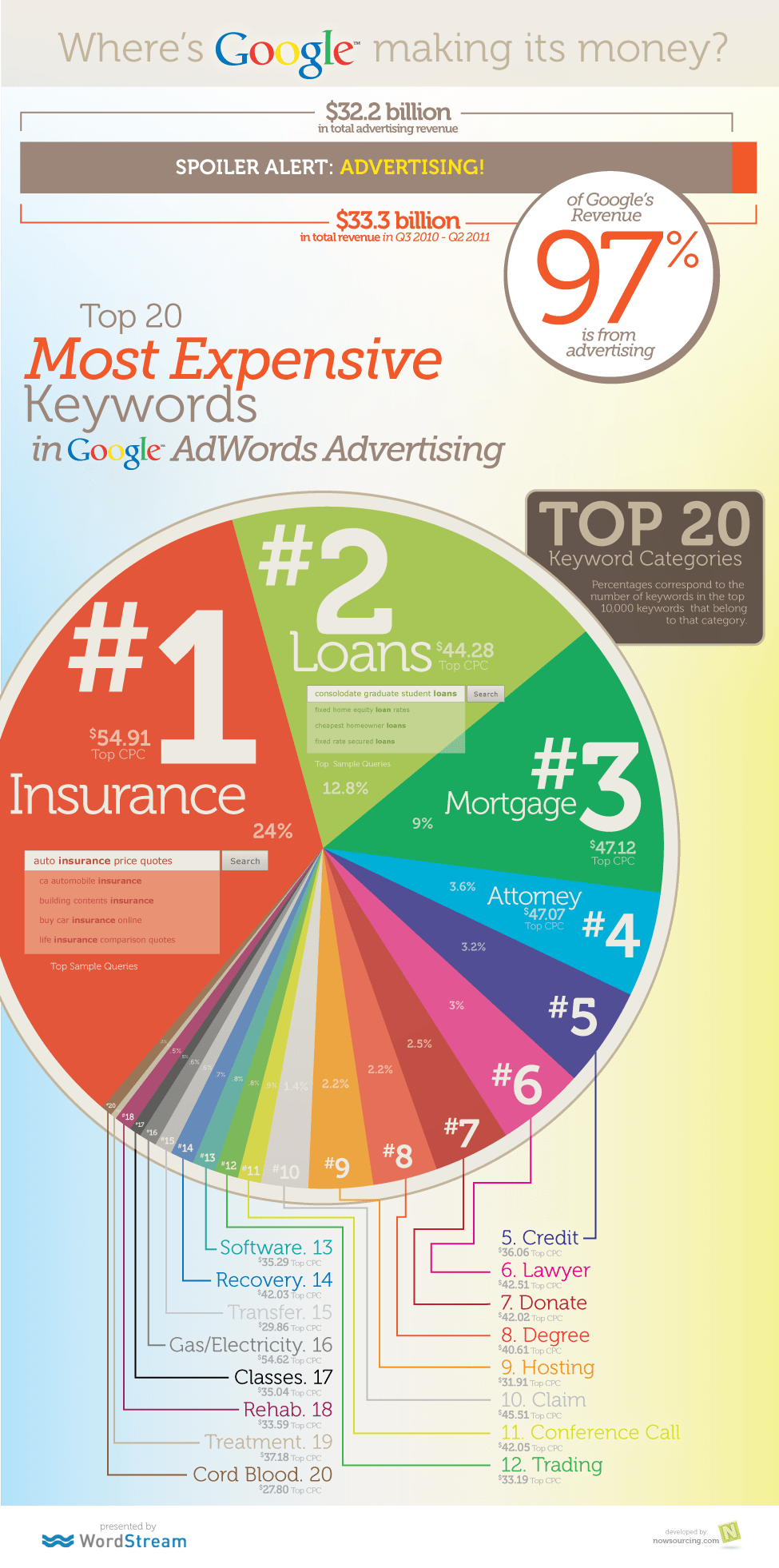
Any business can benefit from a properly built and executed paid ad strategy. Drug rehab and behavioral health centers are no different. In fact, some of the most competitive and most expensive search terms on Google are addiction treatment-related. Rehab, recovery, and treatment all hold a position in the top 20 most expensive PPC terms on Google.
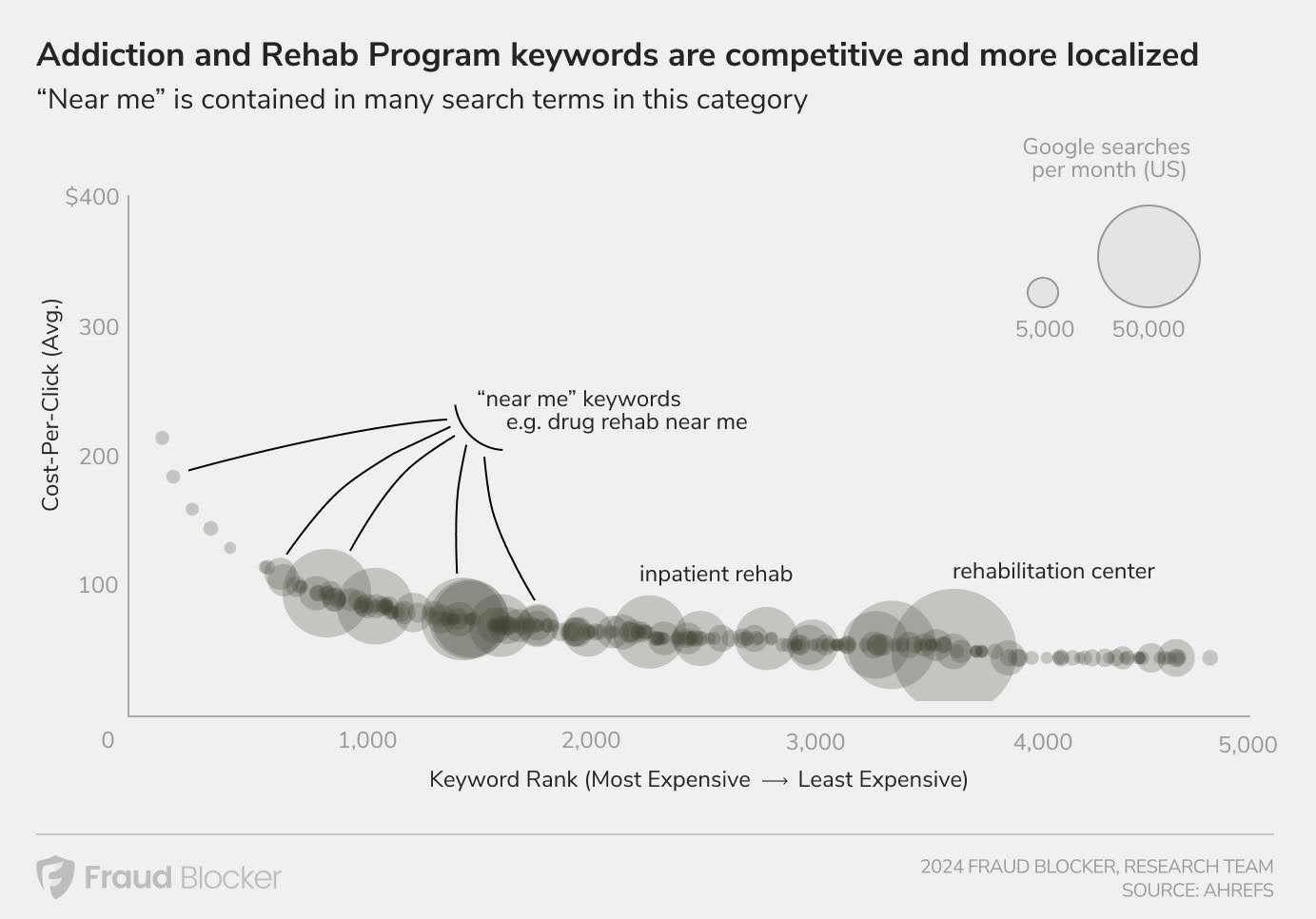
Additionally keywords such as “alcohol rehab near me” in exact match form run up to $185 per click in 2024 according to data by Fraud Blocker.
The Inner Workings of PPC and Paid Advertising for the Treatment Industry
PPC or pay-per-click advertising for drug treatment facilities, at its most basic, works on an auction-based system. This means that if you want to show up for a coveted term like “drug rehab near me” you will compete with all of the other advertisers who also want to show up for that term at that moment in time. Each search has its own independent auction. The top four positions on a Google search result page are always reserved for ads. Only the top four bidders will show up there.
Google, Microsoft Ads, and Facebook (now Meta) also add in a few other factors than the highest bid. Google, for example, takes the quality of the ad and advertiser into consideration as well. Having a good quality ad and user experience will get an advertiser a higher position in the ad auction at a lower bid than another advertiser. This is why it is important in all ad platforms to make sure your ad quality signals are at least good and whenever possible excellent.
How Long Does It Take to Get Results From PPC for a Treatment Center?
Managing a Google, Microsoft, or Meta Ads account for a drug rehab client is quite a time-intensive process. None of the big three platforms are set it and forget it. Especially with the higher budgets and click costs in the addiction treatment world. Without daily monitoring and changes, it is easy for click costs to go very high, or for volume to drop off to nothing. Remember what we said about auction-based systems? That also means your competitors are working hard as well, and new faces are always coming into the game. If your account is neglected, you will start to see your volume drop off as the competition outbids you and builds better-quality campaigns.
Frequent monitoring and updating by a real person (not software, or a script) are essential to a successful PPC campaign for a drug treatment center.
That being said, the setup and initial optimization phase always takes longer than the maintenance phase of an ad campaign on any platform. There is no exact number for the length of time PPC takes for the average drug treatment center. It depends on many variables, such as budget, market competition, number of campaigns, testing needed, audience size, and the effectiveness of the people optimizing the campaign. However, on average, about three months is a reasonable timeframe for enough data to be pushed through the campaigns which allows for baseline optimization of campaigns.
Across our close to $3 billion in behavioral health data, we've found that $50,000 pushed through an account is the optimal initial spend to get enough data back to truly optimize campaigns. Campaign optimization starts on day one, but success is highly dependent on statistically valid data, which requires X amount of clicks and conversions. Google's machine learning needs a minimum of 14 conversions for week to start supporting optimizations. On our side, ideally, we have a minimum of 10 conversions to start optimizing a combination.
This is because each campaign requires extensive testing of keyword, ad copy, landing page, optimization type, and budget combinations. It's simple math. If the average cost per call is $150 and we have 10 keywords with 4 different ads we're testing, that's $6,000 just to get 1 single call through each keyword/ad split test. 1 data point tells us nothing. It has no statistical validity. We need the budget to push the split tests through the campaigns to reach statistical validity and make real decisions.
People unfamiliar with Google Ads often have the false belief that you can simply copy paste campaigns from other successful ones. While there are many best practices that need to be in place to form a strong campaign foundation, conversion trends vary by geography, service line, and provider reputation in addition to changing constantly over time. A simple Google trends search for any term will show you that interest for any given search term changes over time, so we have to be constantly updating strategy to match those changes in user search behavior.
Each unique provider needs to split test their own campaigns. This is particularly true today where patients have 20 plus options in any given market in the country. One of the biggest mistakes most providers and agencies make is running the same messaging as everybody else. There is this false idea that there is some magical keyword combination that always works and, "if we just find and use these magical terms, then our ads will drive high quality calls." Take a look at the ads below. What's the difference between these facilities? Why would you call one vs. the other?
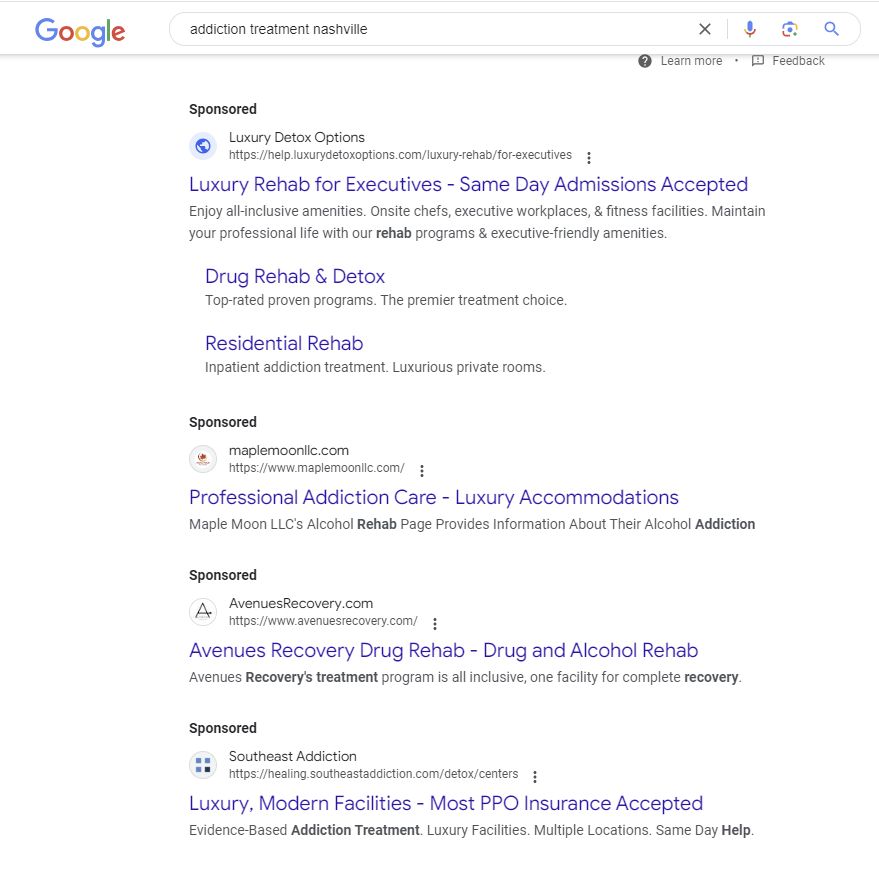
Searchers have no reason to click one ad over another since they all look the same, so they shrug their shoulders and choose one. With a complete lack of expectations, it's no surprise when inquiry quality is low.
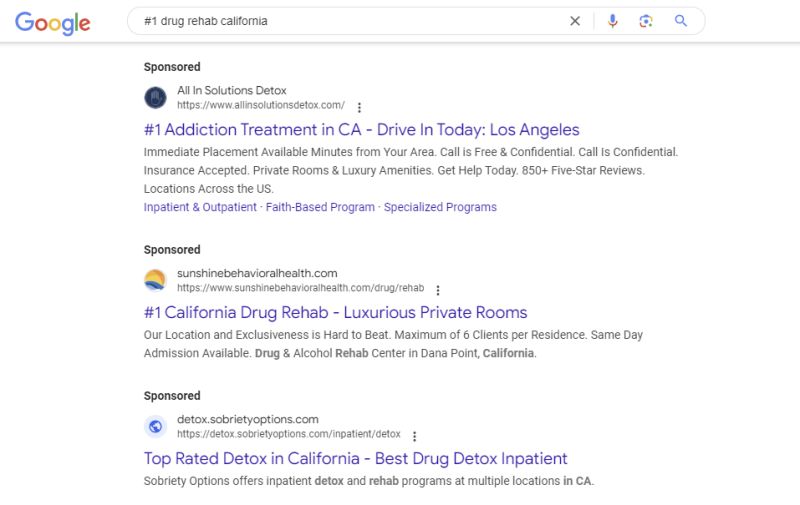
In the second set of ads where everyone claims they're #1 or "top rated", searchers already assume the providers are lying. Additionally, marketing research has shown for decades that superlatives and uses of things like #1 in advertising actually reduce conversions since they're seen as not trustworthy unless the ad indicates a trusted third-party rating agency.
Take a look at one of our high converting ads that consistently delivers high quality inquiries.
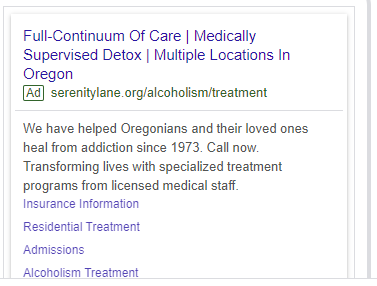
You can see how our ad stands out from the sameness of the previous examples and speaks to the differentiators of the organization. These ads also match messaging across channels, what their community outreach team discusses, and what the call center discusses. Having integrated messaging across channels and departments is critical for long term success.
What Is the Cost of PPC for Drug Rehab Centers?
You can start a Google Ads account for as little as $5. But of course, you cannot compete in the behavioral health sector for that price. The method to determine how much budget your treatment center should devote to PPC is fairly simple
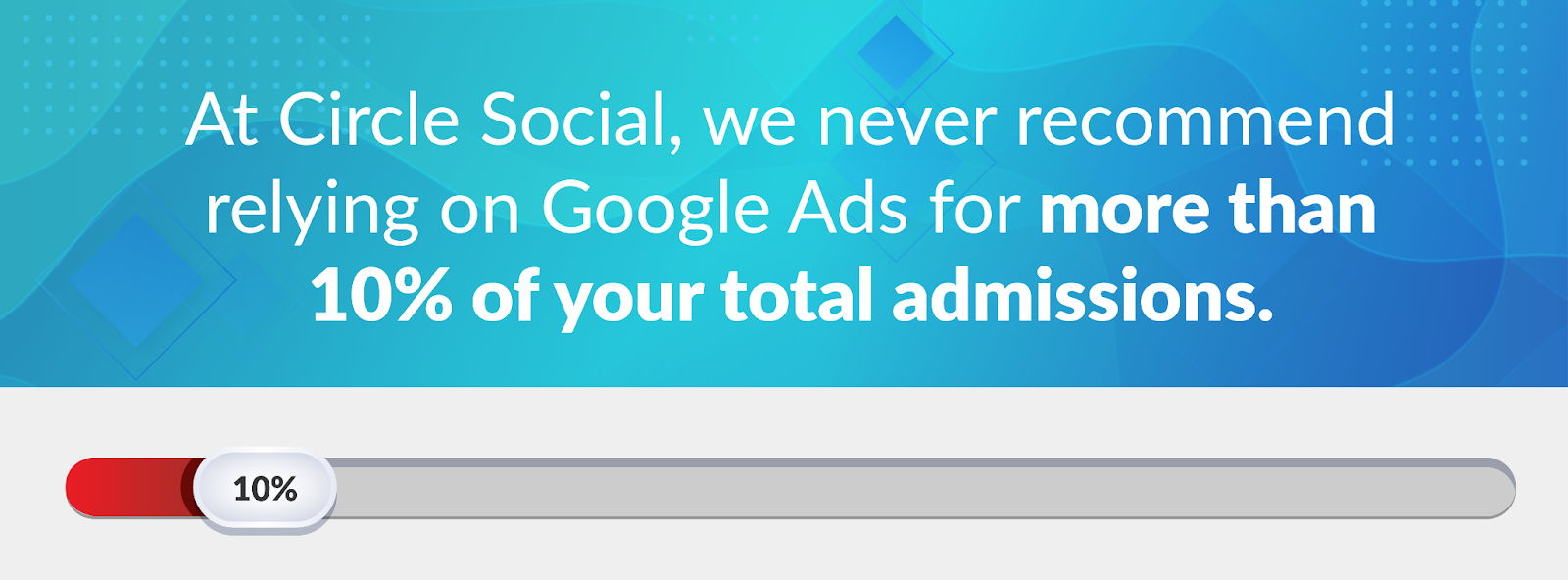
First off, keep your expectations reasonable. At Circle Social, we never recommend relying on Google Ads for more than 10% of your total admissions. This is because PPC is simply the most expensive channel for admissions and the new patient admissions generated directly from PPC ads are generally loss leaders. $12,000 per direct admission on an OON campaign is certainly not unheard of.
However, Google Ads PPC remain a significant source of admissions for providers nationwide. The phrase “the whole is greater than the sum of the parts” definitely applies when using Google Ads as a part of a holistic strategy that includes business development, alumni, community referrals, and other digital marketing channels such as SEO and brand awareness pushes.
How Much Money Should Addiction Treatment Centers Spend on PPC Advertising?
The amount of budget an individual addiction center should devote to PPC ads entirely depends on the desired outcome. Going back to our simple formulation. Say you generate $30,000 in revenue for a 30-day residential client. What are you willing to spend to get that client? We talked about direct admissions from PPC campaigns being a loss leader so many centers are willing to pay a lot.
One challenge driving up costs is that OON providers regularly have budgets of $500,000 a month or more and are willing to pay $7,500 - $12,000 for an admission. In-network providers can't pay anything close to that, but they still have to compete in the auction process with OON providers who are willing to drive up costs.
Our in-network providers are able to achieve costs per admissions of $6,000 or under because they are able to admit more of the calls. Patients these days do not want to pay OON deductibles or co-pays, so are more likely to search for an in-network provider.
The math is quite simple. If we've optimized campaigns down to a cost per inquiry of $200 and 1 in 10 calls has in-network insurance (the average nationwide on an optimized campaign), that's $2,000 per VOB. No call team in the country converts 100% of calls, so let's say they convert at a decent average of 1 in 3. That's $6,000 as a minimum assuming the team consistently converts at 1 in 3, which is certainly not a given.
It's important to remember that cost per admission ICPA) is a product of both cost per quality inquiry and the conversion rate on the phone. No matter how good our marketing campaigns are, if the call team doesn't convert, the CPA will be high.
Additionally, different budget levels drive different qualities of calls. Small budgets can target crisis calls only, which are the easiest to convert. But larger budgets need to expand targeting and keywords to non-crisis calls, which means more discerning callers comparing and contrasting several providers. The way a call center rep speaks with a crisis caller is very very different from the way they need to speak with someone researching multiple facilities. A large mistake many providers make as they grow is that they think the call team they had when they were small will be effective doing the same thing as they grow. This is not the case. It's very different skills.
The lowest viable budget for an intensive addiction treatment or mental health provider is $10,000 per month. Less than that and it's not even worth advertising on Google Ads as there isn't enough budget to push statistically valid optimizations through campaigns. Ideally, especially for a new program with no data, the budget is $30,000 per month. This is the same whether the provider offers detox, residential or PHP/IOP levels of care. Working to improve internal processes and channel attribution helps a lot. You can see in our formula how a shift from a 2% to a 3% conversion rate can dramatically improve your overall cost per acquisition. Or even an optimization of $250 per call to $200 per call.
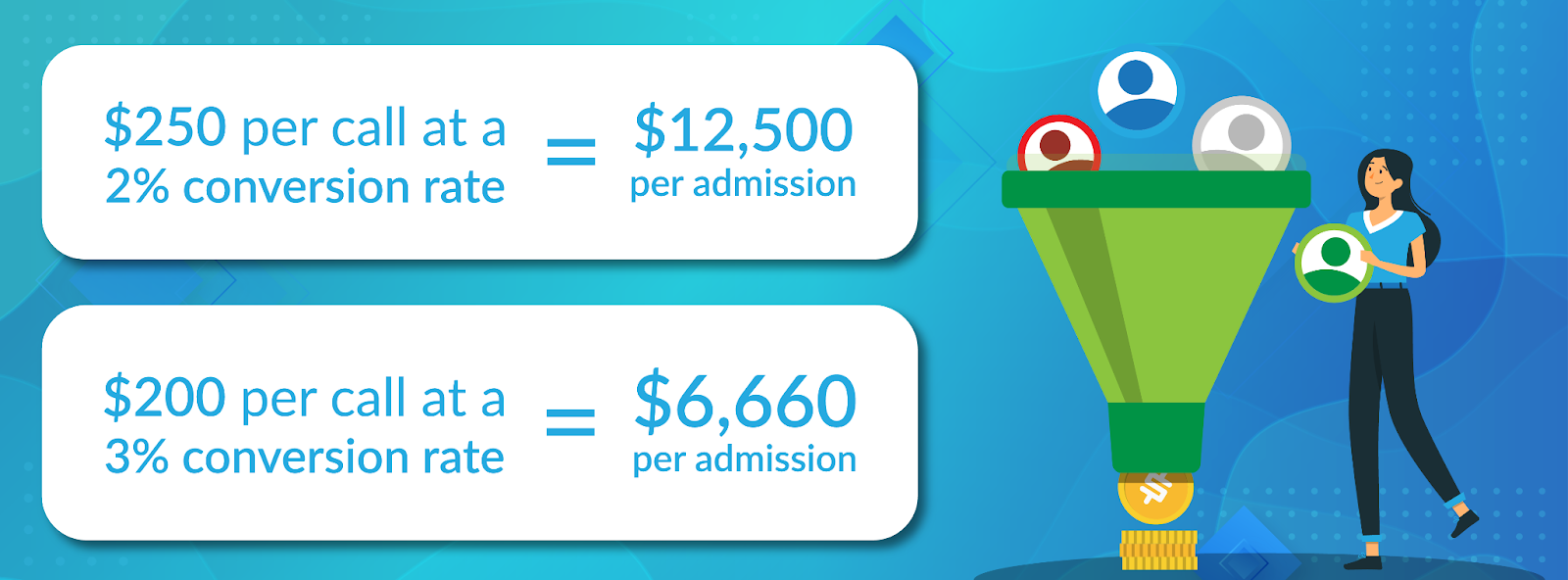
$250 per call at a 2% conversion rate = $12,500 per admission
$200 per call at a 3% conversion rate = $6,660 per admission
Remarketing and Retargeting Using PPC
Remarketing, also known as retargeting, for drug rehab centers is an online advertising tactic that serves targeted ads to audiences of people that have already taken some kind of desirable action. These actions can target many engagement audiences such as
- Website visitors, globally or segmented
- People who open an email
- People who saw an ad or engaged with an ad
- People on your email contact list
- People who viewed a video
- People that took certain actions on your web property, like clicking a call button
- Segments from Google Analytics or Google Ads
- Any number of creative audience segments you can think of
The types of audiences available for retargeting in most industries are as limitless as your creativity. However, retargeting for behavioral health clients is severely restricted by the big three. It is still possible to do limited retargeting within the publishers' terms of service. For example, Google Ads will not allow ANY audience targeting for drug rehab ads, and attempting to do so is a violation of their terms of service and grounds for account suspension.
Facebook also restricts retargeting using the website Meta Pixel data, however, you can still retarget using on-Facebook audiences such as video views, ad interactions, or business page interactions.
PPC Allows for Incredible Measurement and Attribution for Treatment Centers
That sounds like a hot take but it does hold true. Since the advertiser is paying the publisher for clicks, reach, impressions, or whatever the end product is, the publisher has the obligation (and it is in their best interest) to show where that money is going. This is advantageous for us, the agency, and the publisher. In most cases, our clients have access to data right down to the search keyword, cost, and conversion data to the click level. While the publishers do limit search term data to protect end-user privacy, there is more than enough data available that allows for very good insights and modeling.
Because of this data density, it is really easy for us as an agency to create an accurate budget and results in models for you, our client. It is also easy for us to answer questions quickly and pose questions based on what we see in the paid advertising data.
This is one reason we LOVE PPC and paid channels so much. It can inform many areas of your business. Not just what clicks you paid for, but what is trending in the market, the types of programs you should be focusing on, etc. You can use paid advertising data to inform you about what your customers are looking for and help you build out specific differentiators. Paid media data also can be used to help you determine the best markets to expand to, the viability of specific tracks and programs, and more!
This makes PPC even more valuable than a simple linear measurement of click to admission.
Addiction Treatment PPC and LegitScript
After years of shady business practices, lead selling, and body brokering in the drug rehab space, NAATP and other industry organizations were finally able to push Google to step up and use its power as the largest publisher to make a positive impact on the industry. As a result, since May 2018, Google has required any business that provides addiction-related services to be LegitScript certified in order to advertise on any of its publishing platforms. Facebook (Meta) and Microsoft Ads (formerly Bing Ads) summarily followed suit.
Becoming LegitScript certified is neither easy nor inexpensive. Your addiction treatment company must pay a hefty upfront fee and a yearly monitoring fee for each location you intend to advertise for.
In addition to this fee, LegitScript performs a deep and extensive look at your facility processes and procedures, licensure, DEA prescribers, and criminal background checks on your executive team. We have seen this process take anywhere from two weeks to nine months.
Circle Social does not perform LegitScript certification for facilities as it is entirely upon the provider to get the proper information based on LegitScript requirements. However, we have helped many clients through the sometimes complex certification process through consultation and assisting in communication with the LegitScript team on behalf of the facility.
My Google Rep Keeps Calling Saying They Can Improve My Ads. What Do I Do?
Google Ads reps are persistent and annoying. At Circle Social, we get dozens of calls a day from reps at Facebook, Google, and Microsoft.
These individuals are not ads experts, which is the impression they try to give. In fact, they don't even work directly for any of the big three. Instead, they are paid contractors from outsourced third party firms who are paid a commission based on how much they get an account to increase their budget.
They have no expertise around running campaigns, they are simply sales reps that benefit when you increase your budget. This is why, if you take a meeting with them, their primary recommendation will always be to increase your budget.
To get a real rep that is employed by one of the big three which may have insights of value, you need to be spending over $500,000 a month on Google or Microsoft and over $2 million a month on Facebook. As certified Google, Microsoft, and Facebook Partners, we regularly work with these individuals, but they usually learn more from us than we learn from them since we have such a high level of expertise in behavioral health, whereas their knowledge is across industries. Their experience running $50 million dollar campaigns for Pizza Hut or Mercedes has very little value when it comes to behavioral health.
Is Google the Best Publisher to Do PPC Advertising for Drug Rehab Centers?
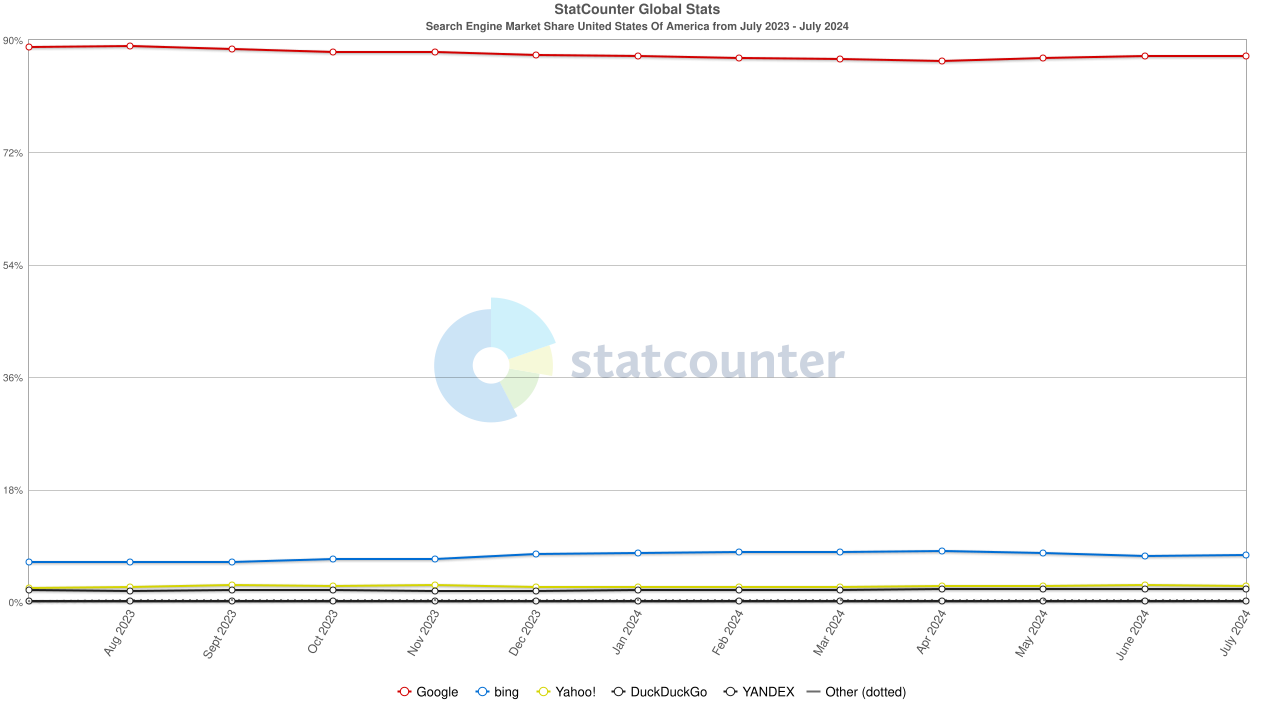
Since Google has about 87% of the search market share in 2024, that is where most drug rehab companies start when they want to begin any kind of paid media campaign. But that doesn’t mean it is the best or even the channel where you should make the largest investment.

The Problem With Google Ads for Drug Treatment centers
As we discussed earlier, Google Ads is the most expensive channel for acquiring patients for addiction treatment. We often discuss with clients how Google Ads is a bottom-of-funnel, crisis-centered medium. These people need help and they are taking direct action to get the help. Sounds great right? It is, to a point.
You see, there are a lot of people searching Google covered by Medicaid, or no funds, and they are simply calling the first place and going down the list. A lot of searchers just have questions, or do not want to make a commitment to your facility.
So a lot must align for Google Ads to be a really great channel - you must have a good call center, a great person or agency running your campaigns, and a very good reputation.
Even with all of those business nodes in alignment, Google Ads is still a high-cost affecting your treatment company’s profit. As we noted earlier, even in an optimized state you should still expect to pay around $7,500 or more for an admission into an OON facility. Somewhat less for in network, depending on the market. Once you stop running Google Ads, you don’t get any ongoing benefit from them. Unlike other brand-building channels such as SEO and Social, where your investment continues to have ROI even if you change course.
Other Paid Advertising Channels That Work for Addiction Treatment Providers
We already discussed the big three, Google, Microsoft Ads, and Meta Ads.
Microsoft Ads, which delivers ads on the Bing search engine and other Microsoft properties is a decent good adjunct to Google and Meta Ads once volume needs grow beyond what Google and Facebook can provider. Bing users tend to have a higher income than most Google users, but they also convert less (usually because call teams are used to crisis calls, which is not as common on Bing). Another problem is the volume is very small so any viable PPC strategy for drug rehabs cannot only include Microsoft Ads.
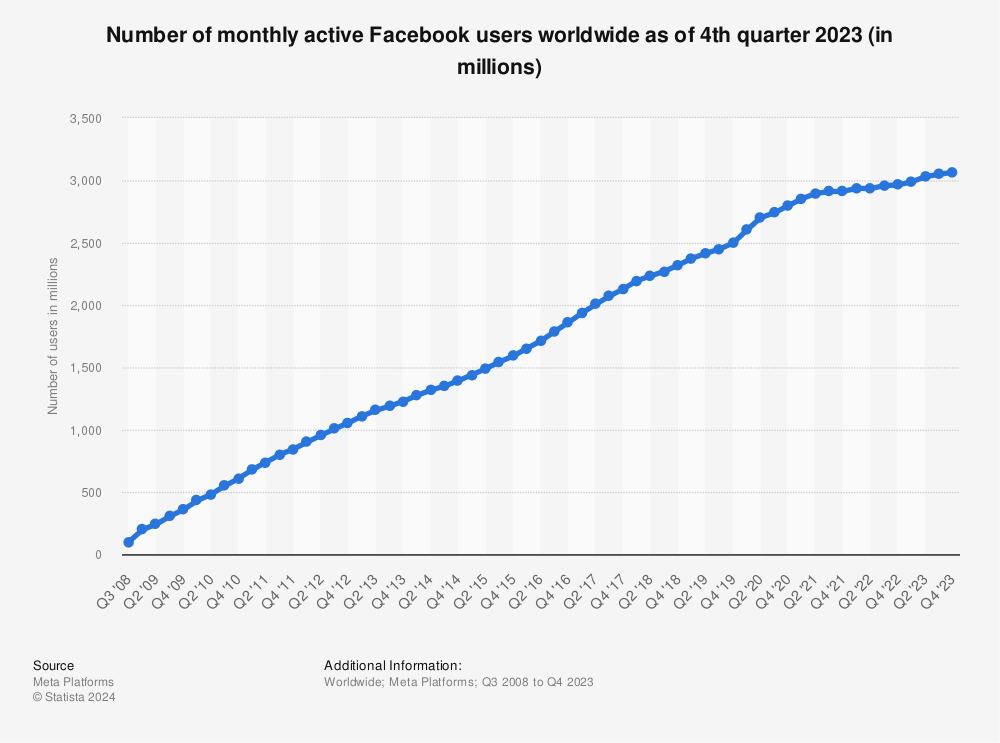
Meta Ads, which includes Facebook and Instagram, has an incredibly large pool of potential users. According to Statista.com Facebook had roughly three billion monthly active users as of the second quarter of 2023. Considering that 10% of people know a person in active addiction and 5% of people are in active addiction, the number of eyeballs that are relevant to your drug treatment center is mind-boggling. Meta properties are an extremely valuable part of a comprehensive marketing strategy for drug rehab centers. We go into Facebook advertising for drug treatment centers in detail over here.
If you need B2B marketing for patient or partner acquisition in the behavioral health and addiction treatment space, LinkedIn is a valuable channel to invest in. Though the cost is quite a bit higher than other platforms, the audiences are highly targeted and engaged for B2B campaigns. We did a case study on using LinkedIn to reach B2B decision makers in the behavioral health industry that is definitely worth a read.
Ok, so Where Is the Best Place for Me to Advertise as an Addiction Treatment Provider?
The best online channel for addiction treatment centers to advertise depends on what the end goals of your efforts are. How many admissions a month do you need? Are you large enough that you've expanded beyond crisis volume and need additional channels to nurture patients earlier in the patient journey? Are you looking for brand awareness and reach? Do you want direct inquiries for treatment? At Circle Social, we help you define these goals and get you set up with a strategy that may include PPC.
How We Can Help You Generate Quality Drug Rehab Inquiries With PPC
At Circle Social, we have a distinct market advantage for behavioral healthcare marketing. We have billions of dollars of behavioral health data at our fingertips. Plus decades of combined experience directly within behavioral health and addiction treatment center marketing.
We use this data to tailor a strategy for your business and your business needs. We don’t just drive a lot of inquiries, anyone can do that. We drive more targeted inquiries that result in helping more people get into treatment.
We are passionate about the field of behavioral health. Remember the large costs per acquisition that some centers are comfortable with that we mentioned before? Well, we generally beat those, by A LOT.
Whether you already have a person in house who does PPC, already work with an agency or have never run a single paid ad for your treatment center, we can find a way to help. Contact us for a free audit or consultation with your current team. Let’s see how we can work together to propel your efforts and get more patients connected with care.
Get in touch at engage@27aa2dbd3f.nxcli.io or call us at 800-396-9927.