
As providers grow and scale, they always have the same question about website setup, “Do we build a single website with each of our locations having a unique page or do we build separate websites for each location?”
Circle Social has worked with and tried both. The answer is definitely the latter, but let’s take an in-depth look at these two options.
Option 1: A Single Multilocation Site
There are some advantages to having a single website.
- Significantly cheaper
- Hosting cost for only a single site
- Lower maintenance and upkeep costs from a web development labor standpoint
- Paying for development of a single page for new locations rather than an entire website
- Overall long-term website authority will give a boost to SEO rankings for any new location page added as new locations open, potentially helping new locations rank quicker
- Patients and referral partners can quickly access all locations in a single site
Most of the time, when providers go with the single multilocation site option, they cite lower costs and the initial SEO boost for new locations as the primary reasons for making this choice.
However, these benefits are small and in no way outbalance the benefits of having individual sites. For a large brand such as McDonald’s or Starbucks, it makes sense for them to have a single multilocation site. This is because almost nobody is searching for “hamburgers near me” or “coffee near me.” In fact, these brands have enough mind share that, if someone wanted a hamburger or coffee and preferred McDonald’s or Starbucks, they would simply search for Brand Name + Near Me.
Behavioral health works much differently. If your organization has some mindshare in your community already, that’s great, then those people will already search for your organization’s name if they decide they need treatment. But the reality is that most behavioral health providers have built up very little in the way of community mindshare through their marketing efforts, even locally.
For this reason, most people looking for treatment will search something like, “drug rehab near me” or “help with depression + city name” because they don’t know what they should be looking for. Should they be looking for a therapist, a treatment center, a psych hospital? We can see some of the more common searches related to depression in the screenshot below.
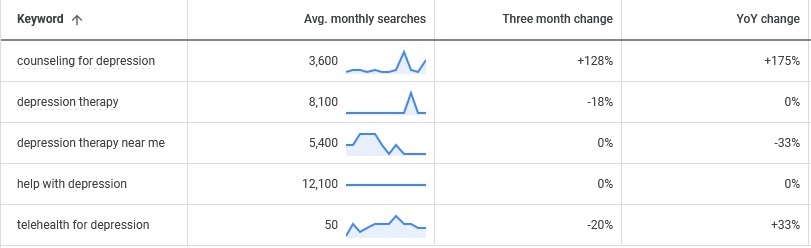
Because potential patients ARE searching for generic terms related to treatment, ranking for these search terms locally is incredibly valuable as a provider when trying to grow and maintain census. A single multilocation site is not nearly as effective at ranking locally.
Here are some examples of multilocation sites:
In order for a location page to rank on a single multilocation site, you have to cram all of the key terms you’re looking to rank for onto that single page. Mentioning the term once isn’t enough, you need to have a paragraph or two describing the service around the keyterm. Let’s say you’re a SUD treatment provider with detox through IOP. That one page has to have a paragraph on detox, residential, PHP, IOP, addiction treatment, alcohol treatment, opioid treatment, etc. etc. The page gets very long very fast. The Google bot is also the best at understanding single focus pages. If your page lists everything on it, it’s unsure if it should rank for any one of those terms, so it will devalue the page in the ranking algorithm versus a competitor that has a single page for each of those terms (which can only be done with a unique site’s architecture due to cannibalization issues as explained below).
The bottom line is that multilocation sites can and do work, but they are at a very real disadvantage. If you took two sites with the same “level of SEO”, one being a multilocation site and one using unique sites for each of their locations, the latter will win out in search rankings.
Option 2: A Unique Site for Each Location
Here are the advantages to a unique site for each location
- Much easier to rank in Google and Bing locally, which is the primary reason you should be building a multisite strategy. Google views behavioral health as local, so it prefers to rank local organizations. A large national site is at a disadvantage. (Yes, the Google algorithm is smart enough to identify a location page and rank that in the appropriate search, but it will not give a single location page as much weight as an entire site dedicated to that location.)
- A multisite strategy avoids cannibalization issues. Cannibalization is an SEO term that refers to sites on pages competing against each other in Google for a specific search term. The Google algorithm will only rank 1 page per site. Google wants to help people find choices that match their query, so if they allowed one site to take up all the page 1 spots, this would not be helpful to searchers. This is why Google only allows a provider to rank once per search result both in organic search results as well as Google Ads results.
SEO content must be strategically crafted according to an overarching plan. Google doesn’t rank websites, it ranks pages. For example, if your site has a page titled “Counseling for Depression” and another one titled “Depression Therapy,” you now have a cannibalization issue. Google will be unsure of which page to rank for a user search for “depression counseling/therapy” and related terms. We should note here that Google uses latent semantic indexing, so “counseling” and “therapy” are going to be seen as the same term in Google’s eyes. One of two things usually happens in a case of cannibalization, Google will rank neither page, or it’ll constantly swap out which page it ranks, which effectively lowers the page’s ability to rank higher. You can see how, in the image below, two separate pages are showing for the same search query “what is lean.” You’ll also notice how the pages are in constant flux, having months of ranking and then months of nothing. This is due to cannibalization on the site.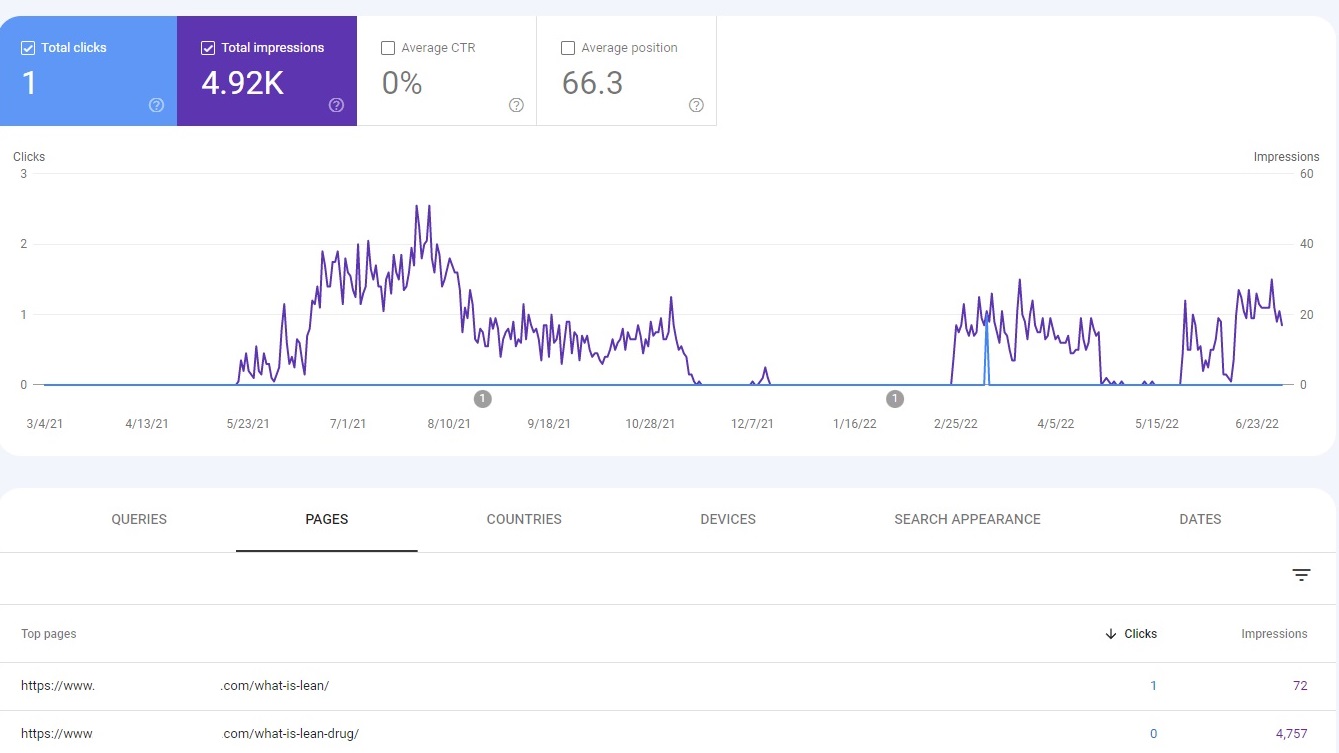
- Google’s limit of one page per query means that you cannot build out content silos for multiple locations. Let’s say you have a Plano, TX location and an Indianapolis, IN location, both of which offer the full range of behavioral health services. If you create a page for depression treatment linked up to your Plano, TX location, then you will not be able to rank for those terms in Indianapolis. You could try to reference and link to all your locations on the new depression treatment page, but trying to cram them all on will lower the page’s ability to rank for any one location as well as this being impractical at scale once you have more than 5 locations.
In short, you’re making it harder to rank locally than an individual site setup. Take a look at these results for “help for depression Chicago.”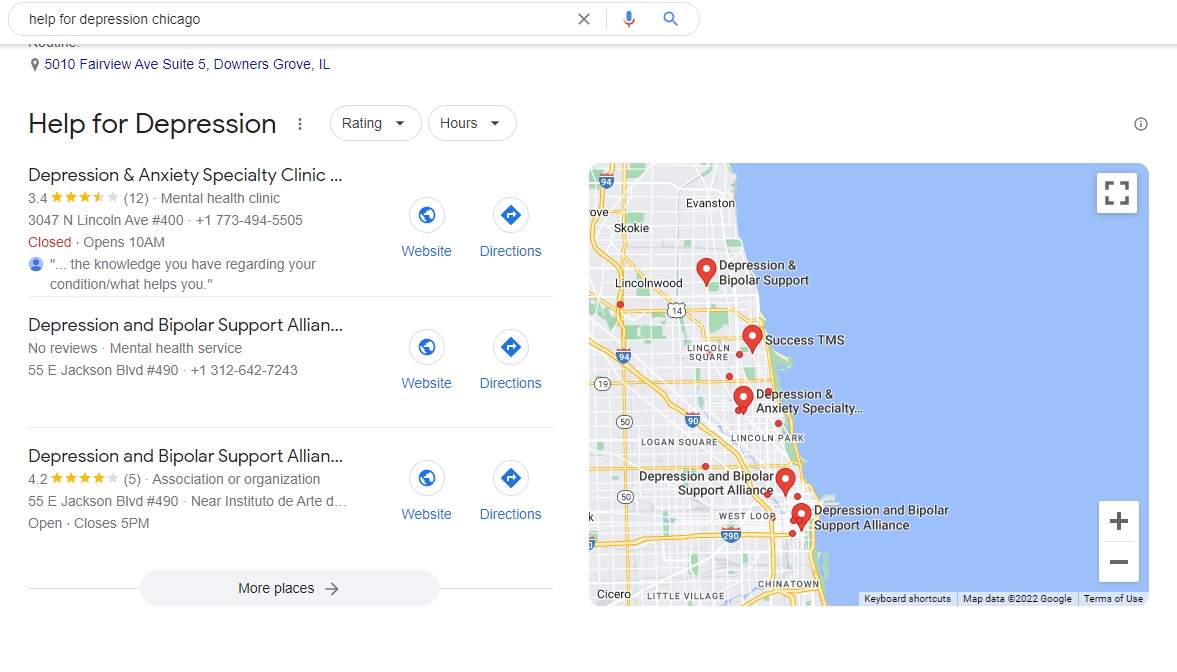
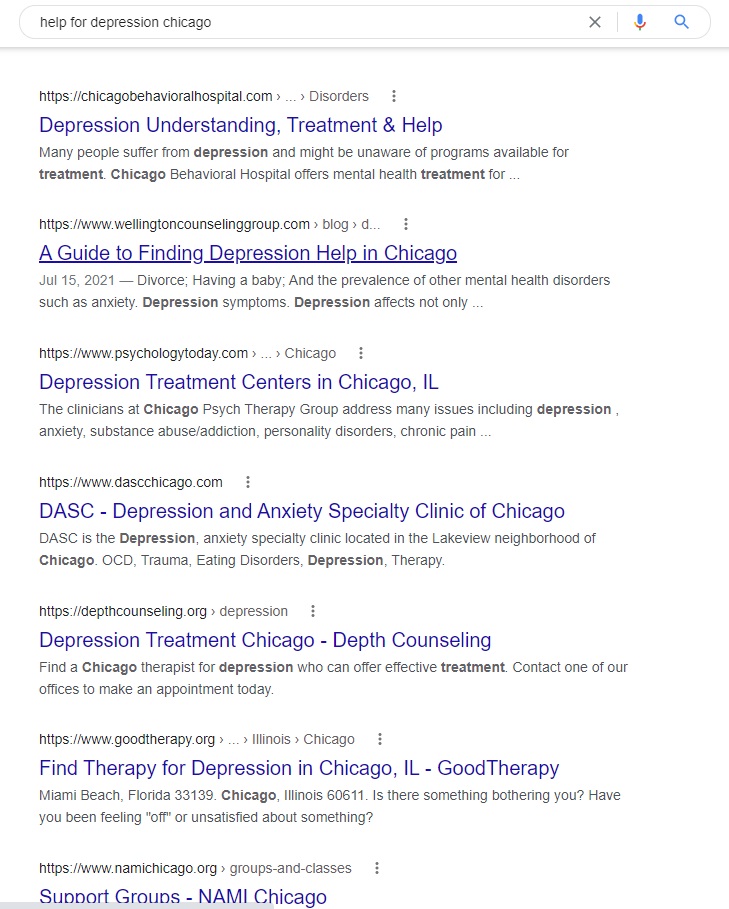
Note how individual websites are the top rankers in both the Map Pack and organic results. You will sometimes see aggregator sites like psychologytoday.com or goodtherapy.com ranking in results, but Google has been working to refine its algorithm to eliminate aggregator results as much as possible and will continue to do so. Additionally, aggregator sites are more likely to rank when individual sites in that area do not have good SEO built into their sites.
By having a site for each location rather than a single multilocation site, you can create a full array of relevant content per service line silo, which greatly aids your ability to rank in a specific DMA. - If you decide to sell a specific location, you can sell the website and all its inquiry and admissions volume with it. If you decide to sell off a location for whatever reason and are using a single multisite strategy, there is no way to carve off a single page in the sale. The acquirer will have to build their own site from scratch without any of the inquiries or admissions your SEO for that location may be generating. Since sometimes as much as 20% of admissions come from SEO searches depending on the service line in a given location, this significantly devalues the location’s valuation in the event of a sale.
There are, of course, some cons to having a multisite strategy. These are mainly cost-related. You will need to purchase individual hosting for each site, but this costs less than $1,000 a year, so is a negligible expense. The cost to build each website and then ongoing SEO for each can cost up to $100,000 per location, but, considering the fact that a good SEO strategy will both drive sizeable patient volume as well as create a moat on Google and Bing preventing competitors from ranking above you, this more than pays for itself. Let’s say your location sees 100 patients a month and your SEO strategy only brings in 10% of your volume, or 10 patients a month, and that your average lifetime value of a patient is $4,000. 10 patients X 12 months X $4,000 is $480,000 in revenue, a nearly 5X return on SEO spend with the average cost per patient acquisition at $833.
An ongoing SEO strategy gets stronger with time. The Google algorithm values time on the web as a ranking factor and your SEO team will continue to build out content that ranks. For a behavioral health provider that has done at least 24 months of SEO, we generally see cost per inquiry under $250 for commercially insured patients and under $50 for Medicaid from organic Google and Bing searches.
For a long time in the fragmented behavioral health space, most providers were standalone locations, meaning they had their own individual P&L and their own individual marketing budgets. Just because those locations have been rolled up into a larger organization or larger organizations are building multiple locations under the same brand does not mean they should no longer be allocated individual marketing budgets.
There is the opportunity for a large multisite provider to introduce efficiencies of scale into their marketing, but that will come from the aggregation of labor as well as SaaS tools, not a reduction in ad spend or SEO efforts. For example, it doesn’t make sense for an individual provider to hire a full-time SEO specialist, Content Writer, Copy Editor, Graphic Designer, and Web Developer to execute on a rehab center SEO strategy. With each role costing north of $50,000 per year plus benefits, that’d be over a quarter million a year simply to implement SEO. The reality is that you don’t want more than one new article per week, otherwise Google will start to see the site as spammy. So that team would be sitting around most of the time with little to do. This is why outsourcing to an agency makes economic sense for smaller providers. For larger providers, there is a tendency to want to handle marketing in-house. At 5 locations, it can make economic sense to have full-time staff in the aforementioned roles as there is enough work to keep them occupied across the locations and splitting their salaries across P&Ls is cost-effective.
However, now you’re moving out of your core skill set of clinical care and trying to build an in-house marketing agency that requires recruitment, training, and management. While it’s possible to do so, after having worked with over 100 providers, we have not yet seen an instance of an in-house team that does well. The reasons for this are generally three-fold.
- The organization doesn’t know how to hire for the disparate roles
- The organization doesn’t know what ongoing training to provide or how
- The organization doesn’t know what KPIs should be in place to hold marketing team members accountable for results at a granular, per role level
Instead, organizations tend to build in-house teams based on tasks. They “want more content” so they hire some content writers or they think they should “do PPC” so they hire some PPC specialists. But it never becomes part of a holistic, integrated strategy. A lot of bloat tends to come into the organization as marketing teams should be built around outcomes, not tasks, and the executive team has a hard time discerning if the results they’re getting are reasonable.
Here are examples of programs with individual sites per location:
- https://www.pyramidhc.com/programs/
- https://www.northpointrecovery.com/about-us/addiction-treatment-locations/
- https://www.foundationsrecoverynetwork.com/locations/
- https://vertavahealth.com/locations/
- https://delphihealthgroup.com/treatment-centers/
Option 2 (Continued): The Umbrella Site
Just because you have a unique website for each location doesn’t mean you shouldn’t also have an umbrella site for the organization. This site is mainly for payers and referral partners, but can also help with direct-to-consumer patient acquisition.
When individuals find your unique location sites, they will likely not understand that each location is part of a larger national organization, especially as you start out. But having a larger state, regional, or national footprint conveys authority to patients, referral partners, and payers. We recommend this umbrella site being the one that most payers and larger referral partners are sent to when looking for more information about your organization, and the content and layout of the website should be designed with them in mind.
You can also build out multilocation elements of your website here as well. This showcases to payers and referral partners how large you are. Each location page also has the potential to rank locally. Remember how we said Google will only rank one site per search term? That’s correct, so if you have two sites, it is possible to rank both for the same search terms (though, admittedly, not that likely).
If you build out enough content on this site, it can eventually rank nationally as well, which is unlikely to happen (nor would you want it to happen) for your local sites. 90% of admissions, even for residential/inpatient providers for the commercially insured come from a 150-mile radius around their locations. Unless you’re a specialty provider such as one that deals with high medical complexity, has specialized programs for a unique demographic, or caters to a high-income private pay demographic looking for concierge care, patients will rarely fly in or travel long distances for treatment.
An excellent example here is American Addiction Centers (AAC) which had some of the best SEO in the country for close to a decade, but only had facilities in a handful of states. Even though they ranked on page 1 of Google nationally for many coveted key terms, they still went bankrupt in 2020. Of course, there are many reasons for that, but it does go to show that ranking nationally doesn’t drive a sustainable number of admissions. At the time, AAC owned a multitude of websites from rehabs.com, addictionblog.org, drugabuse.com, recovery.org and many others. In total across websites, they were receiving over 8 million hits a month! Most treatment programs are lucky to break 10,000, so this is a phenomenal amount of traffic.
According to public presentations in 2018, AAC was generating 30,000 calls per month, but they only had an average daily census of 995, a conversion rate of 3.3% of calls. Comparing calls to site traffic, only 0.38% of that traffic turned into a call.
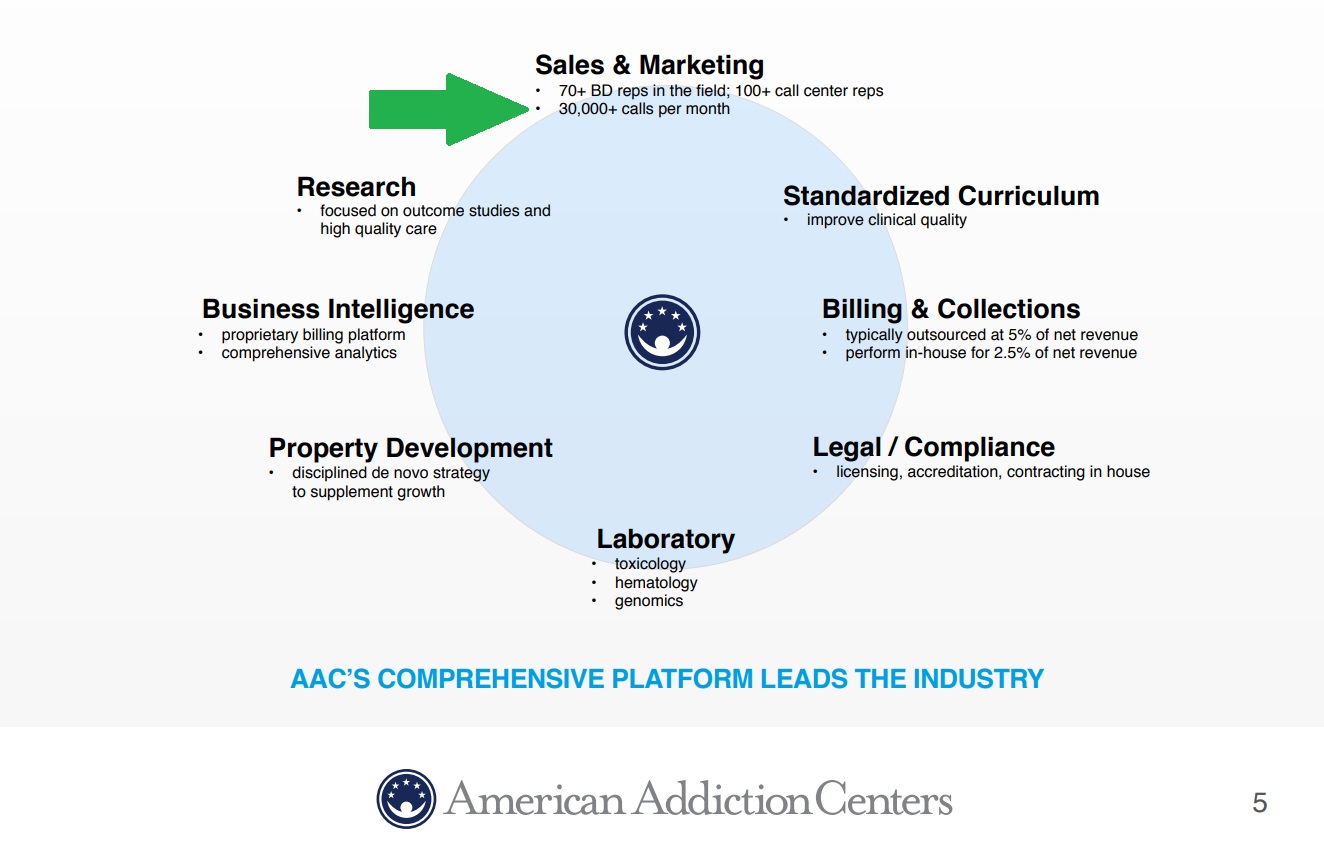
Sorting through 29,005 calls a month to get 995 that convert is an incredibly inefficient use of your admission team’s time. Their average cost per admission was $3,416. If we take $3,416 per admission times 995 admissions per month at 12 months, that’s a marketing spend of $40.7 million, 13% of AAC’s $318 million in revenue that year. As reimbursement per patient has continued to drop since then, a facility paying $3,416 per patient acquisition today would go bankrupt quite fast.
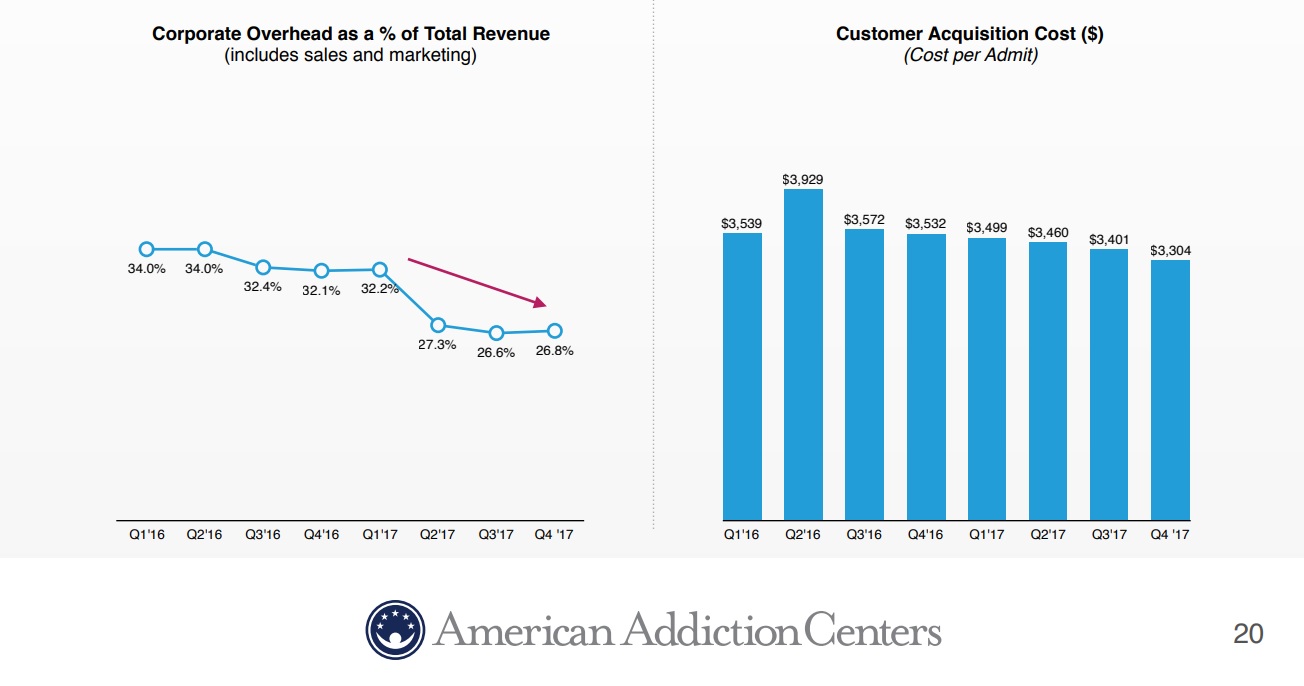
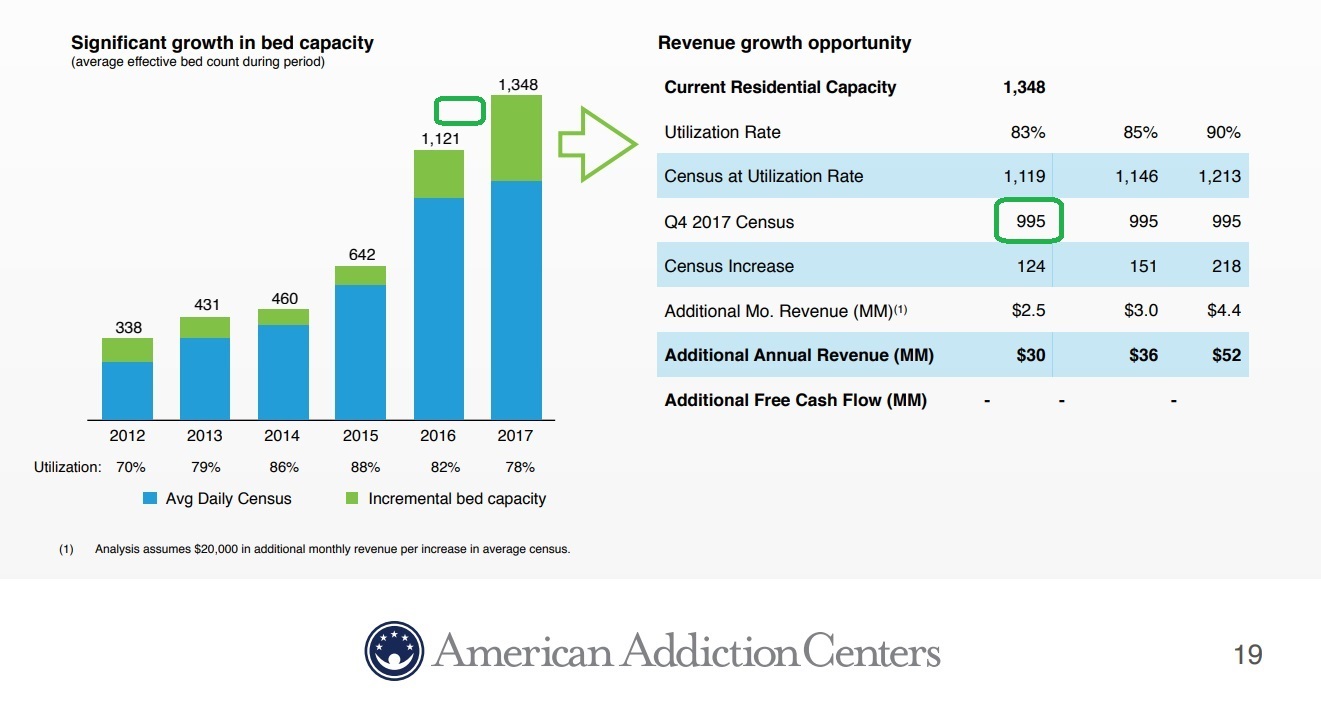
Having helped several large national programs convert from national marketing strategies to highly targeted local ones, we can state with confidence that much of this high cost was driven by inefficient marketing spend targeted to areas far away from where AAC had facilities because we’ve seen the same thing at at least four other large providers that had a footprint similar to AAC’s.
The old adage that “healthcare is local” is just as true for behavioral health as it is for physical health services. This is why AAC’s 8 million+ website visits per month didn’t translate into much patient volume. We have clients getting over 100 patients a month from Google organic search and they don’t have 1/20th the traffic of AAC. Our clients’ SEO works better because we focus on localized strategies.
For providers offering non-residential/inpatient levels of care, patients will rarely travel more than 10-30 miles. If they do, it’s because there is no other provider closer to their home and they will leave you for one closer as soon as one opens up.
If you achieve a level of scale where you have locations across much of the U.S., there is an advantage to ranking nationally. However, local rankings are what’s going to drive success the vast majority of the time, so any national rankings from an umbrella site should be seen as icing on the cake, not a core part of the strategy. And national rankings are only desirable once a provider has locations across much of the US, otherwise, as in our American Addiction Center’s example, you’ll be paying to field calls from patients not willing to travel to you.
On the flip side, we’ve helped many providers cut their call volumes down while increasing admissions. For one national provider comparable to AAC, we cut their call volume in half from 20,000 calls per month to 10,000, while at the same time increasing admissions by 33%. That reduction in call volume also came at a cost savings of 66% from previous marketing spend. This happened because incoming inquiries were more targeted and qualified, increasing the likelihood they would admit themselves as well as freeing up the admissions team to focus their time and effort on the right inquiries.
To wrap up, we’ll also mention that Google continues to focus on localizing its algorithm for behavioral health providers. In November of 2021, Google made an unannounced update to its algorithm that de-ranked pages of most SUD providers that had national rankings. Some of the larger sites lost as much as 60% of their traffic overnight. One provider that didn’t was, ironically, American Addiction Centers. However, looking at search results, we saw that AAC, along with a couple other websites, still had national rankings because the new algorithm update was viewing these sites as general resource sites similar to a WebMD. People searching for “addiction” might see AAC show up on page 1 of search results, but Google is assuming these people are searching for general information, not local treatment. Typing in “addiction treatment + city name” and AAC’s site was nowhere to be seen, meaning a lot of that national traffic retained by AAC is not valuable traffic related to patient acquisition.
Bottom line, behavioral health is local and so your website and its attendant SEO strategy should be as well.