
Telehealth is all the rage since the start of the pandemic with many startup providers receiving sky-high valuations. Talkspace is valued at $1.4 billion, Teladoc is valued at $24.1 billion including its acquisition of BetterHelp. Then there’s Lyra Health, Mindspace, Headstrong, Mindbloom, PlushCare, Talkspace, BetterHelp, Cerebral, Mental Health Match, Lemonaid Health, Lifestance, Brightside, and the list goes on.
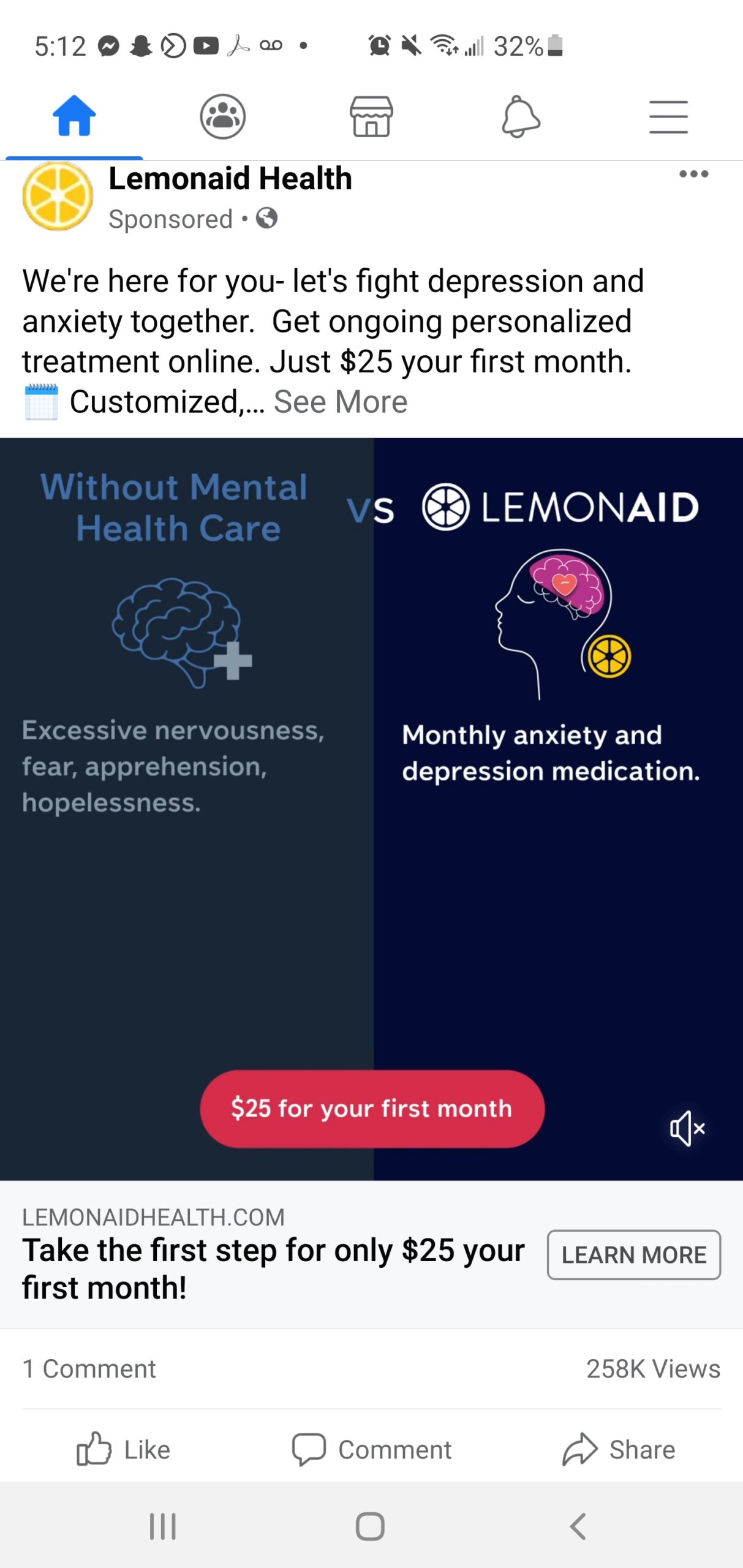
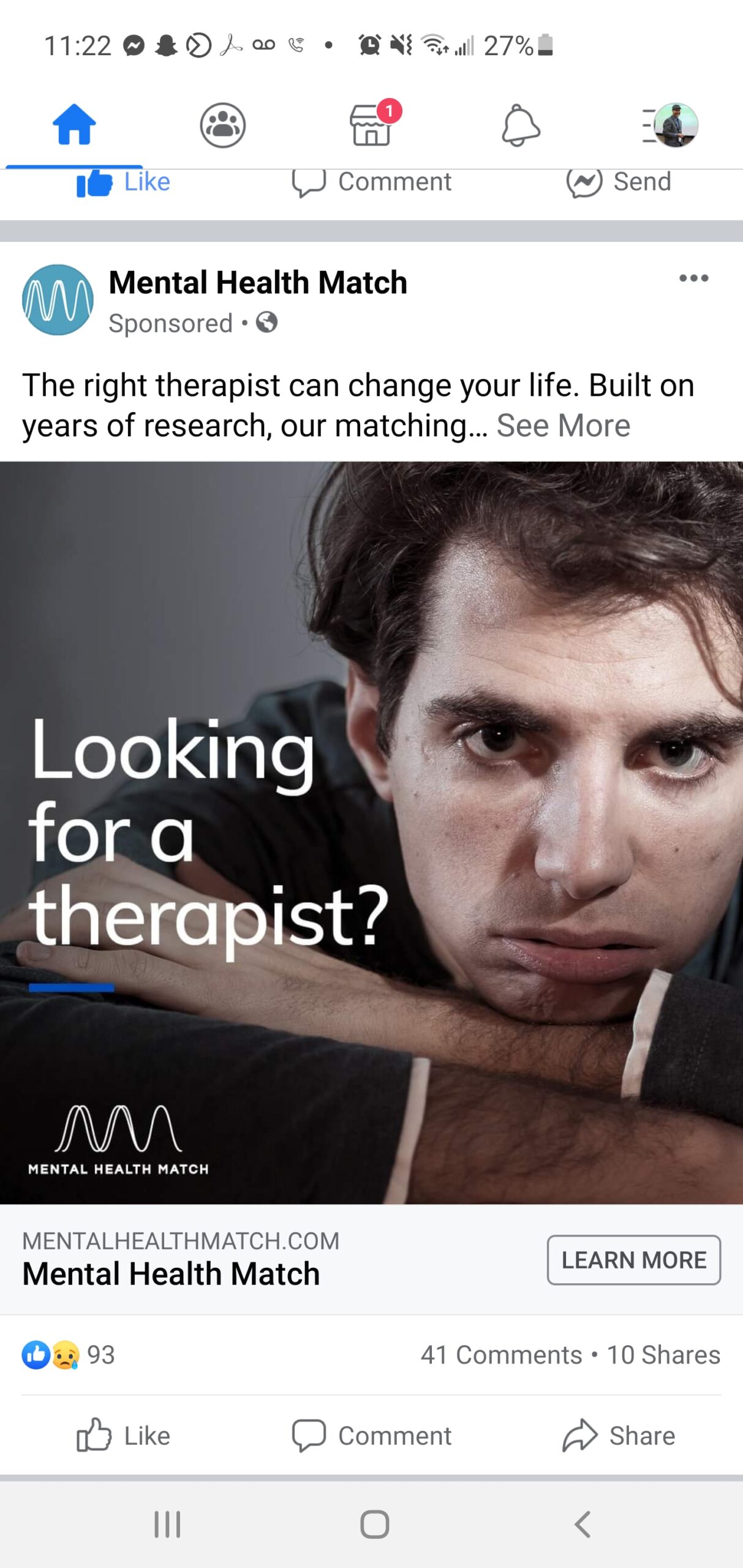
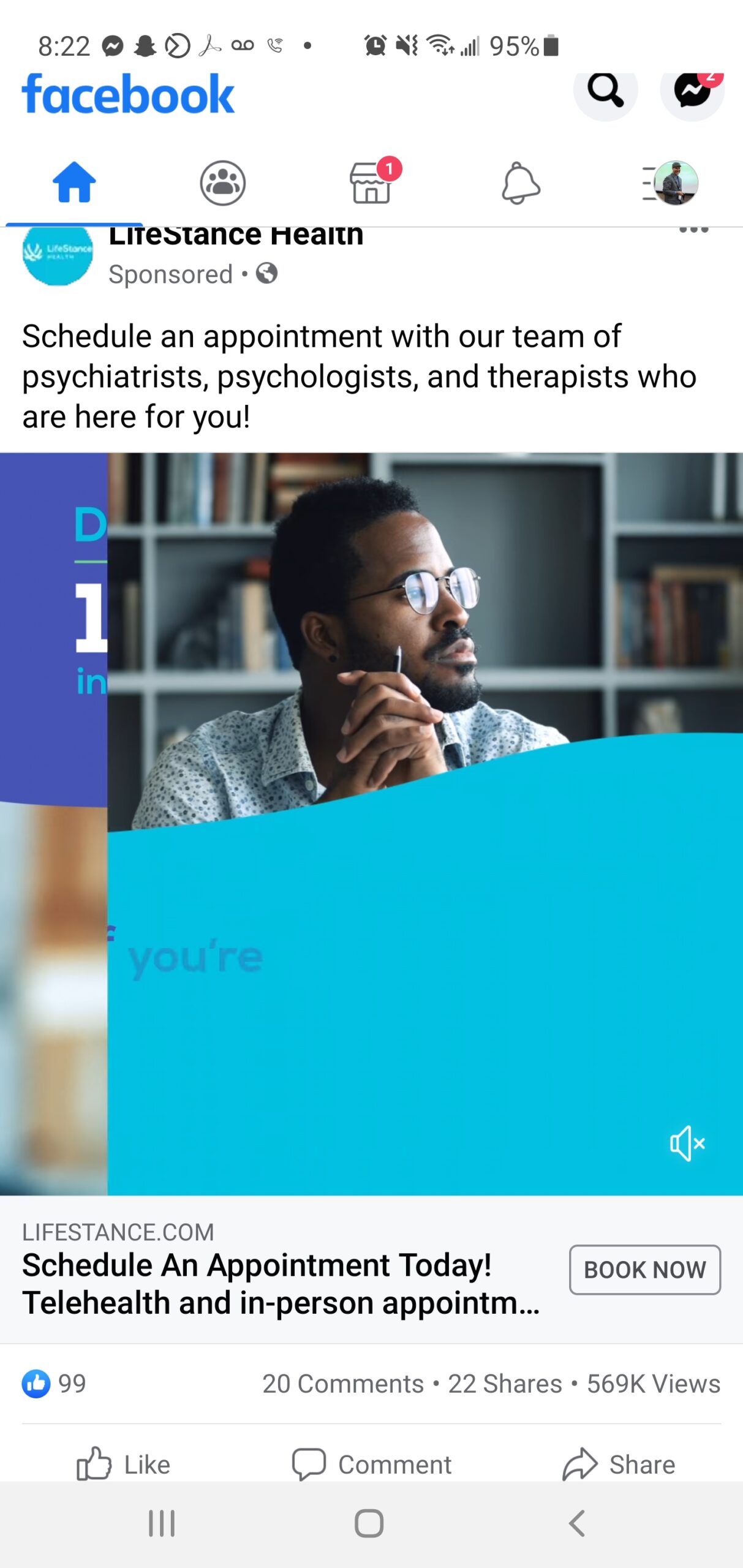

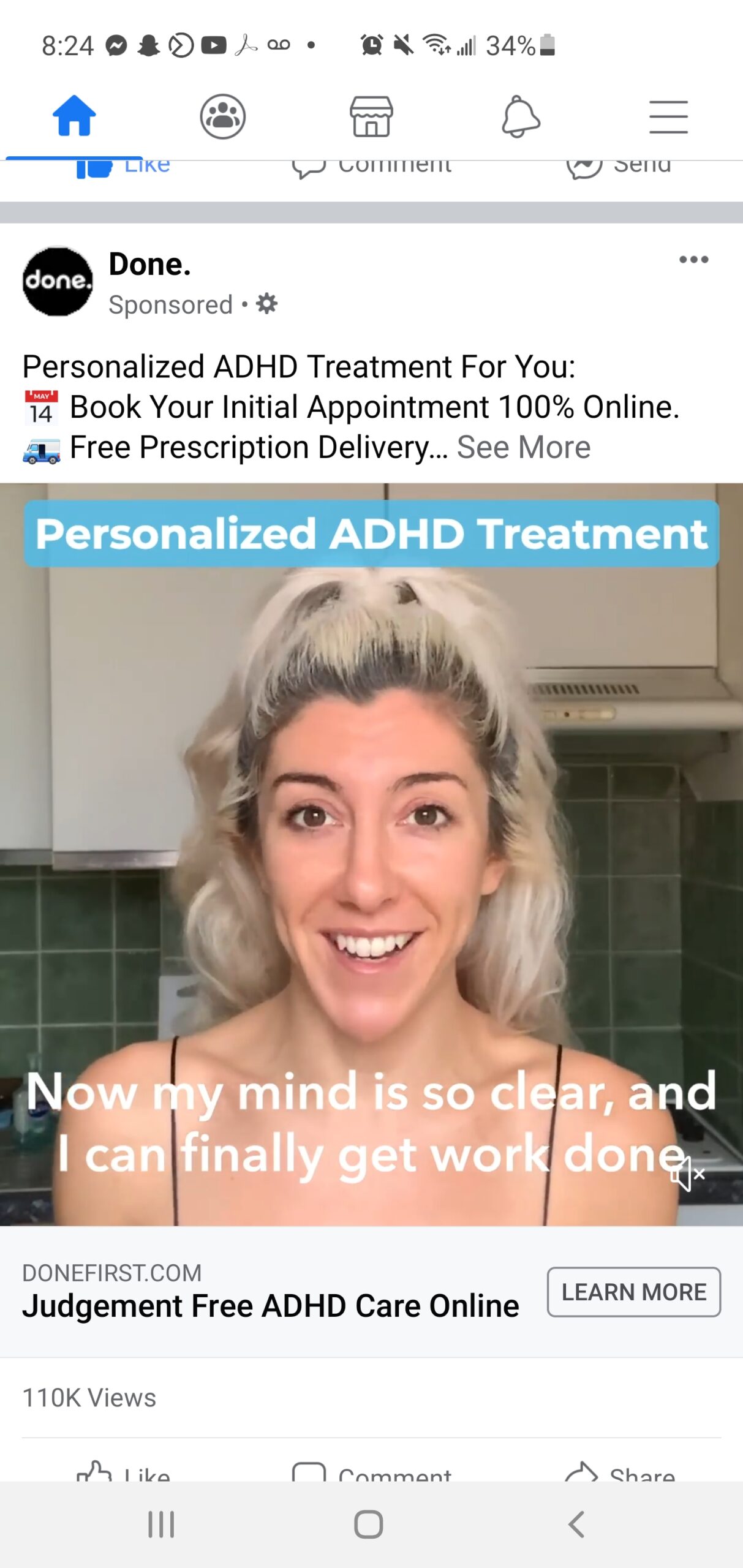

In fact, over just a 15-minute period on Facebook last week, I had more than 10 separate providers’ ads come across my feed. Here are just a few. Notice how they all say basically the same thing?
Talk about a crowded space!
Both investors and established providers see opportunity–mainly connection with the estimated 52 million Americans who struggle with mental health issues each year–through a model that doesn’t require costly and logistically complex growth tied to brick and mortar facilities.
It all feels a bit like the euphoria around the dot.com boom of the late 90s. Companies are being valued not because of profits, but because of simple association with a popular trend. While the opportunity seems clear, we can tell you that profitable execution is not nearly as apparent based on the long history of telehealth campaigns that we’ve been running since at least 2018.
Challenges in Telehealth for Acute Care Providers
Take Teladoc for example. The company went public back in 2015 and has yet to be profitable. Last year, it reported a loss of $485 million, which includes the BetterHelp platform it acquired in 2015. As of Q4 2024, BetterHealth is still unprofitable.
Talkspace only has 46,000 active members even though it was founded nearly a decade ago in 2012. Talkspace is projecting revenue of $125 million for 2021. Their lowest cost subscription is $260 a month, but only includes the ability to message therapists with a 24-hour turnaround time, so very low labor cost. Total potential patient revenue is only $3,120 to $4,800 per year assuming patients stay a full year, which is doubtful. Based on other app retention we’ve seen, we’d guess a 3-6 month ALoS. Patient acquisition costs are probably around $350 and we can assume a 30% labor cost given their model. So average profit per patient would be $1,560 to $2,400, about a 50% margin. You’ll also note they don’t have community outreach or call center staff. The cost model is dependent on users registering online directly to keep labor cost down.
This model works, but Talkspace and other direct-to-consumer telehealth providers strongly rely on volume. If after 9 years they only have 46,000 active members, we don’t see those numbers changing much. Covid certainly increased interest in telehealth, but it also increased interest from providers who have added on the service which means a lot more competition.
In our experience at Circle Social, pre-covid, getting people to sign up for telehealth programs was like pulling teeth. We actually needed specific scripts at the call center to convert them and, even then, patients were usually only willing to do so if no live sessions were available. Covid has changed that preference, but we don’t see that as a permanent trend as the pandemic starts to wind down, particularly for intensive programs requiring 3 hours or more of time per day.
All of our clients across the country switched to telehealth at the onset of the pandemic. While a few programs have gone completely virtual, the majority maintained inpatient programming, which is also the option the majority of patients choose for higher levels of care. After hundreds of thousands of dollars in spend, it became clear to most programs what we’d stated at the outset, telehealth is not the preferred entry point into intensive treatment programs.
Teladoc is a public example of a telehealth company that has struggled to become profitable after nearly 20 years in operation. Talkspace was profitable for a bit, but relied on a high volume model largely disconnected from insurance billing, something most acute care providers are not set up for. As they moved in-network, their marketing costs proved unsustainable for direct to consumer, which is why they’ve pivoted to B2B arrangements.
Talkspace went from $20 million in revenue in 2019 to $90 million in 2020, obviously a massive growth rate spurred by covid. While that’s a strong topline revenue growth trajectory, we see Talkspace as lacking a competitive durable advantage. Covid aside, 46,000 active subscribers after 9 years in operation is not that many, especially considering that, precovid, they only had around 5,500 active subscribers. We have more patients than that at brick-and-mortar outpatient clients operating in a single city, even ones that have been around a much shorter period of time. As more and more providers crowd into telehealth, there isn’t a strong case to be made for continued growth as the pandemic subsides.
For your standard intensive or acute behavioral health and addiction treatment models, simply transferring the current care delivery model from in-person to telehealth is, as we’ve seen consistently at Circle Social, unlikely to meet with the kind of success most providers envisioned. The increased cost of patient acquisition combined with a much more expensive care delivery model largely supported by insurance reimbursements make profitable telehealth programming more difficult. Instead, an increase in incremental revenue is the more common reality. Even with the Talkspace model, it’s much easier to get people to sign up for low-cost, on-demand text therapy than it is to commit to intensive therapy every day or multiple days per week. We think there is great opportunity for combining a Talkspace model with traditional acute care, which I’ll highlight later on in this article.
Why Isn’t Telehealth What So Many Think It’s Cracked Up to Be?
With all the high hopes and investment capital backing them, let’s look at why telehealth is unlikely to be a driver of scalable growth, particularly for intensive/acute care delivery models:
1) The space is already overcrowded. Not only are there the well-funded startups, some with nearly a decade’s head start, but, from the conversations we’ve had over the past year, it seems that nearly every investor and established provider has designs to try and reach every patient nationally through their own services.
There are currently over 200 digital mental health startups. Telehealth went from underutilized service to a commodity in less than a year, and commodities are rarely profitable long-term.
2) There is no barrier to entry. Any provider with a HIPAA compliant Skype or Zoom account can offer telehealth services, again making the service a commodity. Sure, you can build your own proprietary interface, but why reinvent the wheel at higher cost for little difference in functionality and outcome?
3) The marketing costs are astronomical. The more people you want to reach, the more money you have to spend. But, as we all know, it’s not enough to simply reach people. This isn’t some kind of territory play where first movers in a geography somehow get all the patients. You have to reach them, engage them, then convert them, all requiring considerable spend.
As any private therapist will tell you, patients attending outpatient services are hard to retain. On average, 25% will only show for a single session. Canceling sessions is common and retaining patients long-term is the exception rather than the rule. This is why most of the telehealth startups use a subscription model independent of insurance reimbursement.
Additionally, you have to out market the local competition. At its core, marketing is about building trust. Even if it’s telehealth that can be done from anywhere, a patient is more likely to go with someone they trust, which is almost always going to be a local provider. So each local market you go into requires an uphill battle in terms of capturing market share.
4) There are no differentiators in the basic model. Patients and payers don’t care about the platform. Those are easy to build and deploy. Ginger (discussed below) has value because it has long-term contracts with employers that are likely to be quite sticky. Talkspace, on the other hand, merely facilitates the connection between a therapist and a patient, something the patient, or any other provider, can do just the same. Any telehealth platform that serves as nothing more than an intermediary is unlikely to have long-term viability in the marketplace.
5) Based on our own data, we estimate there are between 30,000 to 50,000 potential behavioral health patients per month looking to attend once-a-week therapy per metropolitan statistical area (MSA). These would be patients actually seeking treatment, which doesn’t include the oft-cited patients that have a diagnosable disorder but are not currently seeking treatment. In behavioral health, most people who could be eligible for services often do not have a desire to seek them out. This would put the market cap nationally somewhere between $8 and $14.5 billion for outpatient behavioral.
The outpatient space sees 8 times as many patients as inpatient, but reimbursements are much smaller and delivery of care is much more logistically complex due to the increased volume of short-term sessions. The same challenges that have always existed with the outpatient model exist within telehealth. There are models that work, but packaging face-to-face acute care into telehealth programming is not the most attractive of them.
What Telehealth Models Look Attractive?
There are unique models that seem to be working very well, like Ginger. Ginger is another telehealth unicorn with Blackstone most recently investing in them. Their baseline services (companies with under 600 people) sell for $30,000 a year to employers only, which, in our opinion, is a much smarter model than trying to go direct to consumer. They also have some large clients like Delta Airlines which we can guess pays at least 10 times that amount. They had 200 clients as of 2020, with revenues estimated at around $90 million.
Let’s say you’re a company with 500 employees. Ginger’s baseline cost would break down to about $5 per employee per month. That’s not a lot of money for the employer, so a fairly easy sell. Ginger is making $2,500 per month. The average EAP utilization rate for behavioral health is around 3% (which is why EAPs as outreach targets are not particularly attractive), but these lighter touch services can go as high as 20%. So maybe 100 of 500 employees using the service (likely in mostly 15-minute chunks, but could be an hour or more for heavy users). Ginger’s fee only covers coaching, not licensed therapists, so that’s probably a staff cost of $15 an hour and say the employer’s staff utilizes 50 Ginger labor hours per month, that’s only $750. That’s a solid 70% margin if accurate.
So while Ginger is a slow-growth model due to B2B client acquisition, they potentially have very high margins. Unlike an insurance company that has to pay out sky-high claims, Ginger has a fairly fixed cost of on-demand therapy and coaching services with only standard labor cost. Since most interactions with Ginger are less formal, it’s likely a user’s average interaction with a provider is only around 10-30 minutes. That’s a very workable model. Insurance providers, such as Cigna, are starting to add on their own telehealth services as well, so we see this as threatening Ginger’s current model unless a payer decides to acquire them rather than build their own tools and services.
Another successful model is Calm. Mental health services have always been labor and capital intensive, making profitable growth at scale much harder to manage than a subscription app like Calm’s. Calm has an annual charge of $69.99 or lifetime subscription of $399. This is extremely affordable for the average person, which is why Calm has top-line revenue of $150 million off of 1 million subscribers. Calm is an app with no costly interaction from a licensed therapist, enabling them to scale profitably.
Note how both Calm and Ginger are basically just apps with content. Even for the majority of the labor portion of Ginger’s model, its low-cost coaching has no need to involve insurance or expensive therapists. These models are stronger because they are low-cost, sticky, or, like Ginger, have strong, long-term employer contracts.
What Are the Features of a Viable Telehealth Business Model?
It should be clear that growing telehealth marketing nationally is not merely a simple process of transferring acute care from an inpatient model to an online one. Since 2020, Telehealth has become a baseline service that all providers need to have. However, there are several major opportunities with virtual telehealth platforms.
1) It is an excellent complement to residential services supporting step-down levels of care. If you have a patient travel halfway across the state for residential, they are going to want to go back home for intensive outpatient and outpatient services. Where you might previously have had to refer that person out or see them disconnect from care, now you can continue treatment.
Telehealth allows for the addition of incremental revenue by increasing ALoS across the entire continuum of care, which is one more reason that providers with fuller continuums will be more successful.
2) Many potential patients are looking for a light touch–help with smaller problems. Maybe they had a bad day at work or a fight with their spouse. These are non-billable events, but they are the entry point for many into the world of mental health treatment.
This is why we see apps like Calm, or Talkspace and Ginger’s coaching services, working successfully. They are meeting the demand for light touches on smaller problems, all at extremely affordable rates. There is a lot of opportunity for potential patients to enter the continuum of care through coaching or app engagement as well as the opportunity to continue recovery supports post-intensive treatment. Telehealth delivery is perfect for these services.
So a provider acquiring a company like Talkspace, then creating a system that identifies and enables the smooth transfer of referrals to higher levels of care would be extremely valuable.
3) Employer contract carve-outs. Ginger was smart. Rather than seek a behavioral health carveout from insurance, they came in as a low-cost mental health app and coaching service for employers. They then later started to add on reimbursable therapy visits as an additional option.
This requires low labor cost on Ginger’s end and the model is subscription-based, so they get paid either way, meaning they don’t have to worry about maximizing clinician time with patients.
4) There is probably opportunity for very niche markets such as rural areas, peripatetic military families, and the disabled. But these markets are small. We’ve worked with telehealth initiatives in rural areas and high-speed Internet accessibility is still a major barrier. For the disabled, most are on Medicare, so more viable for behavioral health than addiction treatment as far as standard payer contract mix goes.
Telehealth expansion, both by providers and insurance payers, has been a welcome addition to the care model, one that lowers barriers to treatment by increasing accessibility and, in some models, lowering the cost of care.

We also think there is tremendous opportunity to connect with individuals struggling with episodic, rather than long-term diagnosable, problems. There are far more people that need everyday, routine help than there are who need acute care. Intervention at an early stage also will likely help reduce the onset of longer term problems, something our current models have been unable to do. The challenge is the complex logisitics and low overall reimbursement.
However, like any business model, making it work requires a sophisticated understanding of what’s actually needed in the marketplace and the ability to execute that differentiates one program from another. Good luck out there!