
As the coronavirus, and its attendant state-wide lock-downs, have progressed in the US, a number of new challenges have emerged for addiction treatment and behavioral health providers. Unlike other industries such as hospitality or service, behavioral health is faring quite well and many of our clients have even seen an uptick in admissions. However, this is not the case for everyone and clearly additional challenges are being faced even if census is doing fine.
Here at Circle Social, we monitor a little over 2.5 million website visits and 40,000 calls a month across all of our clients, so we have a very good grasp of the data trends happening in this space. Starting the 2nd week of March, we started to see an impact on client call volume. On average, website traffic and call volume dropped by 10% from March 9th to the 15th. It then dropped another 10% from March 16th to 22nd, so a total drop of 20%.
Now, that’s in the aggregate, not uniform. Some clients have had larger drops and some have seen none at all. However, throughout this, we have not seen a significant attendant drop in admissions yet. What seems to be happening is that those who are often calling for questions, or just shopping around but not urgently seeking treatment, have decided to hold off. While those who need treatment are still seeking it just as urgently.
As our commitment to the field is to help providers and patients whenever possible, rather than send some lame email stating, “We’re here for you,” we have created a basic overview guide of actionable steps you can or should be taking to both prevent rapid spread of the virus as well as maintain revenue and business operations successfully.
There are currently three other factors driving either the same or an increased level of admissions:
- Some providers have closed their doors, so that demand is going to the providers staying open as supply dwindles.
- As people get stuck at home, in their own heads, with little to do, and possibly surrounded by family who either aggravates or simply becomes more aware of addiction and mental health issues, people are being driven to seek out more treatment. (We’ve heard some evidence of this on calls, but we’d say not to a degree that this is more than a supposition at this point).
- Workers, who before could not take the time off of work, particularly those in the hospitality, tourism, and restaurant industries, suddenly have the time to seek treatment without fear of losing their job while in treatment.
However, there are still a number of challenges arising for providers during this time.
- The virus itself is a concern in terms of preventing contagion in facilities, especially if you’re dealing with those who have compromised immune systems or are 70+. Those serving the Medicaid community are presented with the most challenges in this regard as those individuals are more likely to have attendant health conditions.
- A move to telehealth. To lower risks of contagion, staying put is recommended, so there has been a big push to online delivery of care for IOP and below, also a canceling of outside meetings, field trips, etc. (which potentially leads to additional AMAs as people get restless).
- What MAT providers can do in this regard as well.
- Those interested in admitting are not following up to the same degree. Call backs with VOBs go unanswered more often, or those who say they are coming in simply don’t show.
- As individuals get wind of what’s happening in the outside world, or families become more panicked, AMAs are increasing.
- Cash flow is becoming a concern. While addiction treatment and behavioral health are set to weather the storm much better than many other industries right now, the most recent state-wide shelter in place orders are showing evidence of a slow down in admissions as people fear or are dissuaded from leaving their homes.
We’ll talk about addressing all of these.
Screening and Protocols for Preventing Transmission of the Virus
Obviously, the first thing that you need to do is implement screening procedures for both staff and patients entering the facility. A challenge here is that the regular flu and coronavirus symptoms are basically identical. So, to err on the side of caution, anyone with flu-like symptoms needs to be immediately quarantined or sent home to self-quarantine.
The main features to screen for are:
- Fever of 100.4 F or higher.
- This is the most accurate giveaway and anyone with a fever should be quarantined or sent home.
- Runny nose
- Runny nose without an accompanying fever is unlikely to be coronavirus.
- Cough
- A cough without an accompanying fever is unlikely to be coronavirus.
- Respiratory issues. This is the main differentiator from the normal flu, but 1) can also accompany the common flu and 2) is not present in most cases of coronavirus, only the more serious or severe.
Symptoms range from barely noticeable to severe, so the only full-proof way to know is to use a test kit, but those are not widely available. Fevers of 100.4+ or respiratory issues are the best screens at the moment. Every facility should be taking temperature checks of staff and patients before they enter the building each day.
Viruses are most easily transmitted in close quarters or when people are close together inside for longer periods of time. So testing outside the facility is best.
These screening procedures both help keep people safe as well as provide assurance to patients and families that appropriate precautions are being taken.
In addition, a number of protocols should be instituted to further mitigate transmission.
- Daily and pre-admission screening, as we just covered.
- No outside meetings or field trips until the situation starts to resolve nationally.
- Institute telehealth delivery of services whenever possible (more on this later).
- Frequent cleaning of all surfaces, especially those most frequented like restrooms or the front desk.
- Suspension of in-person visitation by family. Obviously, phone or virtual visitations should still be allowed.
- Ensure both staff and patients know what symptoms to be on the lookout for and who they are to report to immediately upon manifestation of any symptoms. Reinforce this daily.
- Also, daily reminders on proper hygiene around covering their mouth while coughing/sneezing, washing hands, etc.
- Designate one person to monitor any federal, state, or CDC announcements on updated guidelines. We still don’t have all the data we need, so recommendations on how to prevent and address the virus are being updated daily.
How to Provide Telehealth Quickly and Cheaply
With incredibly rapid turnaround times, we’ve seen our clients get approval from insurance providers to deliver all services via telehealth. Most of our clients are doing this for IOP levels of care and we’re even seeing it done for PHP levels.
We’re not sure if this is a blanket provision yet, but we know that insurance providers have been approving this quickly for anyone who asks. Talking with those leading the SUD divisions of a couple of the payers ourselves,, they are establishing this as a priority as they recognize the need of their members to still be able to access services in the current environment, especially as free support groups such as in-person AA meetings have been shut down.
There are a number of software solutions out there for providing HIPAA-compliant telehealth. Some EMRs, such as Alleva, or KIPU through PingMD, also have these features built in, and we know other EMR providers are working on solutions. However, this can just as easily be done using cheap tools such as Skype for Business ($35 per user per month) or Zoom ($200 per month).
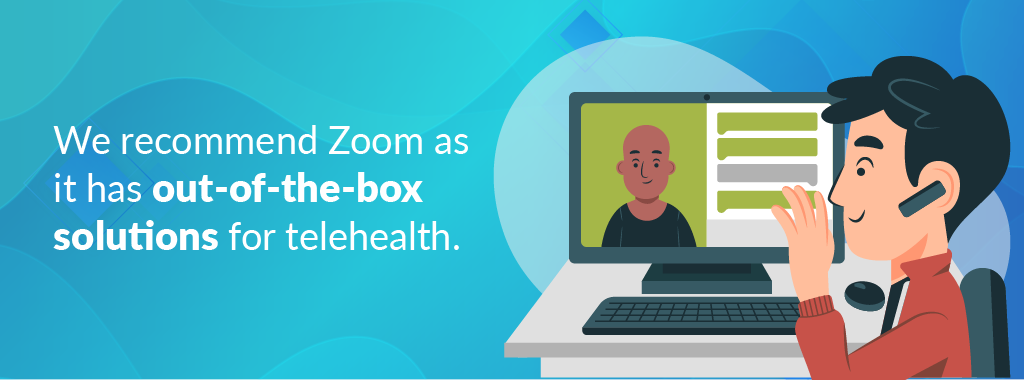
We recommend Zoom as it has out-of-the-box solutions for telehealth, although you will have to get on the phone with sales to get a BAA to sign.
Skype is a little more complicated. You actually need a Microsoft E3 or E5 package that includes Skype for Business, and the automated log feature needs to be enabled for proper storage of communications. Then the BAA needs to be downloaded here. Also, technically, both users should have a HIPAA compliant version of Skype running, so you would need to pay for a license for each patient and ask them to install on their computer as well. Note that the free version of Skype is NOT HIPAA compliant.
Another solution is Luxsci, though they are pricier, starting at $500 a month. We also don’t know anybody that has used them, so can’t comment on the effectiveness of the solution.
Then, all you need to do is deliver the same exact sessions and groups you were doing previously, but with everyone attending virtually instead of in-person. It’s actually really easy.
How MAT Providers Can Reduce Exposure
Many states and payers are loosening requirements around face-to-face visits for first-time subscriptions. Medicaid and Medicare have already loosened such requirements at the federal level. So these can be moved to telehealth using the options we outlined above.
However, there is still the need of in-person visits to access medications. The main tactic we suggest here is staggered access to the facility. If you have not already done so, break the day up into blocks and assign each patient a block of time. For example, 8 to 10:45, 11 to 1:45, 2 to 3:45, and 4 to 6. This way patients won’t all be coming at the same time, so you’re better able to get them in and out while maintaining social distancing recommendations of at least 6 feet. This also gives staff more time to clean surfaces between blocks.

Increasing Commitment and Follow-up with Prospective Patients
While we’re seeing conversion rates from call to VOB or call to commitment to admit remain fairly stable, we’re seeing a higher percentage of “Unavailable” for the follow-up. More people are not answering the phone when you call to confirm a VOB or they are simply not showing up when they said they would.
What can you do to help this? The first part is psychological. You need to ensure admissions reps are getting patients and families to finalize concrete plans on the phone:
- What day and time are you coming in (ask them to be very specific).
- How will you get here?
- Let them know who they’re meeting. It needs to be clear people are expecting them and, if they don’t show, people will be worried and possibly going out to search for them.
Then reassurance is extremely important. Even if they don’t bring up the coronavirus, they’ll be thinking about it after the call, so this needs to be addressed.
- Reassure them this is the right decision and that now is a good time. If they have not discussed the coronavirus on the call yet, then the rep needs to bring it up. State clearly the states have made sure healthcare providers stay open to meet the needs of people like the caller. Now, with isolation and uncertainty increasing, it’s more important than ever to ensure people are getting the care and support they need, as they could get much worse under the circumstances.
Set more frequent and concrete follow-ups between the call and the admission.
- Setup concrete follow-up calls. For example, “OK, you’re arriving in the morning at 10am and will be meeting Eric at the entrance. I’m going to give you a call at 8am tomorrow morning just to make sure everything is OK. Is that alright?” Also, “I’m going to send you our welcome packet after I hang up. To ensure it doesn’t go into spam, please reply to me that you’ve received it. Then, once you look it over, reach out to me with any additional questions.”This could also be another opportunity to connect. “I’m going to send you our welcome packet. Take some time to read it over today. Someone from our team will give you a call in 3 hours, at 4pm, to go over it with you and answer any additional questions you may have.”The whole key here is maintaining contact, building rapport, and helping them crystallize all the plans, and reassuring them that this is the right move now. Note the logistics required of the follow-ups though. Rather than each rep managing that schedule, it would be better for a rep or reps to be assigned purely as follow-up people. Their schedule can be broken into 15-30 minute blocks in a Google sheet accessible by the team, and they can then add the name and phone number in available time slots for call back. Note that PHI should not be added to that sheet to maintain HIPAA compliance.
AMA Blocking Protocols Need to Be More Robust and Virus-informed
In addition to your current AMA blocking protocols, you should be adding a couple more.
- Adding activities. AMAs most often happen when people have too much time to think in their own head. And news of the virus will only amplify uncertainties and anxieties. Even if it’s not work specific to recovery, make sure patients have something to do, especially in the evening and on weekends.This can be fun group activities like playing board games together. Or it can be an assigned task like journaling or homework time. If it’s a more solo activity like journaling, behavioral health techs should be stopping in more frequently and checking both progress and patient mood.
- Talk openly about coronavirus protocols that you’re taking at the facility and provide news about what’s happening outside. Emphasize that this is the best and safest place for them right now due to the fact that you have trained medical professionals on staff and have stricter screening procedures and protocols than the precautions the average family is taking when they go to the grocery store.
- Potentially increase family communication. We’d recommend that family calls only take place in conjunction with a therapist, particularly if the family members are more anxious themselves. A good alternative here can be to relay messages. Maybe family calls are limited to once or twice a week with a therapist, but messages are taken and relayed with a behavioral health tech as the go-between.
- During this time, families may be just as likely to encourage an AMA if they don’t feel certain their loved one is safe. So increase family communication as well. This could be email blasts to families, text updates, or just calls. Let them know all the precautions you’re taking and keep them updated on how things are progressing both at the facility and with their loved one.

Stay Lean and Monitor Cash Flow
While most providers will be fine, it’s never a bad idea to monitor cash flow. Look at ways to generate cash to build out the rainy day fund in addition to opportunities to cut cost.
Here are the most common areas where we see excessive cost:
- Labor: Labor is always the largest cost to providers. If you do have reduced admissions, some staff may need to be put temporarily on part-time. Usually, we notice many staff are underutilized. Are clinicians working at least 20 clinical hours a week? Can they do more with the right systems and supports in place? If structured appropriately, most clinicians can handle between 20 and 30 clinical hours a week.If labor is more than 50% of your budget, you’re definitely running with a high labor cost for any program over 10 beds. Small IOPs and MAT clinics would be an exception to this as labor is generally a higher percentage of revenue there.
- Food and Medical Supplies: If you’re buying food and medical supplies (including medications) from local suppliers, it’s highly likely you’re paying too much. We’ve seen as much as an 80% reduction in costs when food and medical supplies are done through Group Purchasing Organizations (GPOs) and other more professional services with economies of scale in place to lower cost.
- Marketing: It’s been our experience that as much as 80% of marketing budgets, particularly digital marketing, are wasted by providers. Just in the past year and a half, we’ve come across multiple providers with cost per admissions (CPAs) of $15,000 to $23,000! Or we’ve seen $10,000 a month going to SEO that was just spammy or blackhat link-building that was actually hurting their rankings, rather than helping.Marketing behavioral health requires a specific skill set and deep knowledge of the space. Oftentimes, providers hire agencies or individuals with no experience in behavioral health because they fear that someone more knowledgeable will “steal their secrets” and share it with competitors. While that would obviously go against an NDA, the alternative is wasting tens to tens of thousands of dollars a month and paying 15-23K an admit.It doesn’t make sense to throw that much money away, but we see it all the time. Just like you wouldn’t want to hire a lawyer without a background in behavioral health law, or a therapist that’s never worked with addiction before, you don’t want marketing vendors or staff without specific experience for the same reasons.
We should also note that none of the providers we’ve gone into knew they were paying that much. We’re always told CPAs are around $1,000 to $3,000 for digital PPC or under $1,000 for SEO before we engage. But when we go in, nothing was being tracked or assessed accurately, and actual costs are 10-15X higher. In fact, we’ve helped a number of providers literally cut their marketing budgets in half or in two-thirds and still retain the same number of admissions each month. That’s some pretty serious savings for cash flow or reinvestment.
- Subscriptions. Having your Controller or CFO look over every subscription you have is always worth doing. It’s not uncommon to find services that haven’t been used or have been barely used that you’ve been paying for for months or even years.The best way to do this is have someone go through your latest monthly invoice and identify all subscriptions. Then that person should track down what it does and if/how it’s used. From there, you can cancel anything you no longer need.
- Billing: Billing can be the bane of existence for some providers. It’s very hard to find a good billing company and just as hard, if not harder, to hire in-house for it. We’ve seen providers getting reimbursed as little as 8% of all billed charges, or with millions of dollars in 90 day+ A/Rs. We’ve even seen providers entering people into programs at the wrong level, costing them hundreds of thousands in either missed billing or insurance clawbacks.Documentation and proper VOB screenings are also a large area where many providers struggle, resulting in significantly lower reimbursements. If you’re getting lower than average length of stays approved, or frequent UR requests, this is why.
- Length of Stay: This is a big one that many people fail to look at. Are you getting your full length of stay? We’ve seen programs where 50% of admissions are being discharged halfway through the program!This happens because either proper screening is not being done during the admissions process, so patients who aren’t a fit are getting admitted and then discharged. Or clinicians are discharging patients early for a variety of reasons.Always ensure you’re tracking length of stay as a key metric, and check monthly if patients are staying their full length of stay. If not, you better fix that as soon as possible. We all know 30-60 days is not enough time to heal from addiction or mental health issues, and the longer they’re connected to treatment the better. So your clinicians should be fighting for longer lengths of stay.
This also obviously connects back to AMA blocking above, which can be a factor if AMAs rather than administrative discharges are the primary factor reducing lengths of stay. Usually, it’s a bit of both.
- Sale-leasebacks. If you own your real estate, that means a lot of your capital is locked up, just sitting in a building and not being able to be used for growth or other investment. A sale-leaseback means you sell your real estate to someone else, and then start paying them a lease. It’s an alternative to loans, and can give you a cash injection fast at better rates. If that’s something you’d like to look at, get in touch with us and we can walk you through options.
Once you’ve identified opportunities for cost savings, we always recommend creating a cash reserve. Ideally, your business has enough cash in reserves that it can operate for 3 to 6 months continuing all current operations, but with no income. So if it costs you $100,000 a month to operate your facility, you should have $300,000 to $600,000 in reserves for times like these.
This is extremely important, as some providers are realizing, because it creates huge opportunities. While providers with less reserves have to cut back on marketing spend or maybe shut down entirely, you’re actually able to maintain or even increase marketing spend as the crisis passes, allowing you to grow. Cash reserves can also be used to make acquisitions of providers that weren’t so well prepared at lower valuations.
Need some help in any of the above areas? The team here at Circle Social are experts in operations and marketing for addiction treatment and behavioral health. Through even smaller one-month engagements, we’ve helped providers save millions a year in expenses while delivering the same and/or better results than before. For ongoing engagements, we’ve helped providers as much as triple revenue within 6 months.
We can help you reduce costs now to weather this bump in the road or, in a couple weeks when things start to return to normal, we can help you capitalize on all the growth opportunities that always follow such massive shifts in the overall landscape. Get in touch at 800-396-9927 or engage@circlesocialinc.com