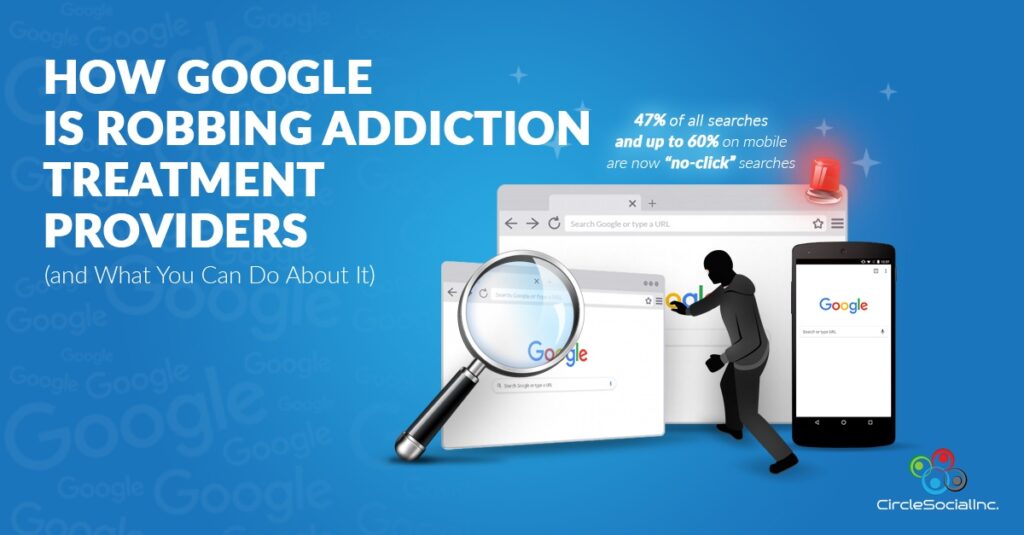
One of the major trends affecting addiction treatment is that SEO and consumer search is more and more being affected by Google’s local search algorithms. In addition, a trend towards no-click searches is also appearing as Google removes the need for users to actually visit websites to get the information they want.
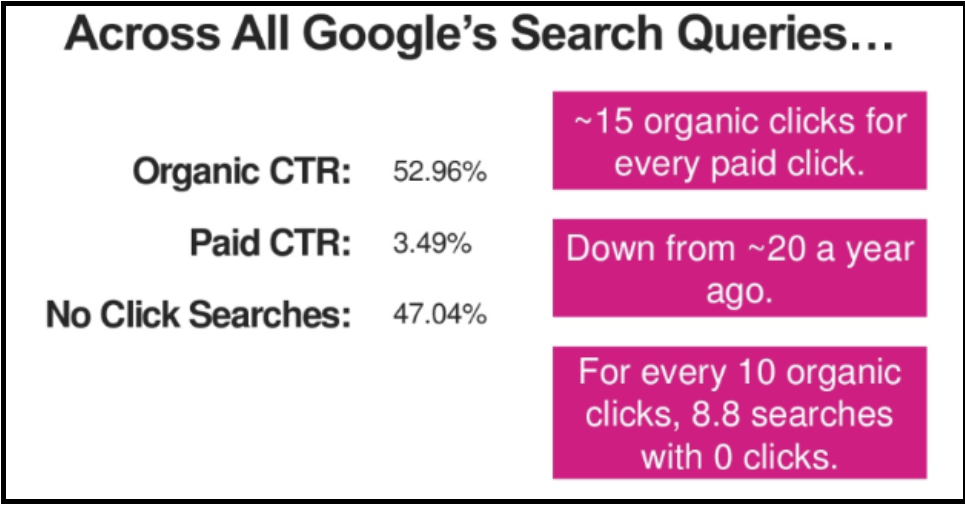
According to Rand Fishkin, who runs massive data analyses over at Moz, they’ve found that as much as 47% of all searches ( and up to 60% on mobile) are now “no-click” searches. This means that people are searching and finding their answers without ever clicking on a website. Moz lays it out in the graphic below:
Additionally, we’ve seen a large shift in call volume from the website to Google My Business calls from our addiction treatment program clients.
Here you can see a client where calls from their website have dropped off compared to the year prior.
January 2019 to February 2019

January 2020 to February 2020
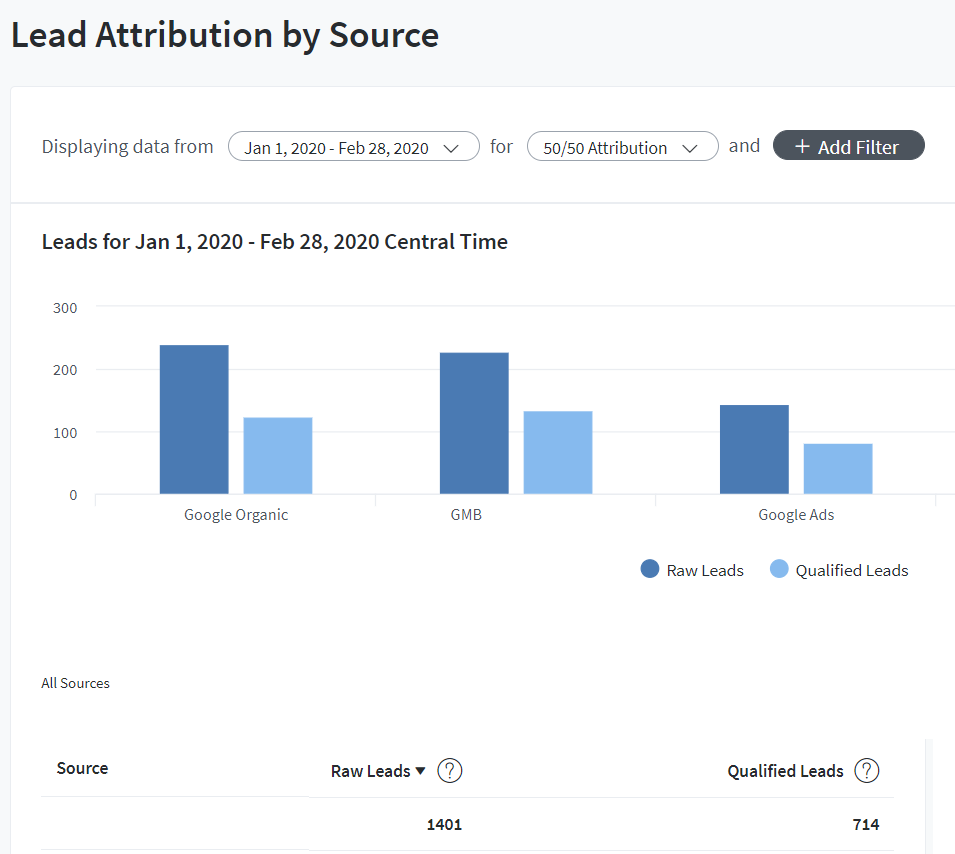
In 2019, they got over 200 qualified calls from Google organic search, but in 2020, that’s down to about 121. However, Google My Business local calls have shot up to 131 whereas they’d only been at 48 the prior year.
How Google and Customer Search Is Changing
There are two things happening here. First off, Google’s business model is to make money from ads, which can only be seen on Google owned properties like search. So the longer you stay on Google search, the more likely you are to click on ads and make Google money.
To this end, Google has instituted a number of features that make websites irrelevant in many regards.
- Rich Snippets and FAQs: These feature the answer to a question or query right on the Google search screen, no need to click to the website. Here’s an example for our search “what drugs cause overdose?”

- Knowledge Panels: These are the business info boxes that pop up when you search for a business name. It’s not uncommon for people to get the info they need or call you from here directly without ever visiting your site.

- The Map Pack: This allows people to find you, request directions, or call, again, without ever visiting your site.
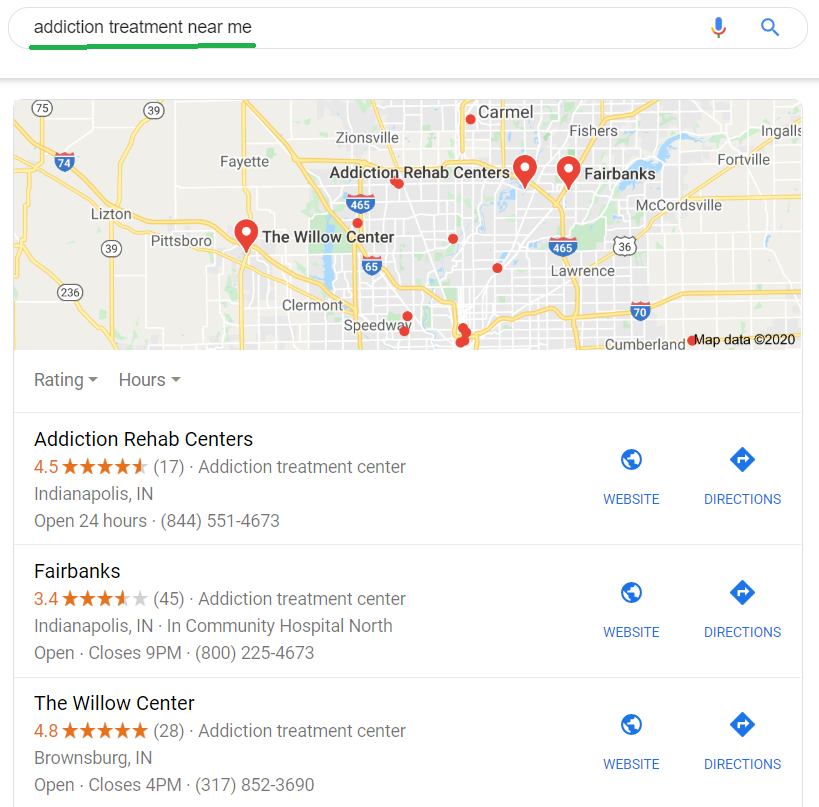
- Finally, they’ve added features like being able to book hotels or flights right on Google, decimating the travel industry and third party booking sites.
Google Is Stealing Your Traffic and Robbing You of Your Data
This all has a huge impact on any local business, behavioral health and addiction treatment included.
If Google was just prompting searchers to call from some of their features like the Knowledge Graph or Google Maps Pack, it might not be that bad, because, at least you’re still getting the calls.
But the real issue is that you get no data or ability to retarget. When someone visits your site, you were previously able to use Google Analytics and Google Search Console to see what keywords they were searching for and which pages they called you from. However, now you can’t do that to the same degree.
Even worse, because they never actually visit your site, you can’t use Facebook, LinkedIn, Twitter, or any other platform to retarget visitors and bring them back to your site.
Finally, your website is one of the primary tools available to you to convince searchers that your program is right for them. If 47% (up to 60% on mobile) of searchers are no longer visiting any sites at all, that means your well-designed, expensive website, and all the well-written content on it has no chance to influence a searcher’s decision as to which provider to go with.
How Is This Affecting Revenue and the Return on Spend (RoS) of SEO?
Let’s take a look at the numbers.
A good addiction treatment page will convert visitors to calls at around 5%.
And a decent call team can convert around 5% of those calls into admissions depending on what insurance you take.
We’ll assume each patient brings in revenue of around $15,000 (in-network).
And, if you’re a smaller treatment program, you’re paying your marketing agency or internal drug rehab SEO expert around $5,000 a month.
Here’s the ROI on that before no-click searches.
- Ranking #1
- Total Monthly Searches for High Intent Key Terms = 5,000
- Click Through Rate (CTR) for Number #1 Ranking = 30%
- Website Visitors (5,000 X 30%) = 1,500
- Callers (1,500 x 5% web page conversion rate) = 75
- Admits(75 x 5% call rep conversion rate) = 4
- Revenue (4 x $15,000) = $60,000
- Net Revenue ($60,000 – $5,000 agency fee) = $45,000
- Previous RoS ($45,000 / $5,000) = 900%
In 2020, you’re now paying the same agency fees, but no-click searches account for at least 50% of all searches when including mobile. So let’s run the same example:
- Ranking #1
- Total Monthly Searches for High Intent Key Terms = 5,000
- Click Through Rate (CTR) for Number #1 Ranking = 15% (Previous 30% x Today’s 50% being no-click)
- Website Visitors (5,000 x 15%) = 750
- Callers (750 x 5% web page conversion rate) = 38
- Admits (38 x 5% call rep conversion rate) = 2
- Revenue (2 x $15,000) = $30,000
- Net Revenue ($30,000 – $5,000 agency fee) = $25,000
- Current RoS ($25,000 \ $5,000) = 500%
Now, keep in mind that that’s all top-line revenue. If your margins are 25%, then you dropped from $11,000 to $6,000 in actual profit. That’s a serious reduction in cash flow.
The problem is that most agencies won’t tell you this as they make their money by pumping out more content and more backlinks, even while your returns on those activities have been cut by 50%.
The Importance of Reviews
We talk about this all the time, online reviews are absolutely essential to driving call volume and admissions these days. Customers trust online reviews second only to referrals from friends and family.
If you have reviews under 4 stars, especially on Google, you’ll see your cost per call and cost per admission increase by as much as 30% compared to a provider with 4+ stars. And the more reviews the better. There has to be a strategy in place to constantly garner reviews (and, no, just having your staff leave a bunch of reviews for you is not going to cut it.)
Driving Volume in 2020 – Google My Business
So what do you do now? SEO clearly still has value, but not nearly as much as it did just 1-2 years ago. And this trend in localization and no-click search will continue with Google.
The reality is that it’s Google’s game. You can complain all you want, but it’s not going to help patients find your treatment center or healthcare practice.

The thing is that Google Maps and Google My Business optimizations are very very different from traditional SEO. Most agencies have never made the transition. They’re still using tactics from 2 years ago that:
1) Google no longer rewards, especially creating huge masses of content. In fact, we’ve taken over a number of accounts where clients had large drops in traffic because their previous agency was just producing huge amounts of low value content. Google actively discourages both low quality and mass quantity strategies these days.
2) Will help you rank in organic search, but won’t help you rank on Maps, which is where the greater call volume has been coming from for some time. Just look at this client’s Google Maps call volume for the past 3 months.
Unfortunately, Google only lets you pull up 3-month windows for Maps calls, but we can tell you that this same upward trend has been going on for the past year.
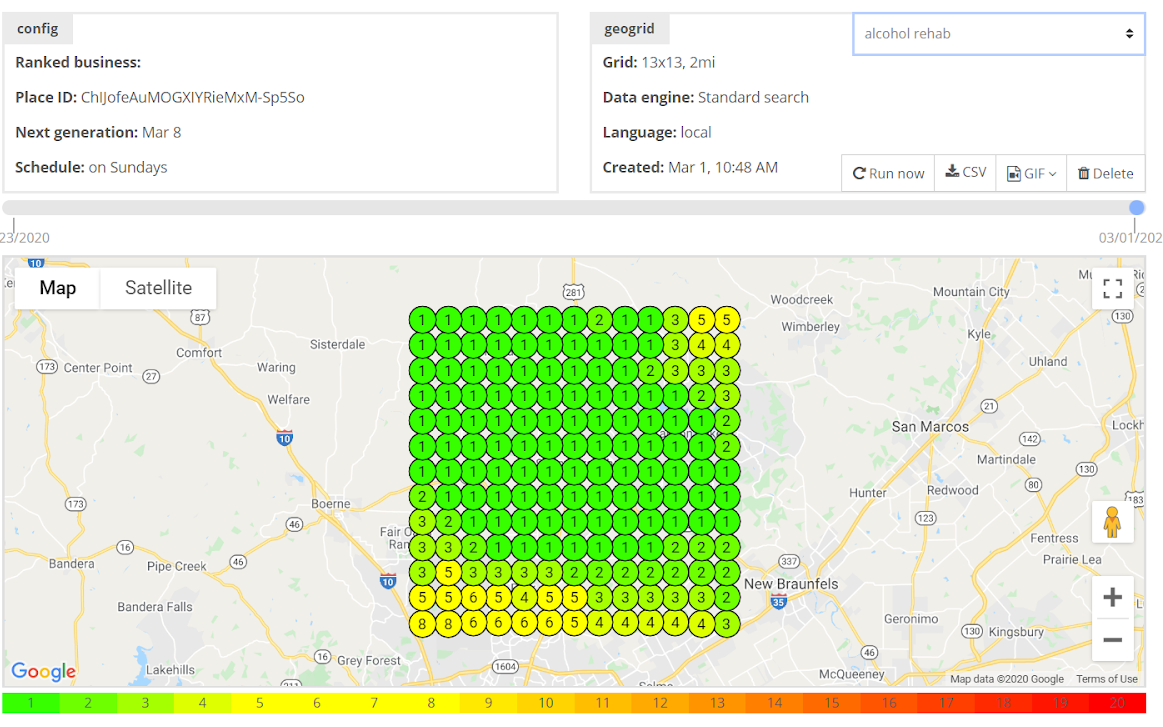
Below you can see what we’ve done for two of our clients and what you want search results to look like. Each node/circle represents a 2-mile radius out from the facility. The keyword in the top right is the word it’s ranking for. The number in the circle is the position it ranks for when you search from that exact location using your mobile phone. Obviously, the higher you are in search results at each location, the better.
Local Search for “Detox”

Local Search for “Alcohol Rehab”
Local Search for “Drug Rehab”
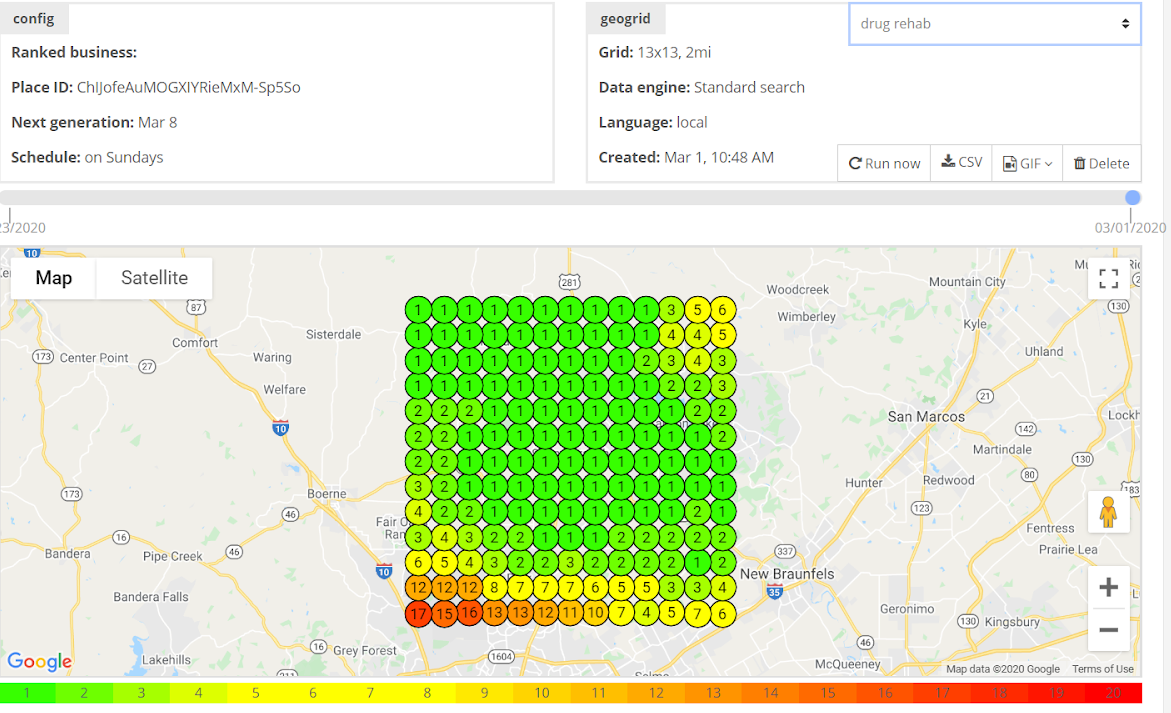
Most providers have either a ton of red or have a small green “1” right on top of their facility with mostly red and orange around that before we start working with them. That’s because they’ve done zero Google Maps optimization, and it is a big reason as for their reduction in overall call volume.
Driving Volume in 2020 – Paid Media
The problem is that Google Maps and My Business Calls don’t convert as well as Google Organic for addiction treatment. Here’s an example from a residential facility so far this year (Jan 1 to Feb 29, 2020):
- Google Organic Calls – 1,034
- Google Organic Admits – 44
- Google Organic Conversion Rate: 4%
- Google Maps Calls – 495
- Google Maps Admits – 10
- Google Maps Conversion Rate – 2%
This makes sense because, with an organic search, they’re looking at your website, getting to know you. With Google Maps, they just called a number near them, so a lot depends on the skill of your call team to build rapport and explain fit.
So getting people to your website is actually really important. But Google is actively working to find ways to have less and less people visit from search. The reality is that you’re going to have to pay to play, like most other businesses in the world.
Of course, there are always Google Ads, which is what Google is hoping you’ll do as a result of this situation. But those are expensive and don’t convert well, so can’t be a heavy part of your strategy.
That means looking at email, display, Facebook, Twitter, and other channels where you can push large numbers of people to your website for fairly cheap.
Looking at over 100 million dollars in paid media spend across addiction treatment providers, here’s what we see once we’ve optimized campaigns and channels:
- Google Adwords Average Cost per VOB – $1,250 to $2,500
- Facebook Average Cost per VOB – $500 to $1,000
- Google Organic Average Cost per VOB – $100 to $500
- Google Maps Organic Average Cost per VOB – $100 to $500
Of course, most programs and agencies have no idea how to run Adwords or Facebook for behavioral health, so we often see cost per call at that price rather than cost per VOB! But that’s what happens when you don’t hire or pay enough to get marketing experts specifically with behavioral health knowledge. Lots of providers hire agencies without industry expertise for a variety of reasons, but knowing how to market used cars is very different from marketing addiction treatment, and that’s before even getting into legal liability issues such as HIPAA compliance.
Time to Make a Shift
We talk to providers all the time who are still relying on just one or sometimes two channels to drive calls, then they wonder why they’re constantly struggling to get consistent volume. Most of the time, those channels are organic SEO, which we’ve seen is quickly being eroded, and Adwords, which is super expensive (Just a note here. Tons of small treatment providers will tell you they’re getting many of their admits from Adwords. We can tell you that, analyzing tens of millions of dollars in just Adwords campaigns over the years, this has never been true. They are either lying, don’t have decent tracking in place to actually be able to tell, or are admitting a lot of patients who can’t actually pay.)
The only way to get that volume back up is to re-allocate budgets to ensure Google My Business SEO and Paid Media are an integral part of your overall strategy.
Curious About How You Rank Locally?
Enter the keyword you’re looking to rank for and the name of your facility (i.e. Joe’s Recovery Center) in the local rank tracking form. Our technology will run a scan and provide you with a map of how you rank at each half-mile “node” from your facility. Google’s local algorithm displays different results at different distances based on how far the searcher is from you. It’s not enough to just rank in one area, literally every mile could be a different rank. Here at Circle Social, we make sure you rank everywhere.
Need help revamping your strategy to one that actually works in today’s world, get in touch at engage@27aa2dbd3f.nxcli.io or call 800 396 9927.