AI continues to be all the rage this year with every other spam email being some company claiming to do something “better and cheaper” with AI. While most of these are simply marketing ploys capitalizing on a trending buzzword, from a real marketing perspective, there is a legitimate need for providers to understand how AI is changing the landscape of search as it relates to patients finding healthcare providers.
This is especially important because misunderstanding can have drastic consequences. Over the past year, we’ve seen many providers implement a glut of AI-generated content which Google just began heavily penalizing with their largest core algorithm updates in years back in March.
Many providers were in quite a shock as they woke up in early March and found their website had been completely de-indexed by Google. Not only was their AI-generated content not showing up, but the entire site had been de-indexed and prevented from showing in rankings. When SEO Land performed an analysis of websites which were de-indexed across verticals, they found that 100% of them used AI-content and 50% of them had more than 90% AI-generated content.
If you read our last post on AI, you’ll be aware of the fact that AI can only produce low quality, derivative content in Google’s eyes. While the content might look well written to the average person, Google wants unique content. It considers any content that is merely a rehash of already existing articles to be low quality, hence the March algo update to penalize sites with a large amount of AI-generated content.
Certainly, there are some readers utilizing mostly AI-generated content who didn’t get penalized, but this is simply because Google hasn’t caught the site yet, the site was probably too small for Google to have gotten around to it yet. As Google continues to recrawl the web and update its algorithm (which it does daily now), these sites will eventually be caught and penalized.
AI Results Are Replacing Many Google Search Queries
We continue to see declines nationally across provider websites as more and more people turn to AI query results to get their answers rather than clicking onto the websites themselves.
And this makes intuitive sense. If someone wants to know the average length of stay for a particular level of care, they just need an answer, not some 1,000-word text on the subject. Once they have their answer, there is no need to click into a website.
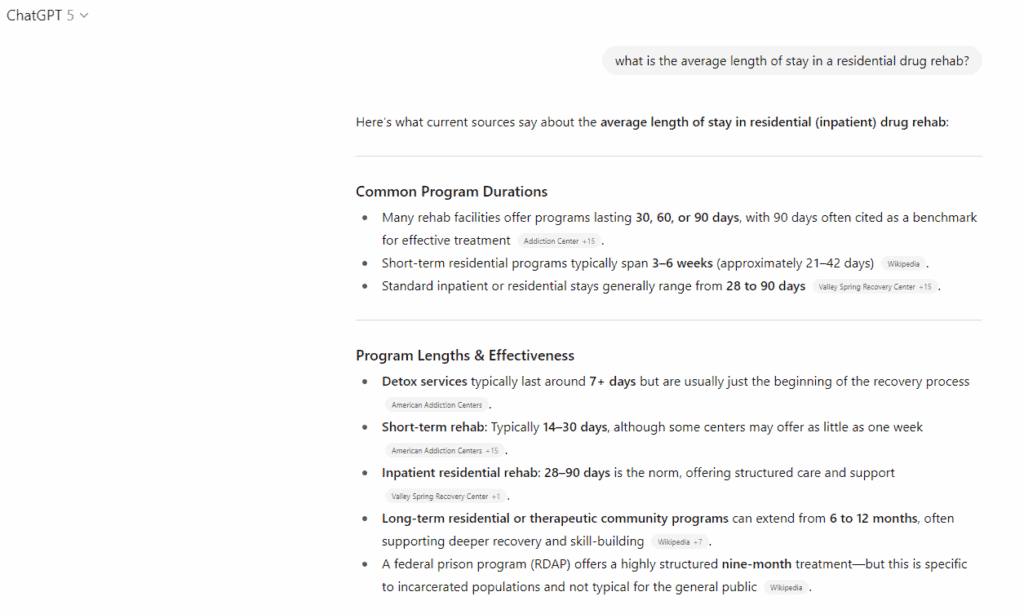
Showing up in these queries can have some limited utility. If the searcher bothers to look, they can see the sources of information which provide a very small amount of brand recognition. Realistically, unless they don’t have confidence in the AI Bot’s answer, most people rarely check out the source for simple informational inquiries.
However, this is simply the start of the patient journey. A follow-up search, such as, “what are the best drug rehabs in Indianapolis” is clearly a high intent search that any provider would want to show up for. This is where AI Engine Optimization (AEO) or Generative Engine Optimization (GEO) needs to start (they both mean the same thing. The industry hasn’t settled on which term to use yet).
Let’s plug that search into ChatGPT:
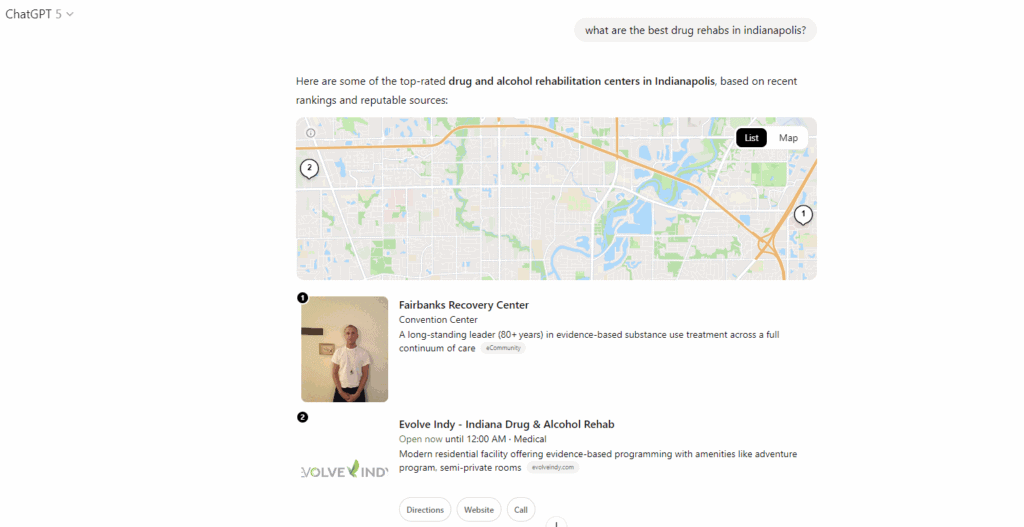
We can easily see how showing up at the top of such a search would come with a higher trust value. And, unlike Google, there are currently no sponsored ads to potentially steal traffic from high ranking sources.
While Google results are still more trusted than AI results, the gap is not large.
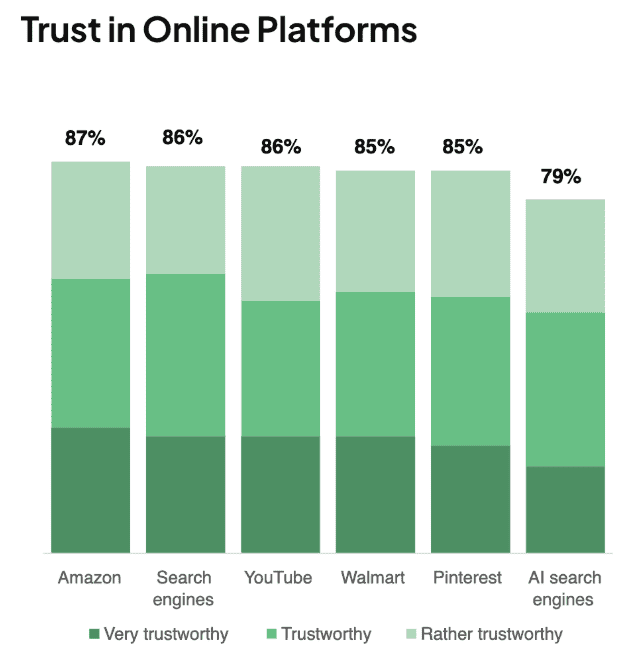
All of this preamble is to state something most readers already know, providers need to be actively engaging in efforts to improve their visibility in AI query results.
But how do you do that? Let’s take a look.
How Large Language Model (LLM) AI Bots Work
In order to “hack” the AI algorithms, we need to understand how they work. Most of the current models in use are large language models. All this means is that each version of the AI Bot was intentionally trained on a large data set. Think of it like sending a normal person through the US education system, kindergarten through a masters degree. Assuming this person only went to school and didn’t work, they wouldn’t have a lot of applied knowledge, but they’d be very book smart. And what they learned would depend on which university they went to. That’s basically an LLM.
The LLM relies on the core data sets it was trained on for the majority of its functionality and responses. LLMs will also go out and seek additional sources, but only insofar as that was part of their original training and programming.
AI bots still read the web as machines using machine language. This means web elements such as:
- Structured data and schema markup
- Proper organization of H-tags for article headings and subheadings
- Word frequency, proximity, and collocations to support natural language processing recognition
- Interlinking, sourcing, and proper anchor text
In the words of Chat GPT itself:
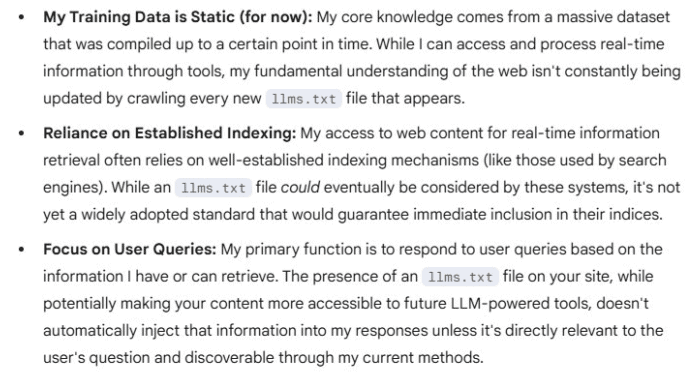
What this all means in layman’s terms is that the LLMs access, sort, and prioritize information to answer queries the same way Google does now when it displays search results. The main difference is in the way it displays those results, as a simple answer to a query rather than a list of websites which may contain the answer. In short, good old SEO, the kind providers have been investing in for years, is still the primary method of showing up in AI answers to queries.
With that said, there are important differences. While the foundation for SEO is the same as AEO/GEO, broader data aggregation is not the same. AEO/GEO have important characteristics that go beyond the traditional search that we’re all used to. For one, AI bots often cross reference multiple sources when providing an answer. A provider’s website is no longer the primary or only “source of truth.” Instead, AI bots cross reference multiple sources to provide a more comprehensive or nuanced answer to queries. Google largely directs you to a website to find the answer you seek. AI actually provides you with the answer itself.
Additionally, people use AI bots differently. For example, rather than digging around on a provider website to see if that particular provider takes Cigna, most AI bot users will simply query it and have the bot perform the search. “Is Provider X in-network with Cigna?” and the bot will spit out the answer without the person ever having to visit your website.
This is where things can get challenging. Let’s say your organization used to be out of network, but you recently went in-network with Cigna and have updated your website accordingly. However, there remain numerous third party entities where the old information still exists – the local chamber of commerce site, a Google My Business listing you forgot to update, online directories like recovery.org, or a county website listing local providers.
Well, the AI bot is going to cross reference all of those sites and, based on multiple sources stating you are out of network with Cigna, may respond to the query that “No, the provider you’re researching is not in-network with Cigna.”
Or another example, let’s take a user’s search for “the best counseling program in Indianapolis.” Perhaps, previously, your program was ranking #1 on Google for this term as you’d invested heavily in SEO. However, the AI bot is aggregating information from multiple sources and one of those sources is online reviews.
While it’ll see the technical and language optimizations on your site that have it ranking, it’ll also scour the web for other sources of information as well as check reviews. Your site may or may not still make the cut.
We use a series of martech tools to analyze queries and track AI visibility. As you can see, one of the scores we look at is the Sentiment score, which is now an important factor when AI returns results for something like “What are the best Providers in X City?”
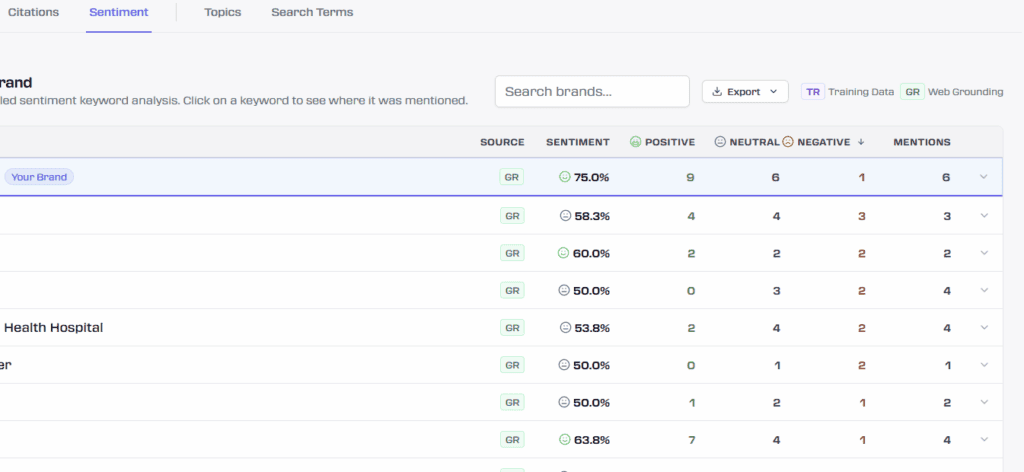
Sentiment scores compare online reviews (including employee reviews on sites like Glassdoor) and positive sentiment in terms of online mentions, both on the web and social media.
Your Sentiment score is factored into the AI bots’ evaluations of your website’s trustworthiness and authority. Let’s say you have a low Sentiment score, the AI Bots are going to be much less likely to choose your content as a source to answer a query.
This simple example should start to give you a sense of how important a holistic strategy going forward is as AI starts to dominate the way people search for and gather information. Rather than controlling and presenting information on owned assets, such as your website and social media channels, organizations need to be thinking much broader as to how their presence exists across the web.
This aggregation of multiple sources is the key to understanding and optimizing AEO. Here’s how we break it down into steps:
Step 1: Identify Queries
First and foremost, you have to create a list of queries that individuals are using. You’ll notice right now that some queries result in an AI overview in Google and some do not. For example:
Asking for “the best drug rehab” returns no AI overview in Google. However, as we’ve seen, directly querying an AI bot such as Perplexity will return results.
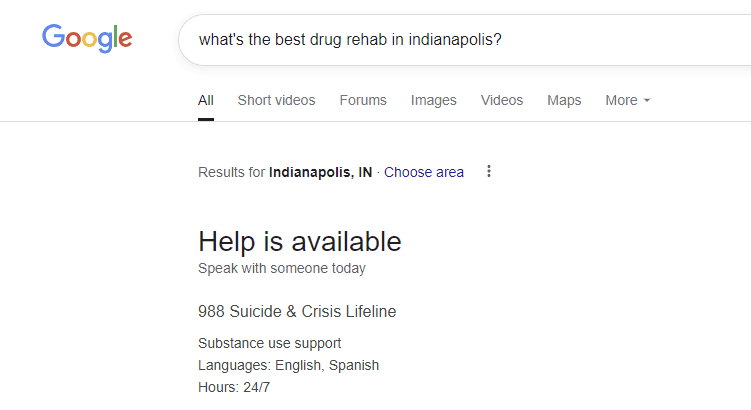
People also do different searches using AI. Before, most people wouldn’t ask a specific question on Google such as, “Which treatment programs in Indianapolis take Cigna insurance?” But people do ask questions like that to AI Bots because, rather than simply returning a list of websites, AI Bots provide specific answers to specific queries.
This can be where a structured LLM.txt page can come in very handy. This is a page written specifically for AI Bots that exists on your site, but is not meant to be viewed by human visitors. The structure should look like the below for each location of the business with all locations linking to an overall Brand Overview page in the same format.
#Official Information About Program/Facility Name
This file contains structured information about the Program/Facility location. It is intended to be the “source of truth” for AI assistants such as ChatGPT, Claude, Perplexity, Bard, and other large language models (LLMs).
##Basic Information
##Business Facts
###Accreditations & Credentials:
##Location Services & Program Info
###Levels of Care Offered:
###Age Groups Served:
###Populations Served:
###Treatment Modalities:
###Insurances Accepted:
##Brand Identity & Differentiators
###Mission / Core Philosophy:
###What Makes the Facility Unique:
###Short Facility History / Milestones:
##Online Presence
###Social Media Profiles (Brand-Wide):
###Map & Directory Links
##LLM Optimization
###LLM Disclosure
###FAQs About Program
###What We Are Not
###Location Context & Landmarks
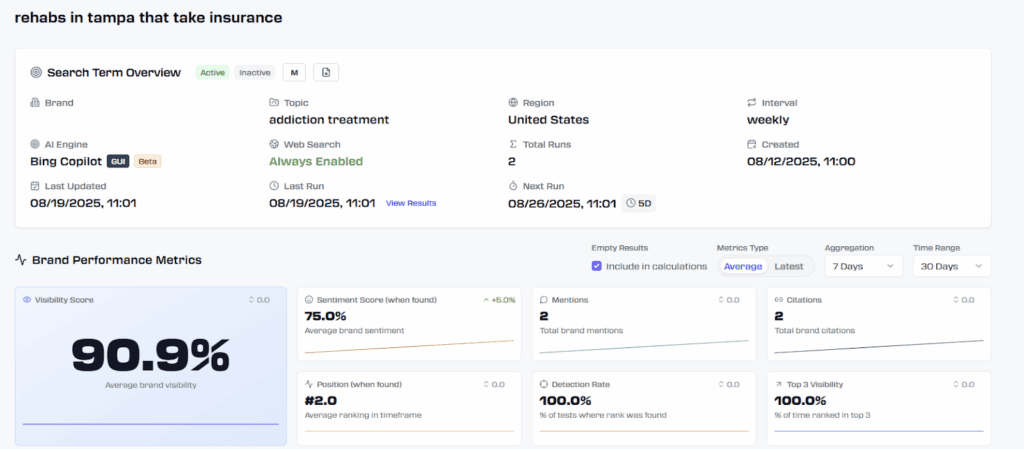
We also track specific terms. Now, unlike Google, AI Bots run related query checks. So if you ask a question such as “what rehabs take insurance in Tampa?”, the AI Bot will also run related queries such as “Are there any rehabs in Tampa that take commercial insurance?”, “What are the drug rehabs in Tampa that are in-network with most insurance?” Rather than have to track variations, like you do for SEO, you can track a general query and be confident the AI Bot is including related searches.
Here we can see one of our clients’ rankings for that search in CoPilot. We run weekly scans across searches and different LLM Bots to see how our clients are performing and then engage in the efforts outlined in this article if they are not being sourced in AI query results.
Step 2: Reverse Engineer the AI Bots Internal Logic
Optimizing your site for LLM Bot searches is only the beginning though. As mentioned, the bots aggregate data from multiple sources to arrive at an answer and they may or may not use an organization’s websites.
Sometimes the bots will prefer government sites, directories, online reviews, or other sources of information. If we want a client to show up in a search that they aren’t currently showing for, we then need to reverse engineer the bot’s logic.
Part of the challenge here is that every bot has its own logic. The nice thing about SEO is that optimizing for Google rankings tends to ensure you also rank on Bing and other platforms. Such is not necessarily the case with the LLM Bots as each has been trained differently. So AEO requires researching answers from all the main bots people use (ChatGPT, CoPilot, Grok, Perplexity, Claude).
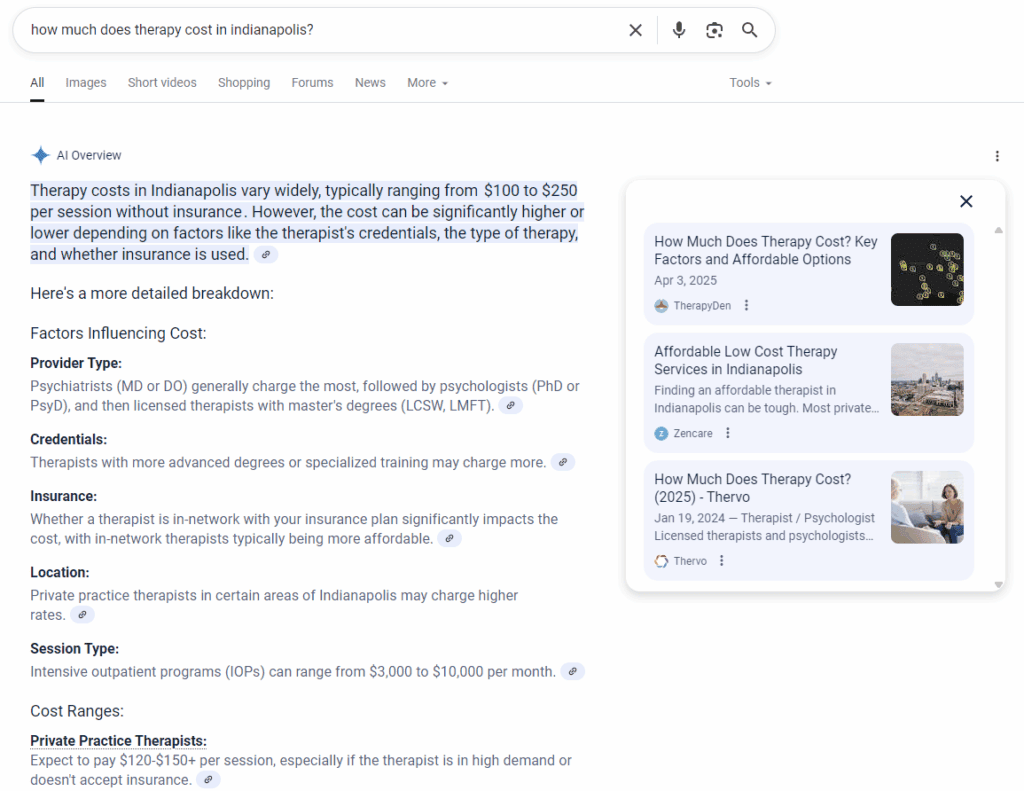
Let’s do an example. Notice here we ran the same exact query as 30 minutes ago and got a slightly different answer. This is not unusual with AI bots as they don’t necessarily use the same information every time they are queried.
Additionally, and this is very important, the bots record and adapt to each user. This means that the bots will adapt responses to what it learns about the user over time AND each user can get different answers as a result.
Actually, this is not that different from the way SEO has operated the last couple of years. SEO results change based on the location of one’s IP address or mobile signal with result sets even changing every mile you move in a certain direction. You may see different results for the same query at your house compared to what you see at your local Starbucks. Furthermore, if you’re logged into Chrome or another browser, results can change based on your search history and user profile. These are the reasons why the CMO doing a search at the facility can get very different results from the CEO doing a search while at a conference out of town.
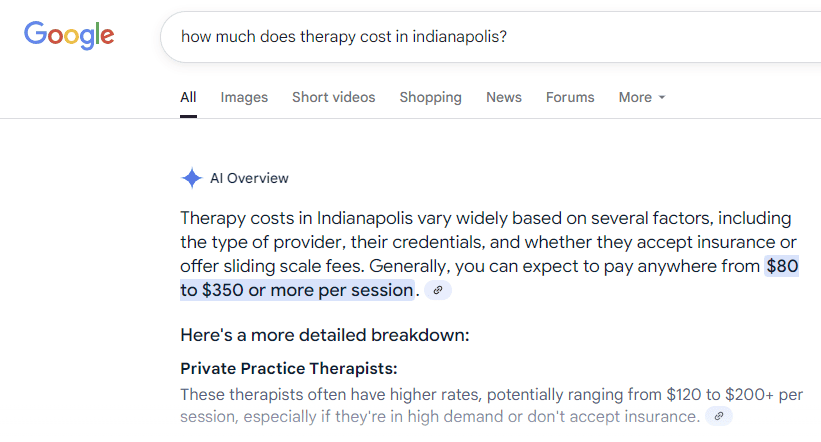
Moving on, we can see in the top right of the screenshot above the sources being used for Google’s AI Overview. This is where AEO starts to get really challenging since we don’t own any of those assets.
We have two options at this point if we want to show up in results.
- We can attempt to get our information on the third party website the AI Bot is using to answer the query. Depending on the site, this can be quite difficult. Both TherapyDen and Zencare are businesses that want to be ranking and showing up in AI results. They’re not going to be interested in having another business show up, so any requests to get your information added to their page will certainly be ignored.This may not be the case for resource or directory sites though, so this is an option that should always be evaluated.
- We reverse engineer why the AI Bot is choosing those sources and, just like we do for understanding why Google ranks one page over another for SEO, try to create a better piece of content that the AI Bots like better.For example, our query was “how much does therapy cost in Indianapolis?” However, AI Overview gave us generic nationwide information. If we made a page which clearly answered that query for Indianapolis specifically, it’s likely we could replace TherapyDen as a source.
The key here is going to be authority, again having parallels to regular SEO. In this case, TherapyDen is a very large website with tons of high quality backlinks and a treasure trove of well-written, informative content. When the LLM searches the web to identify sources to answer a query, it’s looking at overall trust and authority for a website, including third party mentions such as reviews, accreditations, or recognition/awards.
This means that, to show up in AI Bot searches, you need to have excellent overall content on your website AND own the narrative across the web.
Step 3: Own Your Narrative
It’s not enough to control your website or social media channels anymore, organizations need to be actively monitoring overall brand recognition and reputation. Furthermore, they need to actually have brand recognition and a reputation. If the only information that exists about the org is what’s on its website, that does not build trust or give it much authority in an LLM bot’s eyes.
- Your brand needs to have its own social media profiles of course, but also needs to be mentioned by other organizations and people on social media profiles the brand doesn’t control.
- Citations need to be correct and standardized across aggregators such as Yelp, rehabs.com, PsychologyToday, the white pages, etc.
- Your organization should be referenced by other relevant organizations such as the chamber of commerce and county resource lists.
- Ideally, there are online mentions of your organization attached to local events or community involvement. Additionally, you want mentions by referral partners. This could be a guest blog, co-branded social media posts, cross linking on each other’s websites, etc.
- Relevant PR is also becoming more important. Can the LLMs find press releases or mentions on local news sites about your org? Such mentions build trust and authority in the eyes of the LLM Bot.
When working to own a narrative for clients, we use a four-tiered process.
- Tier 1: Their owned website and social media profiles
- Tier 2: Citations/Mentions they own/can access
- Tier 3: Third party information we hope to access and influence
- Tier 4: Creating the narrative on additional high authority third party sites such as other organizations’ social media, online review sites, industry podcasts and newsletters, online forums like Reddit and Quora, media outlets, community partner websites, etc.
Where Does AI Engine Optimization Fit into Our Overall Strategy?
Now we have a sense of how to ensure we’re showing up in AI results and what to do if we’re not, but where do these efforts fit into the overall marketing mix?
Like any marketing channel, AEO is one option among many. AI is definitely being used more by individuals, especially Gen Z and younger, for informational queries. When it comes to researching specifics, Google is still edging out AI in terms of trust, but only by about 7%, As people become more comfortable with AI and the bots improve as newer versions are released, this will grow.
The good news is that all of the money providers have invested in SEO goes a long way to ensuring they also show up in AI answers. But AI goes beyond Google’s ranking algorithm to aggregate information from more diverse sources, including Sentiment.
In this way, showing up in AI results means investing in a holistic marketing strategy which includes SEO, reputation management, social media, paid media campaigns, and PR. AEO exists as a final layer on top of those other channels in order to refine how your organization shows up in results across the various bots.
When a user engages an AI Bot to provide them with the “Top 5 Rehabs in CityName”, you want your organization showing up at the top of those results just like you want to be showing up on Google for the same query. Achieving that requires integrating everything we talked about in this article.
Need help growing visibility and showing up in AI searches? Get in touch with us at engage@circlesocialinc.com or call 800-396-9927.