
Competition is the name of the game in behavioral health marketing today. Take a look at the Google Maps results for Nashville, TN. That’s 20 treatment programs all within driving distance of each other. What’s more? Google only shows 20 dots on any map results. The real number is actually over 40 if you zoom into different areas!
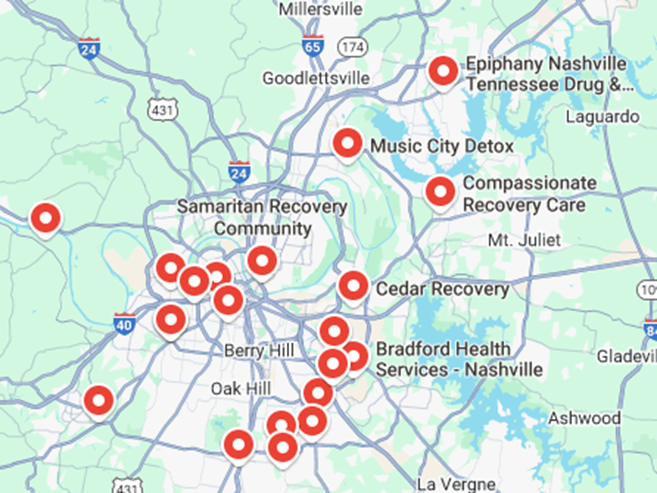
Psych hospitals, MAT clinics, residential rehabs, teen treatment, outpatient counseling programs, all are seeing the same trends.
These trends are continuing from the last couple of years. I encourage you to read our reports from 2024 and 2023. Much of what we wrote in those years is still applicable today. For this letter, we’ll focus on some more recent trends.
SEO Results Are Location-Limited & Harder to Track
Here's a client SEO geogrid in San Antonio. Notice the further out you get, the lower the Google ranking?
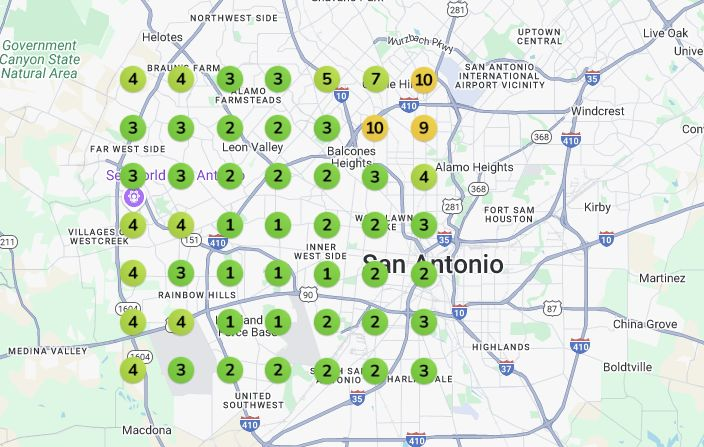
If you haven't seen an SEO geogrid before, they measure rankings by location. Google rankings are heavily dependent on location nowadays. The farther away you are physically from the actual location of the provider, generally the lower you'll show up in search. This is why, when you perform a mock search at home, you’re far less likely to see your program ranking than if you performed the same search while on location.
This grid displays a roughly 10-mile square radius. It depends on the area, but, on average, once you pass the 10-mile mark, it becomes much harder to show up in Google these days. Statewide or national rankings? Google has been doing away with them for years and we saw large drops in 2024 again in terms of ability to rank further afield.
This is one big reason why providers, especially larger providers that used to rank across long distances, are seeing steady drops in traffic. Rather than ranking nationally and getting 1,000 clicks a month from their page, they’re now just ranking for searchers in the city of their physical location. That 1,000 clicks became 10.
What if a provider services further out than the 10-mile square radius it’s easiest to rank in Google?
The answer is that they can't rely solely on SEO. They need to have other marketing channels where they pay for placements in those areas. SEO is a key component of a diversified marketing strategy, but it can't be the only channel. We’ll cover that more later.
AI and No-click Search Are Limiting Data
By some reports, as many as 25% of searches are being completed using an AI tool like ChatGPT or searchers are relying on the short AI summaries provided by Google or Bing’s own tools.
Then there are other no-click results such as Featured Snippets
Or People Also Ask:
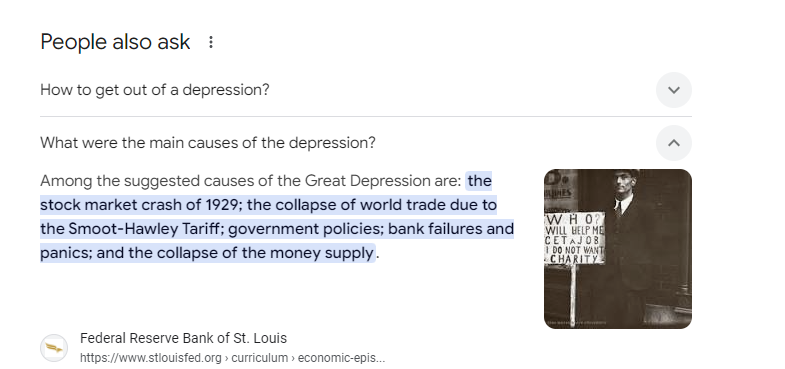
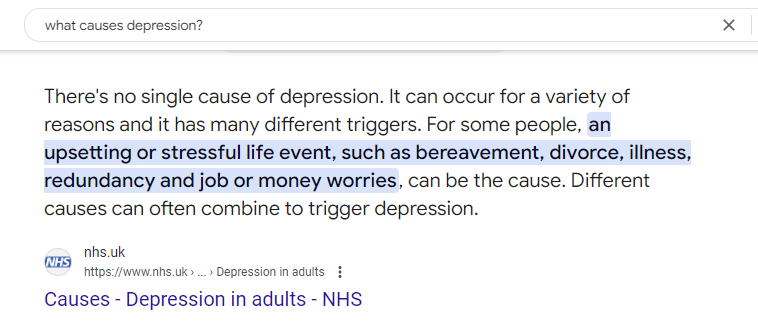
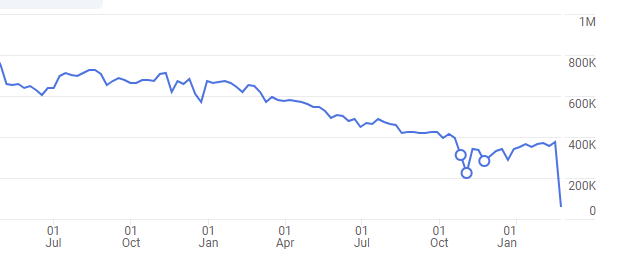
In many cases, searchers are able to get the answers they seek without ever having to click to a website (though we can see not always from Google's AI misinterpreting depression in our search above).. Even though your pages might be ranking well, they could be displaying in these no-click searches. You’ve probably noticed, despite continuing investments into SEO, your traffic has been going down. No-click displays are another reason. It’s not that your page isn’t ranking, it’s that people get the information they need without having to click into your site.
What does this mean from a marketing standpoint for providers?
One Must Reach Beyond Search
Search driven marketing (SEO and PPC) cannot not be the only type of marketing providers are investing in.
Think of your favorite pizza restaurant, your family’s go-to for busy weeknights when no one wants or has the time to cook. Do you Google “pizza restaurants near me” every Friday and then choose one?
Of course not. You go to your tried and true favorite more often than not.
Within this context, let’s say your friend Andy decides to open up a new franchise in town for Jack’s Pizza. What’s the poor guy to do? Everyone already has their favorite pizza spot and no one’s going online to search for a different one. How is he going to attract customers?
Obviously, the answer is display advertising. Since his business can’t survive on the odd newcomers into town who actually might perform a Google search for pizza, he needs to get in front of people and persuade them to give his new joint a shot instead.
That means display channels such as Facebook, X, TV, radio, etc. He needs to grab potential customers’ attention and convince them Jack’s Pizza is worth switching to.
Notice both “attention” and “convince” highlighted in bold above. Intuitively, this makes sense to us. Name the last time you saw an ad on TV, stopped what you were doing, and went out to buy that thing.
Yet, once we get into the board room, the executive meeting, the quarterly review, intuition and common sense seem to disappear. Take 30 seconds and watch the short clip below.

For some reason, once it comes time to discuss marketing efforts, suddenly everyone expects the McRib magic from Family Guy to become a reality. Why is this? Because, that’s how PPC Google Ads work. We see a click, an inquiry, a new patient admission. The false logic is then that, if Google Ads works this way, shouldn’t all channels?
But that’s a fundamental flaw in logic. Google Ads are positioned in front of individuals looking to make a decision right now, today. It’s the difference between trying to sell someone a used car on a dealership lot and trying to sell the same person a used car in the Walmart parking lot. The latter is a heck of a lot harder.
Our buddy Andy knows there aren’t enough people searching for a new pizza place, so he’s not looking for a solution that requires waiting for people to search. Additionally, he also knows that most people already have a preferred pizza restaurant. So he not only has to get their attention, he has to succeed in the hard work of convincing them that his pizza is worth the risk of trying something different from what the family already knows and loves.
Ask yourself, how often have you changed your favorite restaurants? What would it take for a new restaurant to get you to switch? Ask the same question for your favorite model of phone (iPhone or Android), your dentist, or your preferred car brand.
Now, there are two important facets to this conversation:
Marketing direct to consumers has a different customer journey. Most individuals do not have a preferred behavioral health provider. Ask your friends or family who their favorite drug rehab, counseling program, or MAT clinic is and there’s a fairly high chance you’ll get a blank look of incomprehension. If they don’t know, then that means they’ll probably need to go to Google to search should they ever need such services. Then what’s the point of marketing to them beforehand?
This is exactly how you need to be thinking about marketing to your referral partners. As we’ve seen, they have a plethora of options in the community AND they probably already have preferred partners. So why would they choose you out of all those options and, more importantly, why should they choose you over the place they’ve already been referring to for years?
The answers to both questions are roughly the same. You need to grab attention and convince people you’re the right provider for them.
McDonald’s doesn’t wait for people to perform a search for hamburgers before marketing to customers. Nike doesn’t wait for a search for shoes. Pfizer doesn’t wait for a search for “medications for eczema”. Why not? Why don’t these insanely successful companies just sit around and wait for the customers to find them when they’re ready?
Because the landscape is ultra-competitive. They can’t be passive, sitting on their hands and hoping someone comes along looking for them. Because they want consumers to prefer them even before said consumers are ready to make a purchase decision. They want to be the go-to solution to meet the consumer’s need or desire. In short, they want to get ahead of competitors by getting to customers before they end up performing a Google search.
Most behavioral health providers do not think like the successful Fortune 500 companies mentioned above, but they should.
More importantly, where do most behavioral health admissions come from? Google? Facebook? TV? No, they come from community referral partners.
Which brings us back to facet number 2. If community partners aren’t already referring to you, then they’re referring to someone else. You need to convince them to refer to you instead? How are you going to do that? Is having an outreach rep stop by their office once a month going to be enough to persuade them to stop referring to another provider they’ve referred to for years, a partner who they know and trust?
You need to be marketing to those professional referral sources more than a once-a-month drop in. That means LinkedIn and other channels. How many people is that outreach rep you’re paying $40 an hour talking to per hour? Probably just 1 person. Did you know you can reach 1,000 healthcare professionals for $40 on a channel like LinkedIn? That’s a cost of 4 cents per person reached. Quite the cost differential.
So Convince Me Already
Hopefully, you now see the need to be thinking strategically beyond bottom-of-funnel marketing channels like Google Ads or SEO. What kind of message do you need? How should your organization approach those channels?
I’m the CEO of a local non-profit. I’m going to give you your moment. I’m going to give you 10 seconds of my time to examine your LinkedIn ad. I’ll also let you talk to my Case Manager who handles referrals for 15 minutes today.
How are you going to use that time? I’ve got 40 other providers I could be referring to, several of whom we’ve already been referring to for years. What will you say? How will you stand out? How will you convince me that you’re a better option?
I’ll also let you in on a little secret. I’m not going to change over to you because of the 10 seconds I spent on your LinkedIn ad. I’m no cartoon character seeing a billboard for McRibs. I take our referrals seriously and need to know our clients are getting referred to the best place for them. One ad I spent 10 seconds on isn’t going to change my mind. I’m sure you’re the same. Someone trying to sell you on a new EMR, a new marketing agency, a new healthcare plan. Would you make a decision after seeing a single ad or one brief conversation with a sales rep? I’m guessing not.
Our non-profit CEO is right. We need a strategy. We need to think carefully about what message we’re putting in front of him, when we’re putting that message in front of him, how often we’re putting that message in front of him. And he’ll certainly have different questions at different times. Imagine walking into his office and giving him the exact same spiel every time you saw him. You wouldn’t get very far.
When we think about our marketing strategies on LinkedIn and other B2B channels, the ones getting in front of this CEO and his Case Managers, we need to be asking ourselves those questions, thinking strategically about messaging, timing, frequency, and sequencing. What will it take to get him and his team to give us a shot, to partner with us, to stay partnered with us?
Commodities Aren’t Convincing
Imagine getting the short opportunities with our CEO and his team above. Do you think this message would work, “We do the same exact thing as everyone else, including the people you already refer to instead of us.”?
Is that message going to get them to switch to you? Would that message work any better for direct to consumer marketing? Does McDonald’s messaging say, “We sell hamburgers like all of our competitors do!!”?
Without using those exact words, when you market the same terms and use the same language as your competitors, that’s, in effect, what you’re saying. For anything to be successful, it’s not what we do, but how we do it. A key component of effective marketing is effective messaging. Ad copy needs to do a lot of the heavy lifting.
Take a look at these two sets of Google Ad results:
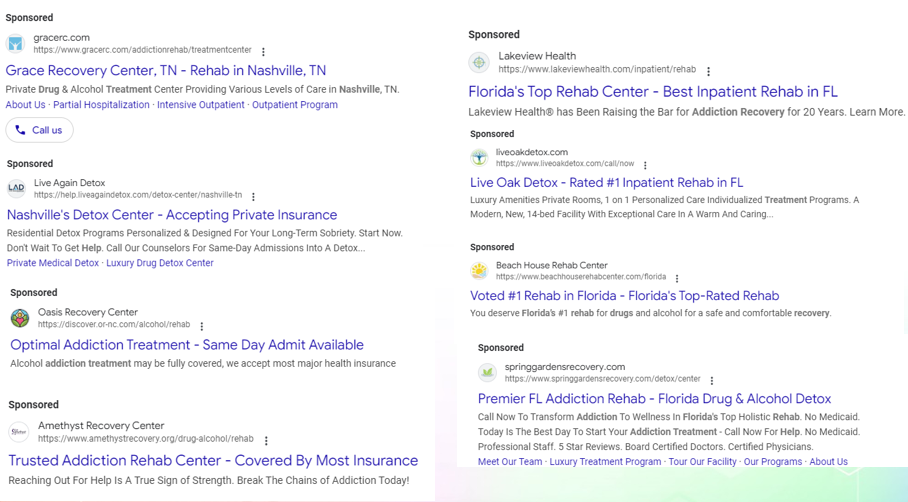
They’re basically all variations of, “We sell hamburgers too!” It’s a sea of sameness. Why would a potential patient choose one or the other? Seeing these results, it’s a shoulder shrug. “None of those ads look very different, so I guess I might as well give one or two a call”, says the potential patient. Is that the kind of mindset you want them going into a call with you on, a shrug of the shoulders?
How about these:
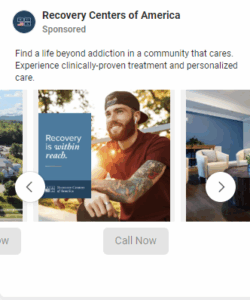

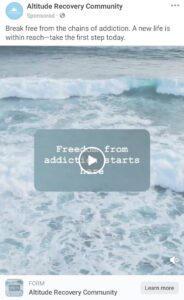
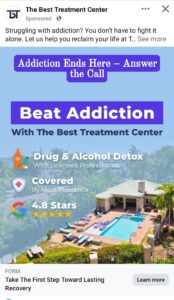


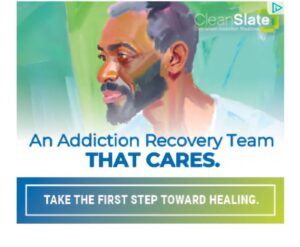
Do these inspire you to “inquire now” as so many of them implore? All these ads came across my Facebook timeline in the short span of 5 minutes. Can you tell why you might choose one versus the other? I think not. And, as we’ve already discussed, “Call Now” or “Learn More” to a form fill is a terrible CTA for a Facebook campaign. Very few people who are scrolling through family and friend photos are going to drop what they’re doing and call a treatment center just like you don’t turn off the TV and go to McDonald’s to buy a McRib after seeing an ad. Channel strategies matter and messaging has to connect to the appropriate part of the patient journey.
Want to see some better ads, check out examples of our work: https://www.circlesocialinc.com/work-examples/
A Quick Note on Teen Treatment Marketing
For those providers that are already in or have entered the teen treatment space, we’re seeing the exact same dynamics play out that we saw with adult mental health and SUD. Providers that relied on high reimbursement OON patients from a wide geographic area are now being pushed out by local in-network providers.
10 years ago, everyone flew to treatment in the adult space because there was nowhere close to home they could go. They went to OON facilities because no one was in-network. Given the option, the majority of patients will take less travel and lower costs, especially for the commoditized treatment we just saw displayed above.
If you’re still out-of-network, why should a family choose to pay a deductible that is 3 to 5 times higher to send their child to your facility? If your marketing and website don’t answer those questions, of course they’re going to choose the local provider.
Did your program rely on out-of-state admissions? Those will continue to decrease. How will you attract more patients locally? These are the questions teen treatment providers need to be able to answer.
The Answer Is Not a Wider Net
I was sitting at a meeting of behavioral health providers in Indianapolis the other week, mostly populated by business development reps. There were over 35 providers represented in the room. 95% were from Indianapolis or the surrounding area but one came from Houston and one came from New Orleans. What the hell are outreach reps from Houston and New Orleans doing in Indianapolis? Hunting for referrals of course.
A common misplaced marketing attempt is to cast a wider net. Houston and New Orleans not filling the beds, why not travel to Indiana? Taking adults? Start taking teens! Taking teens? Start taking adults! Expand to couples, pets, laptops on-site, telehealth, whatever people are hearing that is supposed to be the thing that will save them.
If you can’t be successful in the city in which you provide services, what makes you think you’ll be successful 1,000 miles away? Do we honestly believe Houston, or, at the very least, the State of Texas, doesn’t have enough residents in need of treatment?
As I like to say, “If you can’t make your business model work with your current focus, what makes you think expanding to two focuses is going to make it better?” Being really good at one type of care and then expanding to an adjacent type is a great idea, but only once you’ve got the first model working. Otherwise, you’re just adding complexity, expense, and more uncertainty.
Connecting Care Delivery to Messaging
Instead of casting broader and broader nets, providers need to get really clear on what they do well compared to their competitors in the marketplace. If your program is really good at treating trauma, but so is every other provider in your area, you’re back in the same commodity boat as before. You either need to find out how you truly deliver better trauma treatment to your target patient populations vis a vis competitors, or you need to find something else to set yourself apart.
Once we have clarity on who we are, then we can market ourselves into the community. Remember, marketing is a dependent variable. Going back to our McRib advertisement, it wasn’t the ad that drove the Griffins’ behavior, it was the fact that they loved the McRib. The ad simply notified them of its return. The ad worked because they already liked McRibs.
Let’s create an ad for coffee and we’ll use the same exact ad for two different brands. We’ll use the same images, the same copy, the same everything, but switch out the logos on the ad. In one ad, use the Starbucks logo, in another, use Joe Schmo’s Coffee Shop. Which ad campaign will perform better? Starbucks of course. You can do this with any well-known organization. Run a cancer treatment ad for the Mayo Clinic vs. your local hospital. The Mayo Clinic will outperform every single time. Marketing is a dependent variable.
What we’re really doing with marketing efforts on most channels is building up a reputation. Reputations are built through close alignment between the product or service being offered and the promises made in the marketing messaging. Reputations are built over time.
When marketing strategically, we need to think through capital allocation. Which channels do we budget money to? Who are we targeting on those channels and when? What messaging are we employing at what frequency rate and sequence?
A strong marketing plan involves multiple channels across multiple quarters. Strategic marketing is not overemphasizing a click to an inquiry. Instead, it’s evaluating if we’re working towards building the right reputation in a way that drives desired actions over time. Are we focused on the areas where we’ll have the most impact and, therefore, the greatest return? Are we seeing cumulative growth in qualified inquiries? Are we well positioned as different from our competitors so that both residents of the community and our referral partners understand why they should prefer us?
These are complex questions that require a lot of careful consideration and planning followed by sophisticated, multichannel execution.
The answer to thriving in a competitive behavioral health marketplace is not simply better advertising. It's execution on differentiated care delivery models combined with the right messaging, targeting, and timing in marketing campaigns.
Who are you or who do you want to be? And how do you effectively communicate that to your community to drive the best results?
If you can answer those questions, then you’ve got a real marketing plan in place.
Need help finding those answers? Reach out: engage@circlesocialinc.com